Prefabricated Construction Cost: What Affects ROI Most
Prefabricated construction cost is only one part of the investment equation. For business decision-makers, the real question is which factors drive ROI most—from design standardization and supply chain efficiency to labor productivity, transport logistics, and lifecycle performance. This article explores how to evaluate prefabrication costs strategically, helping infrastructure and construction leaders balance upfront spending with long-term value, speed, and sustainability.
Why prefabricated construction cost rarely tells the full ROI story
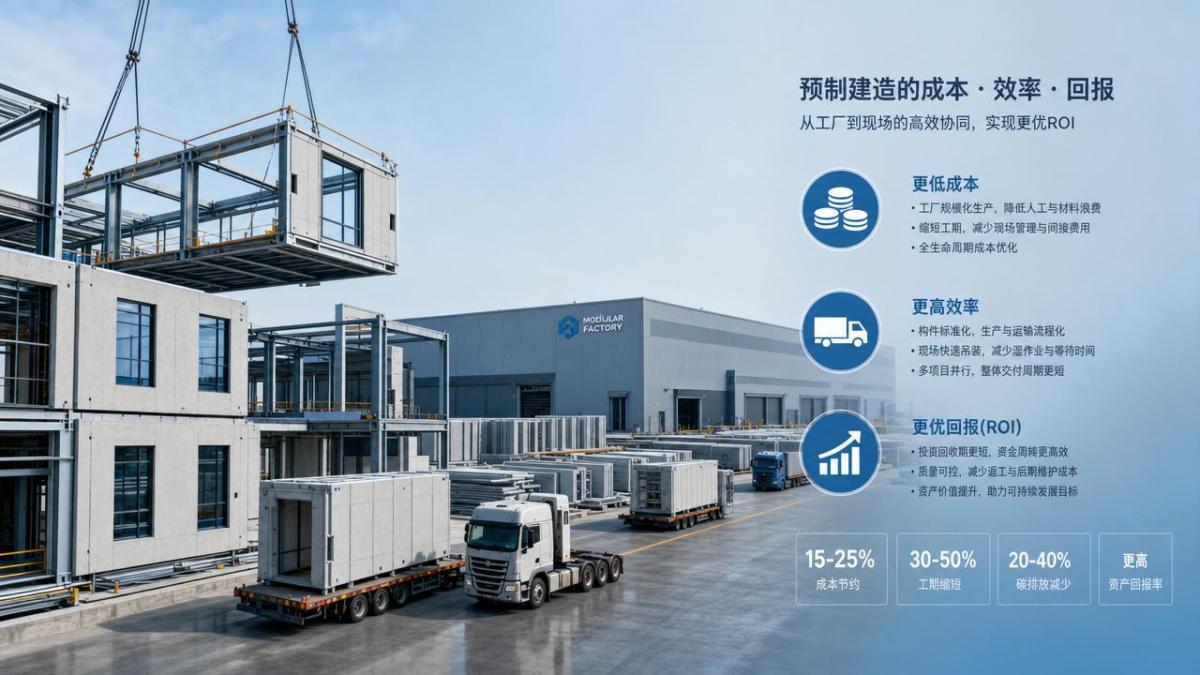
For enterprise decision-makers, prefabricated construction cost can look higher than conventional site-built methods at first glance. Yet that number alone does not capture schedule compression, labor risk reduction, quality consistency, lower waste, or faster asset monetization.
In infrastructure, smart building, rail-adjacent development, industrial facilities, and public-sector projects, ROI depends on the interaction between factory output, transport constraints, installation speed, and operational performance after handover.
This is where many boards and procurement teams misread cost. They compare component prices, but overlook system economics. A modular wall panel that costs more per unit may still create a stronger business case if it removes weeks from the critical path.
- Upfront manufacturing cost matters, but so do crane time, site supervision, weather exposure, and rework rates.
- Financing cost and revenue timing can materially change the ROI of prefabrication, especially in commercial or rental assets.
- Lifecycle value may improve through better thermal performance, repeatable quality, and lower maintenance disruptions.
GIUT’s cross-sector perspective is useful here because prefabrication is no longer just a building method. It connects digital planning, factory control, logistics orchestration, equipment deployment, and urban sustainability targets into one operating model.
Which factors affect prefabricated construction cost the most?
The biggest cost drivers are not identical across all projects. A data center expansion, transit-oriented development, school campus, and worker accommodation program each face different constraints. However, several variables consistently shape cost and ROI.
1. Design standardization and repetition
Projects with repeated room types, consistent structural grids, and stable MEP coordination usually achieve better prefabricated construction cost efficiency. Design variation increases tooling changes, engineering revisions, and quality control complexity.
2. Factory capacity and production maturity
A capable supplier with controlled workflows, trained labor, and digital production tracking can reduce defects and delays. A lower bid from an immature fabricator can become expensive if output consistency or delivery reliability is weak.
3. Transport distance and handling complexity
Modules and panels are not just products; they are logistics events. Oversized loads, route restrictions, escort requirements, remote jobsites, and double handling can significantly raise prefabricated construction cost.
4. Site readiness and installation sequence
If foundations, access roads, laydown areas, lifting plans, and utility interfaces are not synchronized, the benefits of off-site manufacturing can erode quickly. Idle cranes and waiting crews destroy ROI faster than many teams expect.
5. Labor market conditions
In regions with labor shortages, high safety compliance burdens, or volatile wage inflation, prefabrication often becomes more attractive. Reduced site labor can be a decisive factor, even if factory-made assemblies appear costlier at procurement stage.
6. Lifecycle performance requirements
If the asset owner values energy performance, maintainability, acoustic control, or future expansion flexibility, higher initial prefabricated construction cost may be justified by lower total cost of ownership over time.
A practical cost breakdown for decision-makers
Before comparing bids, procurement teams should separate visible cost from hidden cost. The table below helps frame prefabricated construction cost as a system-level budget rather than a single line item.
The key takeaway is simple: prefabricated construction cost should be evaluated across design, production, logistics, assembly, and use-phase performance. The strongest ROI usually comes from controlling interfaces, not just negotiating unit price.
Prefabrication vs traditional construction: where does ROI change?
Business leaders often ask whether prefabrication is truly cheaper. The better question is when it outperforms traditional methods. The answer depends on project repetition, schedule pressure, labor availability, and stakeholder tolerance for early-stage coordination effort.
The following comparison can support board-level or investor-facing discussions around prefabricated construction cost and expected returns.
For hospitals, student housing, hotels, industrial support buildings, remote camps, and urban infill projects, the value of time often makes prefabrication compelling. For highly customized, low-repeat structures with difficult transport geometry, the answer can be less favorable.
Which project scenarios justify a higher prefabricated construction cost?
Not every project should pursue the same prefabrication depth. Decision-makers should map the business case to the project type, urban context, and operating model of the finished asset.
- Fast-track urban developments where earlier occupancy or service launch creates measurable revenue or social value.
- Remote industrial and mining support projects where local skilled labor is scarce and temporary site setup is expensive.
- Railway and logistics facilities that require minimized disruption windows and tightly controlled installation sequencing.
- Public infrastructure with repeatable room or facade modules, such as schools, clinics, social housing, and civic extensions.
- Smart building programs that benefit from early digital coordination between structure, MEP, sensors, and maintenance access.
Across these scenarios, prefabricated construction cost becomes easier to justify when the owner can quantify speed, labor resilience, safety improvement, quality repeatability, and operational consistency.
How to evaluate suppliers and control risk before procurement
A weak procurement process can erase the value of a strong prefabrication concept. Senior buyers should test supplier capability, not only price competitiveness. Factory maturity, interface management, and installation planning all matter.
A practical evaluation checklist
- Confirm design freeze milestones and identify which changes will trigger cost escalation after fabrication begins.
- Review production capacity, lead time visibility, inspection procedures, and non-conformance handling methods.
- Check transport route feasibility, packing logic, lifting points, and crane access before awarding the package.
- Require clear responsibility mapping for structure, finishes, MEP interfaces, fire stopping, and commissioning scope.
- Model the total schedule impact, including permitting, factory slot reservation, shipping windows, and site assembly sequence.
This is also where GIUT’s intelligence-led approach adds value. Cross-disciplinary review helps decision-makers see the hidden dependencies between equipment, city logistics, regulatory pressure, and asset performance that can reshape prefabricated construction cost.
Standards, compliance, and digital coordination that influence cost
Compliance does not sit outside ROI. Fire safety, structural performance, acoustic requirements, thermal targets, lifting design, and transport regulations all shape prefabricated construction cost. Late compliance corrections are often more expensive than early engineering effort.
Common decision points include alignment with local building codes, structural design standards, quality management procedures, and digital coordination requirements such as BIM-based clash detection. Even where standards differ by country, the strategic lesson is the same: compliance must be designed in, not inspected in later.
- Clarify which party owns certification evidence for materials, assemblies, and testing records.
- Align tolerances between factory outputs and site structural works before production release.
- Use digital models to coordinate MEP penetrations, access zones, and maintenance clearances.
For public works and strategic infrastructure, these controls are particularly important because long approval cycles and stakeholder scrutiny can magnify the cost of late-stage changes.
Common misconceptions about prefabricated construction cost
“If unit price is higher, the method is less economical.”
Not necessarily. A higher factory-made component price can still generate a better return if the project opens earlier, reduces claims, or lowers labor and rework exposure.
“Prefabrication always saves time.”
Only when design, production, transport, and site readiness are synchronized. If decisions are delayed or interfaces remain unresolved, schedule gains can disappear.
“It works only for buildings.”
The same industrial logic supports plant rooms, utility compounds, transport facilities, workforce housing, equipment shelters, and smart city infrastructure modules. The opportunity extends beyond traditional real estate.
FAQ: what decision-makers ask most about prefabricated construction cost
How should we compare prefabricated construction cost with conventional bids?
Use a whole-project comparison. Include design coordination effort, transport, lifting, temporary works, site preliminaries, labor exposure, contingency for weather delays, and the value of earlier completion. A like-for-like component price comparison is too narrow.
What is the biggest hidden risk to ROI?
Late design changes are often the most damaging. They affect drawings, production slots, logistics planning, and site sequence at the same time. Governance discipline early in the project usually protects ROI better than aggressive late-stage price negotiation.
When is prefabrication less suitable?
It may be less efficient for highly bespoke, low-repeat projects with poor transport access, unstable scope, or limited lifting capacity. In such cases, hybrid strategies often perform better than full modularization.
Can prefabricated construction cost support sustainability goals?
Yes, if waste reduction, material optimization, energy performance, and carbon reporting are part of the procurement logic. Sustainability value is strongest when environmental targets are measured alongside time and cost outcomes.
Why informed buyers turn to GIUT for strategic guidance
Prefabrication decisions now sit at the intersection of construction, logistics, digital coordination, urban governance, and equipment planning. GIUT helps enterprise leaders interpret prefabricated construction cost through that wider lens, connecting engineering detail with commercial outcomes.
Because our perspective spans smart building, infrastructure, logistics arteries, heavy equipment, and resource-sector project environments, we help stakeholders identify which cost drivers truly change ROI and which ones only appear significant at bid stage.
Contact us for decision support that goes beyond price comparison
If you are evaluating prefabricated construction cost for an upcoming project, you can consult GIUT on design standardization pathways, project-fit assessment, supplier evaluation criteria, delivery schedule logic, logistics risk review, compliance considerations, and lifecycle value benchmarking.
We can also help your team structure discussions around parameter confirmation, solution selection, expected delivery windows, customization boundaries, certification-related documentation, and quotation communication priorities. For decision-makers under pressure to deliver faster, safer, and with greater capital discipline, that clarity is often where ROI begins.
Get weekly intelligence in your inbox.
No noise. No sponsored content. Pure intelligence.
News Recommendations
 Sep 19, 2026How an electronics application guide helps prevent component mismatchHow an electronics application guide helps prevent component mismatch
 Sep 18, 2026When a resource allocation platform improves project deliveryWhen a resource allocation platform improves project delivery
 Sep 17, 2026What to compare when evaluating mineral processing equipment manufacturersWhat to compare when evaluating mineral processing equipment manufacturers
 Sep 16, 2026How mineral separation optimization can reduce concentrate lossesHow mineral separation optimization can reduce concentrate losses
 Sep 15, 2026How to assess lifecycle costs in urban tech procurementHow to assess lifecycle costs in urban tech procurement
 Sep 14, 2026Heavy industry technology trends reshaping capital investment prioritiesHeavy industry technology trends reshaping capital investment priorities
 Sep 14, 2026Global Industrial Equipment Procurement: How Top OEMs Qualify Suppliers for Mining & Infrastructure ProjectsGlobal Industrial Equipment Procurement: How Top OEMs Qualify Suppliers for Mining & Infrastructure Projects
 Sep 14, 2026Industrial & Mining Equipment Procurement: Balancing Local Sourcing, Lead Time, and Certification RequirementsIndustrial & Mining Equipment Procurement: Balancing Local Sourcing, Lead Time, and Certification Requirements
 Sep 14, 2026Infrastructure & Equipment Upgrades: What Procurement Teams Must Verify Before Signing Off on New ContractsInfrastructure & Equipment Upgrades: What Procurement Teams Must Verify Before Signing Off on New Contracts
 Sep 14, 2026Why Infrastructure Equipment Buyers Are Shifting from Catalog-Based to Capability-Based Supplier SelectionWhy Infrastructure Equipment Buyers Are Shifting from Catalog-Based to Capability-Based Supplier Selection
 Sep 14, 2026Process Automation Project Execution: How to Align Supplier Capabilities with PLC Integration, Cybersecurity & Commissioning MilestonesProcess Automation Project Execution: How to Align Supplier Capabilities with PLC Integration, Cybersecurity & Commissioning Milestones
 Sep 14, 2026Are intelligent traffic systems worth the investment for small cities?Are intelligent traffic systems worth the investment for small cities?
 Sep 14, 2026How do intelligent traffic systems handle sensor failures?How do intelligent traffic systems handle sensor failures?
 Sep 14, 2026What should I check before accepting a smart building system?What should I check before accepting a smart building system?
 Sep 14, 2026Is a smart building system worth the maintenance cost?Is a smart building system worth the maintenance cost?
 Sep 14, 2026What data is needed for reliable resource allocation planning?What data is needed for reliable resource allocation planning?
 Sep 14, 2026How can resource allocation software reduce equipment idle time?How can resource allocation software reduce equipment idle time?
 Sep 14, 2026How should smart devices be maintained in harsh outdoor conditions?How should smart devices be maintained in harsh outdoor conditions?
 Sep 14, 2026Do smart devices improve worker safety on construction sites?Do smart devices improve worker safety on construction sites?
 Sep 14, 2026What environmental risks must be assessed before deep-sea mining?What environmental risks must be assessed before deep-sea mining?
 Sep 14, 2026Is deep-sea mining equipment commercially viable in 2026?Is deep-sea mining equipment commercially viable in 2026?
 Sep 14, 2026What Inspection Checks Should Procurement Teams Perform Before Ordering Dredging Equipment in 2026?What Inspection Checks Should Procurement Teams Perform Before Ordering Dredging Equipment in 2026?
 Sep 13, 2026How to verify an industrial product information source before specifying equipmentHow to verify an industrial product information source before specifying equipment
 Sep 12, 2026Which intelligent traffic systems hardware fits an urban intersection?Which intelligent traffic systems hardware fits an urban intersection?
 Sep 11, 2026How pump capacity affects response coverage for municipal fire fighting vehiclesHow pump capacity affects response coverage for municipal fire fighting vehicles
 Sep 10, 2026What to verify before choosing a heavy industry equipment supplierWhat to verify before choosing a heavy industry equipment supplier
 Sep 09, 2026When do adaptive urban traffic control systems reduce corridor delays?When do adaptive urban traffic control systems reduce corridor delays?