How to Compare a Cranes Manufacturer in 2026
Choosing the right cranes manufacturer in 2026 requires more than comparing prices or catalogs. For procurement professionals, the real decision lies in evaluating technical capability, compliance, lifecycle value, after-sales support, and smart equipment innovation. This guide outlines the key factors that help buyers identify reliable manufacturers, reduce sourcing risk, and make informed purchasing decisions in a fast-evolving global market.
For most buyers, the core search intent behind comparing a cranes manufacturer is practical rather than informational. They want a reliable way to shortlist suppliers, reduce procurement risk, and defend their decision internally.
Procurement teams are usually less concerned with marketing claims and more focused on proof. They need to know which manufacturer can deliver compliant equipment, stable quality, predictable lead times, and long-term service support.
That means the best comparison method in 2026 is not a simple feature checklist. It is a structured evaluation of technical fit, plant capability, digital readiness, total ownership cost, and supplier responsiveness.
What procurement teams should compare first
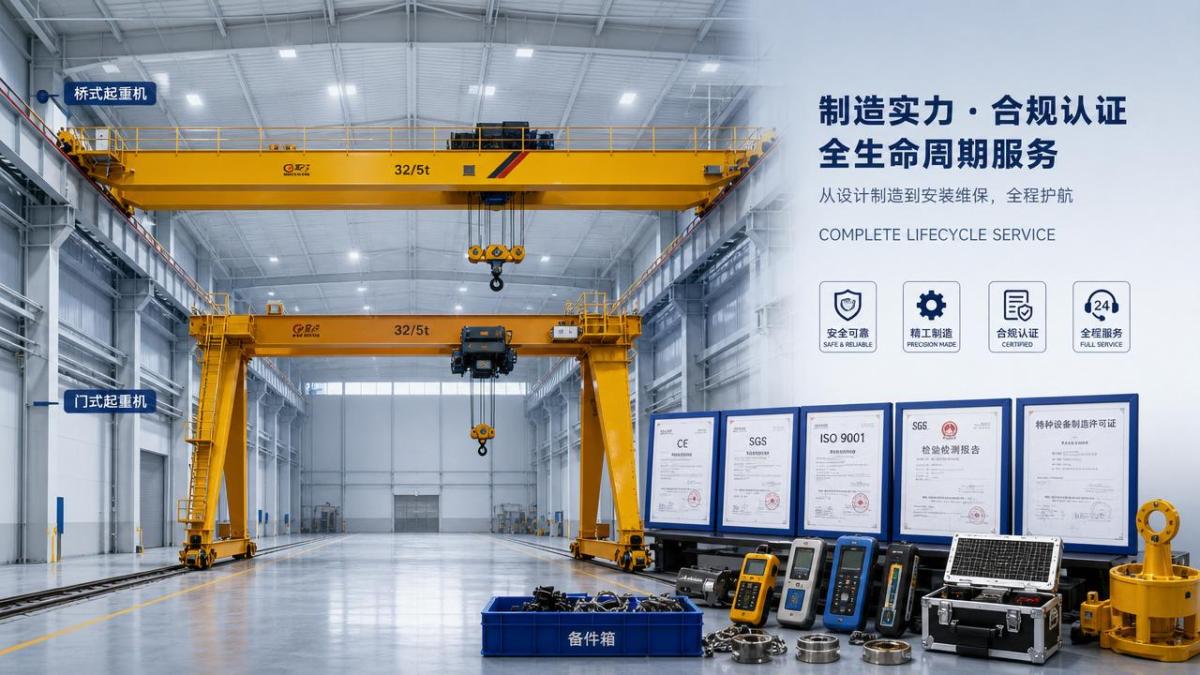
When comparing any cranes manufacturer, start with application fit. A supplier may be strong in one crane category yet weak in another, so the first question is whether their core products match your operating scenario.
Buyers should define lift capacity, duty class, span, working environment, site constraints, and automation needs before contacting suppliers. Without this baseline, comparison becomes subjective and price-driven in the wrong way.
In 2026, many manufacturers offer overlapping portfolios, including overhead cranes, gantry cranes, jib cranes, port cranes, and customized heavy-duty lifting systems. The right supplier is the one whose engineering depth aligns with your actual usage profile.
For example, a steel plant, logistics terminal, precast yard, and waste-to-energy facility all require different design priorities. Heat resistance, anti-corrosion treatment, control precision, duty cycle, and safety redundancy vary by industry.
Procurement professionals should therefore compare manufacturers by project relevance, not by brochure size. Ask how many similar installations the supplier has completed in your sector within the past three years.
How to verify real manufacturing capability
One of the biggest sourcing mistakes is assuming that every supplier branding itself as a cranes manufacturer has the same production depth. Some are true OEMs, while others depend heavily on outsourced fabrication.
This distinction matters because production control affects consistency, quality traceability, lead time reliability, and customization speed. A manufacturer with integrated design, welding, machining, assembly, and testing usually offers better process visibility.
Request a plant profile that goes beyond photos. Buyers should look for workshop size, annual output, major equipment, welding certifications, testing facilities, and evidence of process control for key structural components.
It is also useful to ask how the manufacturer handles core parts such as girders, end carriages, hoists, motors, control systems, and wire rope assemblies. The answer reveals whether quality is engineered or merely assembled.
Factory audits remain valuable in 2026, but remote verification has improved. Live video inspections, digital production dashboards, and traceable documentation can help buyers validate supplier capability before making site visits.
If the project is large or safety-critical, procurement teams should involve engineering and quality personnel in the audit. A low purchase price means little if the supplier cannot maintain dimensional accuracy or process discipline.
Which certifications and compliance standards matter most
Compliance is one of the clearest ways to compare cranes manufacturers objectively. For procurement teams, certifications are not just paperwork; they indicate whether the supplier can meet legal, safety, and customer-specific requirements.
At a minimum, buyers should verify quality management credentials and product compliance for target markets. Depending on the region, this may include ISO certifications, CE marking, OSHA-related design expectations, or local industrial approvals.
For export projects, ask whether the manufacturer has experience with the exact destination market. A crane acceptable in one country may require different electrical standards, safety devices, documentation, or testing protocols elsewhere.
Procurement teams should also review welding standards, load test procedures, coating specifications, and electrical safety design. These details often reveal more about manufacturing maturity than high-level certificates alone.
In sectors such as mining, ports, rail, and heavy fabrication, the required standard can be stricter than general industrial lifting. A capable manufacturer should be able to map compliance requirements to your application without hesitation.
Why total cost of ownership matters more than initial quote
In 2026, the cheapest quote is rarely the best procurement outcome. Comparing a cranes manufacturer only by purchase price can hide future costs in maintenance, downtime, spare parts, energy use, and operator inefficiency.
Procurement professionals should compare total cost of ownership over the expected service life. This includes installation, commissioning, operator training, preventive maintenance, component replacement, software updates, and technical support.
Ask each supplier to break down lifecycle assumptions. How often do wearing parts need replacement? What is the expected service interval? Are spare parts standardized? Can diagnostics reduce troubleshooting time?
Energy efficiency also deserves attention, especially for high-usage facilities. Variable frequency drives, regenerative braking, intelligent load control, and optimized motor systems can lower long-term operating costs significantly.
Another hidden cost is downtime risk. If a crane failure stops production, the financial impact can exceed the original equipment savings very quickly. That is why serviceability and parts availability should influence supplier scoring.
A strong cranes manufacturer should be able to discuss cost per operating hour, not just selling price. Procurement decisions become more defensible when the business case includes productivity, reliability, and maintenance economics.
How to assess after-sales service and spare parts support
After-sales capability is often the decisive factor in manufacturer comparison. Many cranes perform well at handover, but the real test begins after months of operation under load, dust, humidity, or continuous shift conditions.
Buyers should ask where service engineers are located, how quickly support can be dispatched, and whether remote diagnostics are available. A supplier with no practical service network may create long operational delays later.
Spare parts policy is equally important. Procurement teams should confirm stock levels for critical parts, replacement lead times, interchangeability, and whether older models remain supported after new product upgrades.
Another useful question is whether the manufacturer offers preventive maintenance contracts, inspection services, operator retraining, and modernization packages. These programs suggest a long-term service mindset rather than a one-time sales approach.
For multinational buyers, support consistency across regions matters. A globally active cranes manufacturer should show how service quality is maintained through branch offices, certified partners, or digital support platforms.
What smart crane features are worth comparing in 2026
The crane market in 2026 is increasingly shaped by digitalization. However, procurement teams should avoid paying for smart features that sound impressive but deliver little operational value in the intended application.
Useful smart functions typically include condition monitoring, overload data capture, remote diagnostics, anti-sway assistance, usage analytics, predictive maintenance alerts, and integration with plant management systems.
These features can improve safety, maintenance planning, and asset visibility. In demanding operations, they also help reduce operator error and support better scheduling of inspections and component replacements.
When comparing digital capability, ask whether the software is proprietary, cloud-based, open for integration, or dependent on recurring subscriptions. Procurement teams should understand data ownership and long-term platform support.
Cybersecurity is also becoming part of equipment evaluation. If the crane connects to networked systems, buyers should ask about access control, update policies, and operational resilience in case of software or connectivity issues.
The best cranes manufacturer will explain which smart functions produce measurable results for your site, rather than simply listing every available technology option.
How to compare quality, safety, and engineering depth
Serious buyers should dig into design philosophy, not just product specifications. Two cranes with similar rated capacities can differ significantly in structural margin, component grade, control stability, and maintainability.
Ask how the manufacturer approaches fatigue life, overload protection, emergency braking, cable management, anti-collision systems, and environmental adaptation. These topics reveal engineering rigor and practical field experience.
It is also wise to request reference projects, failure rate data if available, and examples of design improvements made after customer feedback. Mature manufacturers usually have a documented process for continuous product refinement.
Safety should be reviewed both at the product level and the system level. A crane may have compliant components, yet poor interface design can still create operator risk during routine use or maintenance.
Procurement teams should involve operations and maintenance stakeholders when reviewing technical proposals. Their feedback often identifies usability and service concerns that are not obvious from commercial documents alone.
A practical scorecard for comparing a cranes manufacturer
To make supplier comparison more objective, procurement teams should use a weighted scorecard. This prevents price from dominating the evaluation before technical and operational requirements are properly reviewed.
A practical scorecard can include application fit, compliance, manufacturing depth, project references, delivery reliability, lifecycle cost, service support, digital capability, and commercial terms. Weighting should reflect project risk and asset criticality.
For example, a heavy-duty continuous-operation crane may give more weight to reliability and serviceability. A standard warehouse lifting project may prioritize lead time and budget control, while still maintaining minimum quality thresholds.
Keep records of all assumptions, clarifications, and deviations between bids. This helps internal approval teams understand why one cranes manufacturer ranks above another, even when headline pricing appears close.
It is also helpful to run a final risk review. Consider exposure to supply chain disruption, currency fluctuation, local compliance gaps, and overdependence on proprietary components. These factors can alter the real value of a bid.
Questions procurement professionals should ask before awarding the contract
Before final selection, buyers should ask several direct questions. Can the supplier prove performance in similar environments? What lead times are guaranteed contractually? Which parts are excluded from warranty coverage?
They should also clarify commissioning scope, training responsibilities, document handover, acceptance testing, and penalties for delays. Ambiguity in these areas often becomes expensive after the purchase order is issued.
Another key question concerns change management. If site conditions shift or specifications evolve, how quickly can the manufacturer revise drawings, pricing, and production plans without destabilizing delivery schedules?
Finally, ask who owns the long-term technical relationship. Is there a dedicated project manager, a service engineer, and a spare parts contact? Strong account structure usually signals stronger execution discipline.
Conclusion: compare manufacturers by risk reduction, not claims
In 2026, choosing the right cranes manufacturer is ultimately a procurement risk decision. Price matters, but it should sit within a broader assessment of technical fit, compliance, factory capability, service strength, and lifecycle value.
The most reliable supplier is not necessarily the one with the largest catalog or the lowest quotation. It is the one that can demonstrate relevant experience, transparent processes, dependable support, and measurable long-term performance.
For procurement professionals, the best comparison approach is structured, evidence-based, and aligned with operational reality. When manufacturers are evaluated this way, sourcing becomes less reactive and far more strategic.
If you compare cranes manufacturers through the lens of reliability, service, compliance, and ownership cost, you are far more likely to secure equipment that performs well long after the purchasing decision is made.
Get weekly intelligence in your inbox.
No noise. No sponsored content. Pure intelligence.
News Recommendations
 Sep 19, 2026How an electronics application guide helps prevent component mismatchHow an electronics application guide helps prevent component mismatch
 Sep 18, 2026When a resource allocation platform improves project deliveryWhen a resource allocation platform improves project delivery
 Sep 17, 2026What to compare when evaluating mineral processing equipment manufacturersWhat to compare when evaluating mineral processing equipment manufacturers
 Sep 16, 2026How mineral separation optimization can reduce concentrate lossesHow mineral separation optimization can reduce concentrate losses
 Sep 15, 2026How to assess lifecycle costs in urban tech procurementHow to assess lifecycle costs in urban tech procurement
 Sep 14, 2026Heavy industry technology trends reshaping capital investment prioritiesHeavy industry technology trends reshaping capital investment priorities
 Sep 14, 2026Global Industrial Equipment Procurement: How Top OEMs Qualify Suppliers for Mining & Infrastructure ProjectsGlobal Industrial Equipment Procurement: How Top OEMs Qualify Suppliers for Mining & Infrastructure Projects
 Sep 14, 2026Industrial & Mining Equipment Procurement: Balancing Local Sourcing, Lead Time, and Certification RequirementsIndustrial & Mining Equipment Procurement: Balancing Local Sourcing, Lead Time, and Certification Requirements
 Sep 14, 2026Infrastructure & Equipment Upgrades: What Procurement Teams Must Verify Before Signing Off on New ContractsInfrastructure & Equipment Upgrades: What Procurement Teams Must Verify Before Signing Off on New Contracts
 Sep 14, 2026Why Infrastructure Equipment Buyers Are Shifting from Catalog-Based to Capability-Based Supplier SelectionWhy Infrastructure Equipment Buyers Are Shifting from Catalog-Based to Capability-Based Supplier Selection
 Sep 14, 2026Process Automation Project Execution: How to Align Supplier Capabilities with PLC Integration, Cybersecurity & Commissioning MilestonesProcess Automation Project Execution: How to Align Supplier Capabilities with PLC Integration, Cybersecurity & Commissioning Milestones
 Sep 14, 2026Are intelligent traffic systems worth the investment for small cities?Are intelligent traffic systems worth the investment for small cities?
 Sep 14, 2026How do intelligent traffic systems handle sensor failures?How do intelligent traffic systems handle sensor failures?
 Sep 14, 2026What should I check before accepting a smart building system?What should I check before accepting a smart building system?
 Sep 14, 2026Is a smart building system worth the maintenance cost?Is a smart building system worth the maintenance cost?
 Sep 14, 2026What data is needed for reliable resource allocation planning?What data is needed for reliable resource allocation planning?
 Sep 14, 2026How can resource allocation software reduce equipment idle time?How can resource allocation software reduce equipment idle time?
 Sep 14, 2026How should smart devices be maintained in harsh outdoor conditions?How should smart devices be maintained in harsh outdoor conditions?
 Sep 14, 2026Do smart devices improve worker safety on construction sites?Do smart devices improve worker safety on construction sites?
 Sep 14, 2026What environmental risks must be assessed before deep-sea mining?What environmental risks must be assessed before deep-sea mining?
 Sep 14, 2026Is deep-sea mining equipment commercially viable in 2026?Is deep-sea mining equipment commercially viable in 2026?
 Sep 14, 2026What Inspection Checks Should Procurement Teams Perform Before Ordering Dredging Equipment in 2026?What Inspection Checks Should Procurement Teams Perform Before Ordering Dredging Equipment in 2026?
 Sep 13, 2026How to verify an industrial product information source before specifying equipmentHow to verify an industrial product information source before specifying equipment
 Sep 12, 2026Which intelligent traffic systems hardware fits an urban intersection?Which intelligent traffic systems hardware fits an urban intersection?
 Sep 11, 2026How pump capacity affects response coverage for municipal fire fighting vehiclesHow pump capacity affects response coverage for municipal fire fighting vehicles
 Sep 10, 2026What to verify before choosing a heavy industry equipment supplierWhat to verify before choosing a heavy industry equipment supplier
 Sep 09, 2026When do adaptive urban traffic control systems reduce corridor delays?When do adaptive urban traffic control systems reduce corridor delays?