Civil Engineering: Common Cost Overrun Triggers
In civil engineering, cost overruns rarely stem from a single mistake—they are usually triggered by a chain of design changes, weak risk controls, supply disruptions, and unclear stakeholder coordination. For project managers and engineering leaders, understanding these common causes is essential to protecting budgets, timelines, and long-term project value.
Across transport corridors, utilities, industrial plants, smart city assets, and building projects, budget drift often begins long before site productivity visibly declines. Early warning signs appear in scope ambiguity, incomplete surveys, late approvals, unrealistic procurement assumptions, and fragmented communication between owners, consultants, contractors, and suppliers.
For decision-makers in civil engineering, the challenge is not only to identify cost overrun triggers after they occur, but to build a delivery system that detects, allocates, and controls them from concept design through commissioning. The sections below focus on the most common triggers, the operational signals behind them, and practical controls that project leaders can implement.
Why Cost Overruns Happen So Often in Civil Engineering Projects
Civil engineering projects combine long delivery cycles, multi-party coordination, heavy equipment usage, regulatory exposure, and high material dependency. Even a 3% to 5% variation in design quantities or procurement timing can expand into a much larger budget impact once labor, plant standby, rework, and delay claims are added.
Unlike short-cycle manufacturing, infrastructure delivery often spans 12 to 48 months. During that period, projects face design refinement, weather shifts, permit dependencies, logistics constraints, utility conflicts, and market price volatility. These conditions make cost control in civil engineering a dynamic process rather than a one-time estimating exercise.
The Most Frequent Root Causes
Although each project has unique conditions, most cost overruns in civil engineering cluster around 6 recurring areas: scope growth, design errors or omissions, inaccurate quantity takeoff, schedule disruption, supply chain instability, and weak contract administration. Projects that fail in 2 or more of these areas usually see compounded rather than isolated budget pressure.
- Unclear scope definition during feasibility or tender stage
- Late design revisions after procurement or construction has started
- Poor site investigation, especially ground, drainage, and utility mapping
- Commodity price movement affecting steel, cement, fuel, cable, or bitumen
- Low productivity caused by access limits, weather, or re-sequencing
- Claims exposure from delay, disruption, and interface disputes
How Early-Stage Assumptions Distort the Budget
Many civil engineering budgets are approved with only 60% to 80% design maturity. At that point, quantities may still move by 10% to 15% in earthworks, structural concrete, drainage runs, reinforcement, or utility diversions. If contingency is thin and escalation is underestimated, the approved baseline becomes vulnerable from day one.
This issue is especially visible in integrated infrastructure projects where buildings, roads, power, water, communications, and digital control systems overlap. A small design revision in one package can trigger downstream changes across 3 or 4 other packages, creating a hidden chain of additional cost.
Typical Underestimated Cost Buckets
Project leaders frequently underestimate temporary works, traffic management, dewatering, environmental controls, testing, commissioning, and stakeholder coordination. These are not minor extras. On constrained urban sites, indirect and enabling costs can account for 8% to 20% of package value.
The table below shows common cost overrun triggers in civil engineering and how they usually affect delivery performance.
The key pattern is cumulative impact. In civil engineering, one trigger rarely remains isolated. A delayed drawing can postpone procurement, delay site access, reduce daily output, and increase preliminaries at the same time. That is why successful control depends on cross-functional visibility, not just cost reporting.
Design, Scope, and Site Conditions: The First Major Cost Overrun Cluster
The earliest and most persistent cost overrun drivers in civil engineering sit in project definition. If scope is not frozen, design packages are poorly coordinated, or geotechnical information is incomplete, the project enters execution with structural uncertainty built into its cost baseline.
Scope Growth After Approval
Scope growth often appears reasonable when viewed one decision at a time. A wider access road, upgraded drainage standard, additional retaining structure, larger pump capacity, or extra monitoring system may each seem manageable. However, 5 to 10 small owner instructions can materially alter quantities, methods, procurement lead times, and subcontract packaging.
For project managers, the real risk is informal scope expansion without cost-time validation. If changes are approved in meetings but not translated into revised budgets within 7 to 14 days, the commercial team loses control of the true forecast.
Design Errors, Omissions, and Coordination Gaps
Civil engineering design is highly interdependent. Drainage affects road formation. Utility corridors affect foundations. Structural sequencing affects crane access and temporary works. When discipline coordination is weak, projects face clashes, missing details, and constructability problems that convert directly into rework and delay.
A common issue is tendering from drawings that are technically adequate for pricing but not complete enough for execution. The result is a procurement package built on assumptions that later require clarification, substitution, or redesign, usually at a higher final cost.
Control Actions for Design-Related Risk
- Set a design maturity gate before major procurement, ideally with discipline sign-off.
- Run quantity reconciliation at least every 2 to 4 weeks during active design development.
- Use constructability reviews involving site, procurement, and temporary works teams.
- Track all design changes through a controlled register with cost and schedule effect.
Poor Ground Data and Hidden Site Constraints
Few factors damage a civil engineering budget faster than inaccurate site assumptions. Rock levels, groundwater conditions, contaminated material, buried obstructions, undocumented services, and access restrictions can all trigger heavy cost movement. These issues are especially severe in rail, mining, urban utility, and brownfield redevelopment works.
A geotechnical campaign that looks adequate on paper may still miss variability between boreholes. On long linear assets such as roads, pipelines, or rail alignments, isolated data points may not fully capture changing ground conditions across several kilometers.
The following table helps project leaders compare common pre-construction weaknesses and the practical controls that reduce downstream overruns.
These controls are not expensive compared with the rework they prevent. In many civil engineering programs, one additional survey package or one stronger design coordination workshop can avoid months of downstream inefficiency.
Procurement, Scheduling, and Contract Management Failures
Once the project moves into execution, a second cluster of cost overrun triggers becomes dominant. Procurement delays, labor productivity loss, poor sequencing, subcontractor weakness, and contract administration gaps often turn a manageable estimate into a stressed delivery budget.
Material Escalation and Long-Lead Procurement
Civil engineering relies on price-sensitive inputs such as structural steel, cement, aggregates, cable, pipe, fuel, and imported electro-mechanical packages. If procurement is launched late, the project may lose favorable pricing windows and face 6 to 20 week lead-time extensions depending on market conditions and shipping routes.
The problem becomes sharper when design information is not stable enough to place orders early. Teams delay procurement to avoid mismatches, but that delay can expose the project to both escalation and site standby cost. This is a classic cost-risk tradeoff in civil engineering.
Schedule Compression and Productivity Loss
When the schedule starts slipping, many teams try to recover through overtime, parallel workfaces, additional plant, or accelerated subcontracting. While these measures can regain time, they often raise unit cost significantly. Productivity may fall instead of rise if crews become congested or if work areas are not truly ready.
For example, adding a second crew can help if access, supervision, and material flow are available. But if drawings, permits, or interfaces are still unresolved, the project simply doubles labor burn without doubling output.
Warning Indicators Project Managers Should Track Weekly
- Procurement packages older than 14 days without release approval
- Look-ahead activities missing drawings, permits, or material allocation
- Earned progress below planned progress by more than 5%
- Labor hours rising while installed quantities remain flat
- Subcontractor payment or manpower instability on critical path work
Weak Change Control and Claims Management
A major budget leak in civil engineering is not the existence of changes, but the failure to price, document, and negotiate them quickly. If variation notices, delay events, and disruption records are not captured in real time, the contractor absorbs costs that should have been visible earlier or recoverable under the contract.
On the owner side, weak governance creates the opposite problem: changes are instructed without a clear impact assessment, so the approved control budget no longer reflects delivery reality. In both cases, the forecast becomes unreliable.
How Project Leaders Can Reduce Cost Overruns in Practice
Effective cost control in civil engineering depends on disciplined routines rather than one-off interventions. Strong projects build a management rhythm that connects technical, commercial, schedule, and supply chain decisions into a single operating view.
A 5-Step Control Framework
- Establish a realistic baseline with transparent assumptions, contingency bands, and escalation logic.
- Review design maturity and quantities before each major package award.
- Run weekly risk meetings covering cost, schedule, interfaces, and procurement status.
- Link site productivity tracking to actual installed quantities, not labor presence alone.
- Enforce change control within a defined approval window, ideally 3 to 7 days for initial review.
Where Digital Oversight Adds Value
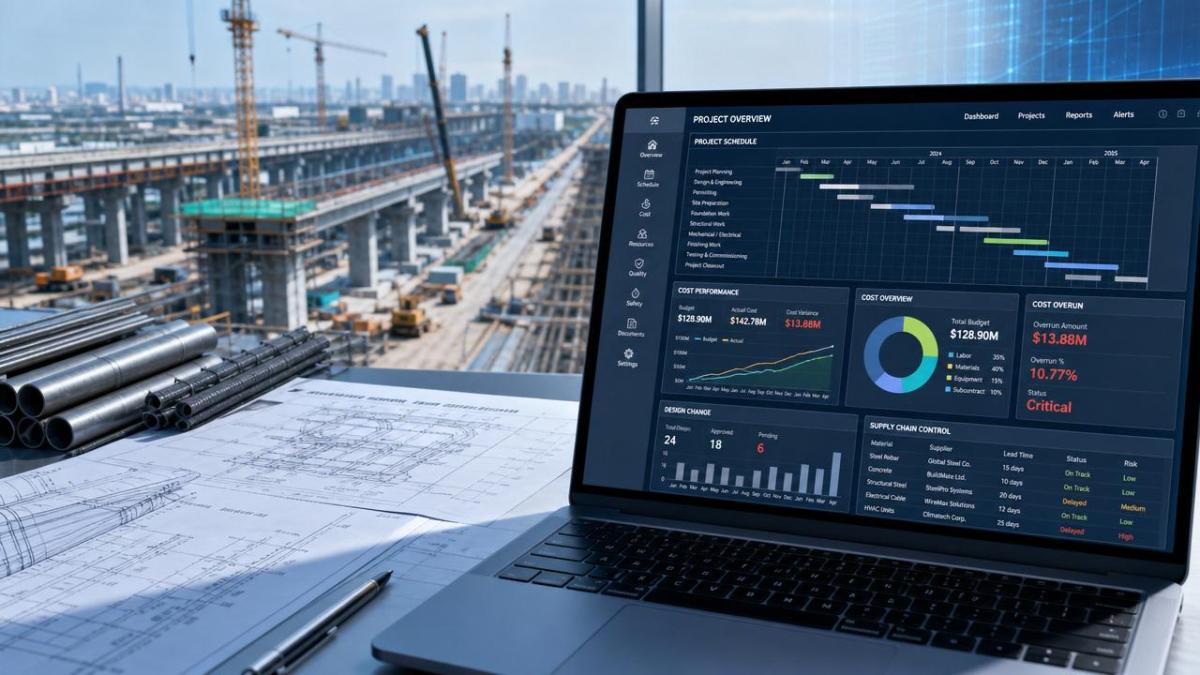
Integrated project dashboards, digital quantity tracking, field reporting tools, and model-based coordination can improve decision speed. For complex infrastructure and smart city programs, a digital twin mindset helps teams compare planned versus actual progress, detect conflicts earlier, and improve resource allocation across interconnected work packages.
This is especially relevant when civil engineering delivery interfaces with rail systems, utility networks, smart controls, or heavy equipment deployment. When asset data, schedule data, and cost data remain disconnected, project leaders react too late.
Practical Governance Measures
A monthly cost report is not enough on fast-moving works. High-risk packages often require weekly forecast updates, 2-week look-ahead planning, and a live risk register with ownership assigned to named individuals. Governance should be light enough to maintain pace, but strong enough to prevent silent budget drift.
For owners and EPC leaders managing multi-package delivery, the best results usually come from aligning 4 control layers: commercial reporting, design change control, procurement status, and field productivity measurement. When these layers are reviewed together, hidden overruns are easier to detect.
Cost overruns in civil engineering are rarely unavoidable, but they are rarely solved by cost cutting alone. The most resilient projects define scope early, test site assumptions carefully, procure critical items on time, monitor productivity at short intervals, and control variations with discipline. For project managers and engineering leaders working across infrastructure, construction, urban technology, logistics, and heavy industry assets, these practices protect both budget certainty and delivery credibility.
If your organization is evaluating better ways to control civil engineering risk, improve project visibility, or strengthen pre-construction and delivery governance, now is the right time to act. Contact GIUT to explore tailored insights, implementation strategies, and infrastructure intelligence solutions that support better project decisions from planning through execution.
Get weekly intelligence in your inbox.
No noise. No sponsored content. Pure intelligence.
News Recommendations
 Sep 19, 2026How an electronics application guide helps prevent component mismatchHow an electronics application guide helps prevent component mismatch
 Sep 18, 2026When a resource allocation platform improves project deliveryWhen a resource allocation platform improves project delivery
 Sep 17, 2026What to compare when evaluating mineral processing equipment manufacturersWhat to compare when evaluating mineral processing equipment manufacturers
 Sep 16, 2026How mineral separation optimization can reduce concentrate lossesHow mineral separation optimization can reduce concentrate losses
 Sep 15, 2026How to assess lifecycle costs in urban tech procurementHow to assess lifecycle costs in urban tech procurement
 Sep 14, 2026Heavy industry technology trends reshaping capital investment prioritiesHeavy industry technology trends reshaping capital investment priorities
 Sep 14, 2026Global Industrial Equipment Procurement: How Top OEMs Qualify Suppliers for Mining & Infrastructure ProjectsGlobal Industrial Equipment Procurement: How Top OEMs Qualify Suppliers for Mining & Infrastructure Projects
 Sep 14, 2026Industrial & Mining Equipment Procurement: Balancing Local Sourcing, Lead Time, and Certification RequirementsIndustrial & Mining Equipment Procurement: Balancing Local Sourcing, Lead Time, and Certification Requirements
 Sep 14, 2026Infrastructure & Equipment Upgrades: What Procurement Teams Must Verify Before Signing Off on New ContractsInfrastructure & Equipment Upgrades: What Procurement Teams Must Verify Before Signing Off on New Contracts
 Sep 14, 2026Why Infrastructure Equipment Buyers Are Shifting from Catalog-Based to Capability-Based Supplier SelectionWhy Infrastructure Equipment Buyers Are Shifting from Catalog-Based to Capability-Based Supplier Selection
 Sep 14, 2026Process Automation Project Execution: How to Align Supplier Capabilities with PLC Integration, Cybersecurity & Commissioning MilestonesProcess Automation Project Execution: How to Align Supplier Capabilities with PLC Integration, Cybersecurity & Commissioning Milestones
 Sep 14, 2026Are intelligent traffic systems worth the investment for small cities?Are intelligent traffic systems worth the investment for small cities?
 Sep 14, 2026How do intelligent traffic systems handle sensor failures?How do intelligent traffic systems handle sensor failures?
 Sep 14, 2026What should I check before accepting a smart building system?What should I check before accepting a smart building system?
 Sep 14, 2026Is a smart building system worth the maintenance cost?Is a smart building system worth the maintenance cost?
 Sep 14, 2026What data is needed for reliable resource allocation planning?What data is needed for reliable resource allocation planning?
 Sep 14, 2026How can resource allocation software reduce equipment idle time?How can resource allocation software reduce equipment idle time?
 Sep 14, 2026How should smart devices be maintained in harsh outdoor conditions?How should smart devices be maintained in harsh outdoor conditions?
 Sep 14, 2026Do smart devices improve worker safety on construction sites?Do smart devices improve worker safety on construction sites?
 Sep 14, 2026What environmental risks must be assessed before deep-sea mining?What environmental risks must be assessed before deep-sea mining?
 Sep 14, 2026Is deep-sea mining equipment commercially viable in 2026?Is deep-sea mining equipment commercially viable in 2026?
 Sep 14, 2026What Inspection Checks Should Procurement Teams Perform Before Ordering Dredging Equipment in 2026?What Inspection Checks Should Procurement Teams Perform Before Ordering Dredging Equipment in 2026?
 Sep 13, 2026How to verify an industrial product information source before specifying equipmentHow to verify an industrial product information source before specifying equipment
 Sep 12, 2026Which intelligent traffic systems hardware fits an urban intersection?Which intelligent traffic systems hardware fits an urban intersection?
 Sep 11, 2026How pump capacity affects response coverage for municipal fire fighting vehiclesHow pump capacity affects response coverage for municipal fire fighting vehicles
 Sep 10, 2026What to verify before choosing a heavy industry equipment supplierWhat to verify before choosing a heavy industry equipment supplier
 Sep 09, 2026When do adaptive urban traffic control systems reduce corridor delays?When do adaptive urban traffic control systems reduce corridor delays?