Civil Engineering Solutions for Faster Urban Projects
For project managers under pressure to deliver urban developments on tighter timelines, civil engineering solutions are becoming the key to faster, safer, and more coordinated execution.
From smart planning and prefabrication to digital site management and resilient infrastructure design, these strategies help reduce delays, control costs, and improve project outcomes in complex city environments.
The core search intent behind civil engineering solutions for faster urban projects is practical, not academic. Readers want proven ways to shorten delivery schedules without increasing risk, rework, or coordination failures.
For project leaders, the central question is simple: which engineering approaches actually accelerate urban execution while keeping budgets, compliance, and quality under control across multiple stakeholders and tight sites.
The most useful answer is that speed does not come from working harder on site alone. It comes from better front-end engineering, smarter sequencing, digital visibility, and construction methods designed for urban constraints.
What project managers really need from civil engineering solutions
Urban projects move slowly when design, utilities, permitting, procurement, and field operations are treated as separate tracks. The best civil engineering solutions connect these decisions early and reduce friction before construction begins.
Project managers care less about theoretical innovation and more about schedule certainty. They need methods that compress timelines, prevent hidden clashes, improve contractor coordination, and make approvals easier in dense city settings.
They also need a framework for deciding where acceleration is realistic. Not every fast-track strategy fits every project. Roadworks, transit interfaces, utility upgrades, mixed-use developments, and public infrastructure each face different bottlenecks.
That is why effective planning starts with diagnosing the true cause of delay. In many urban projects, the issue is not labor productivity. It is fragmented information, utility conflicts, permit dependencies, or limited working windows.
Why urban projects slow down before they ever reach full construction speed
Many schedule overruns are created in the preconstruction phase. Incomplete surveys, outdated underground utility records, weak stakeholder mapping, and unrealistic phasing plans can delay delivery long before heavy works begin.
Urban environments amplify these problems. Teams must work around traffic management, neighboring properties, existing transport systems, environmental controls, and community disruption limits. Small planning gaps quickly become expensive site delays.
Another common issue is sequential decision-making. If drainage, structural design, traffic diversion, and public utility coordination happen too late or in isolation, teams discover conflicts when equipment and crews are already mobilized.
Faster delivery depends on replacing reactive coordination with integrated engineering reviews. When constraints are identified early, managers can redesign access, revise work packages, and align approvals before critical activities are exposed.
Front-end engineering is the fastest way to save time later
For urban developments, stronger front-end engineering often delivers more schedule value than simply expanding field resources. Better inputs at the start reduce redesign, disputes, idle time, and stop-start execution later in the project.
This includes high-accuracy site investigation, utility mapping, geotechnical validation, constructability reviews, and phased logistics planning. These actions may seem slow upfront, but they sharply reduce disruption during delivery.
Project managers should prioritize design packages that support sequencing decisions early. Temporary works, haul routes, crane positioning, drainage diversions, and service protection plans should not remain unresolved until mobilization.
When these packages are coordinated early, procurement becomes more reliable and contractors can plan around actual site conditions. That improves schedule confidence and reduces the need for emergency changes in constrained urban areas.
How digital workflows help accelerate coordination and reduce delay risk
Digital engineering is one of the most effective civil engineering solutions for faster urban projects because it improves visibility across disciplines. It helps teams detect issues sooner and make decisions with fewer assumptions.
Building information modeling, digital twins, GIS-linked utility mapping, drone surveys, and common data environments all support faster coordination. Their value is not the software itself, but the speed and clarity of cross-team decision-making.
For project managers, the biggest benefit is early clash reduction. Conflicts between drainage lines, structures, existing services, and traffic diversions can be resolved before they become field stoppages or redesign requests.
Digital progress tracking also matters. If site status, inspections, procurement milestones, and design revisions are visible in near real time, leaders can intervene early instead of discovering slippage during reporting cycles.
In urban environments, this improves communication with public agencies and utility owners as well. A clear, updated model supports permit discussions, traffic staging approvals, and stakeholder confidence in delivery planning.
Prefabrication and modular methods can shorten urban construction windows
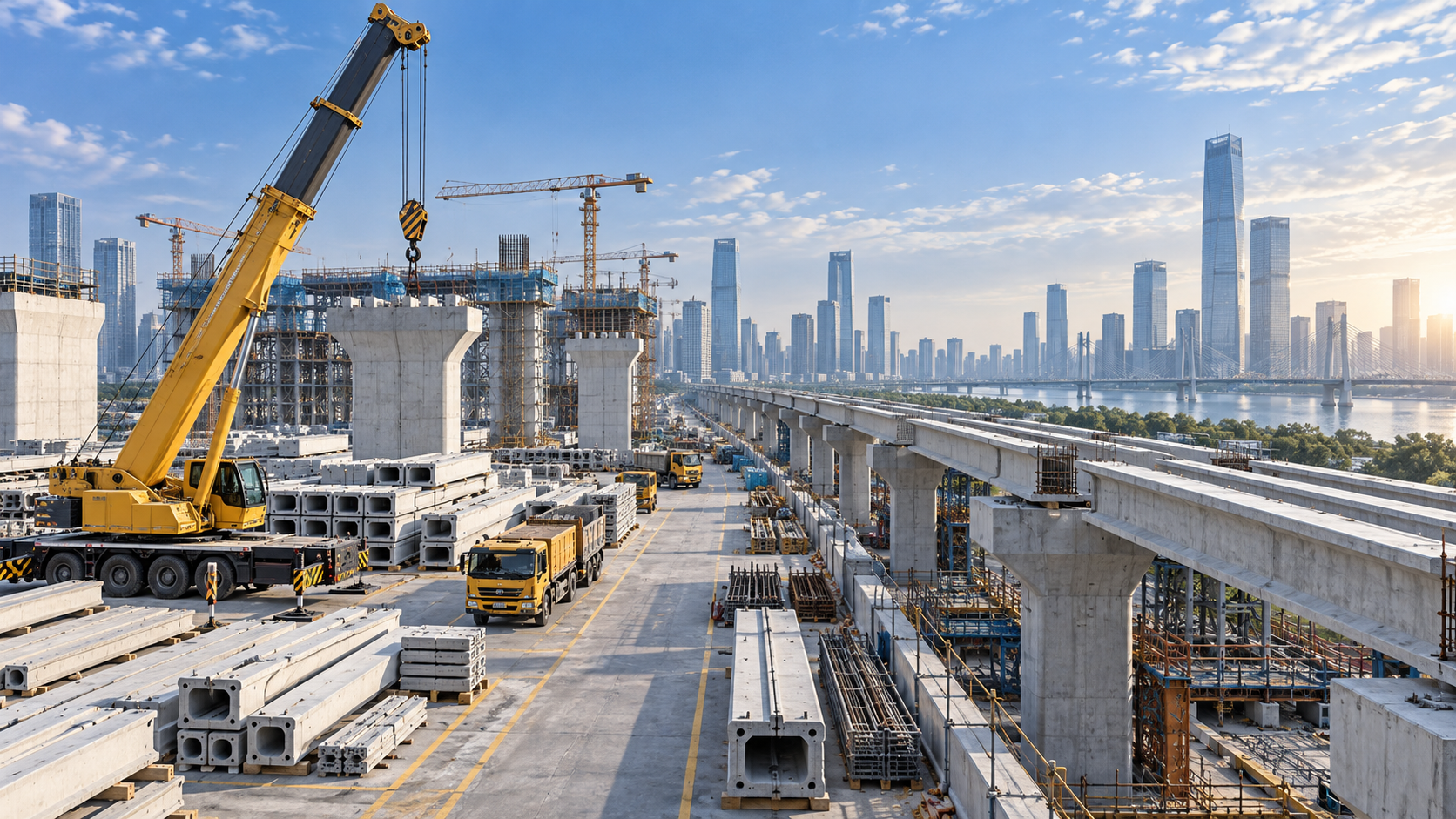
When site access is limited and disruption must be minimized, off-site fabrication becomes a powerful acceleration tool. Prefabricated structural, utility, and building components reduce on-site labor intensity and installation time.
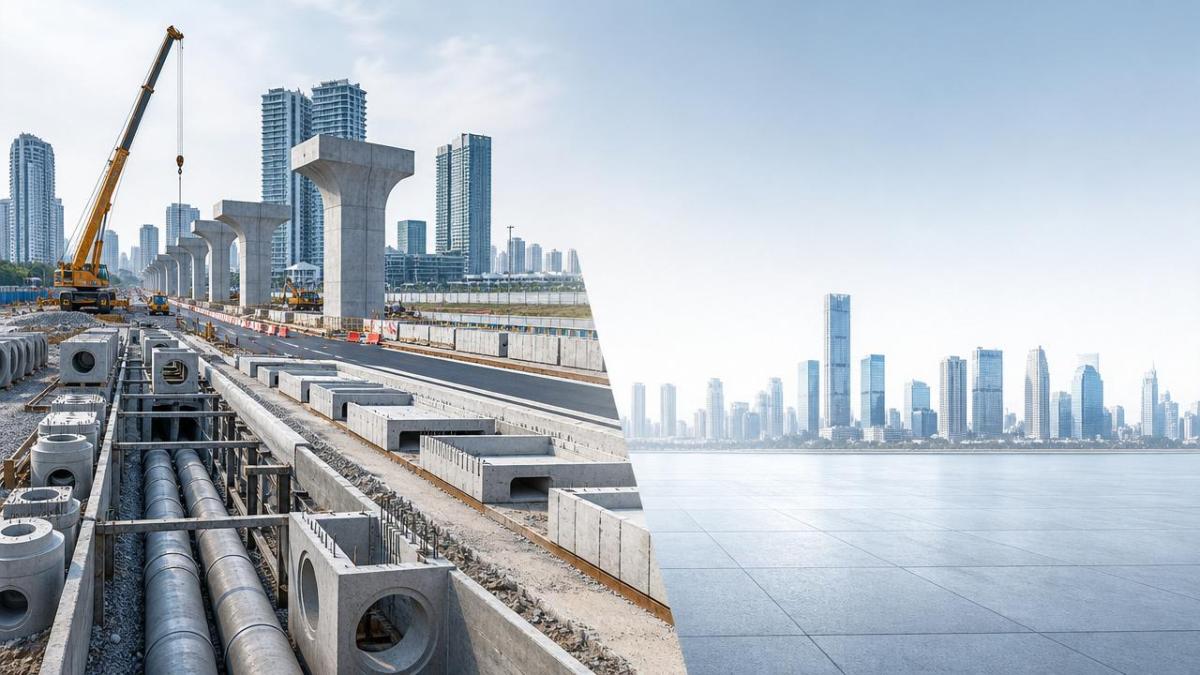
For example, modular utility corridors, precast drainage units, bridge elements, wall panels, and MEP assemblies can compress schedules by shifting work into controlled factory conditions before site readiness is complete.
This approach also improves quality consistency and safety performance. Fewer wet trades, fewer congested work fronts, and shorter exposure to traffic or weather-sensitive conditions make urban execution easier to control.
However, modular strategies only work when logistics are planned carefully. Transport routes, lifting capacity, storage limits, installation tolerances, and supplier lead times must be integrated into the master schedule from the start.
Project managers should evaluate prefabrication not as a trend, but as a scheduling decision. If urban restrictions create expensive site inefficiency, off-site assembly may offer superior total project performance.
Utility coordination is often the hidden determinant of project speed
On many urban projects, buried and overhead utilities cause more delay than structural work. Unknown asset conditions, late relocations, and approval bottlenecks can stop progress across multiple work zones simultaneously.
That is why utility engineering should be treated as a core schedule driver, not a supporting task. Early scanning, record validation, potholing, and owner coordination can prevent major downstream disruption.
Managers should establish a utility risk register linked directly to construction phasing. Each critical service should have confirmed ownership, protection strategy, relocation sequence, approval status, and contingency response defined early.
Where possible, civil design should reduce dependency on relocations altogether. Adjusting alignments, foundation locations, drainage routes, or staging areas may save more time than waiting for external utility programs to catch up.
Smarter site logistics make a bigger difference in cities than on open sites
Urban construction speed depends heavily on movement efficiency. Crews, equipment, deliveries, waste removal, and temporary traffic controls must all function within narrow windows and limited physical space.
Poor logistics planning leads to avoidable downtime. Even if engineering packages are complete, projects slow when access routes are blocked, laydown space is inadequate, or work fronts interfere with each other.
Effective civil engineering solutions include micro-phasing, delivery slot scheduling, temporary deck or platform design, haul path optimization, and separation of pedestrian, public, and construction movement wherever possible.
For project managers, these measures improve more than productivity. They also reduce public complaints, safety incidents, and regulatory pressure, all of which can trigger restrictions that undermine schedule performance.
Resilient design should support speed, not compete with it
Some teams assume faster delivery requires sacrificing resilience or sustainability. In reality, durable and adaptable design often prevents future redesign, maintenance disruption, and approval friction during construction.
Urban clients and regulators increasingly expect stormwater resilience, lower carbon materials, lifecycle efficiency, and climate-aware infrastructure. If these requirements are addressed late, they can create painful redesign loops.
Integrating resilience early allows project teams to move faster with fewer surprises. For example, drainage capacity, heat performance, flood protection, and maintainability can be resolved alongside core civil engineering decisions.
This is especially important for public infrastructure and smart city programs. Projects that align speed with long-term operational value are more likely to receive support from authorities, operators, and funding bodies.
How to evaluate which civil engineering solutions are worth the investment
Not every acceleration strategy deserves immediate adoption. Project managers should evaluate solutions based on bottleneck relevance, implementation effort, schedule impact, risk reduction, and compatibility with local delivery conditions.
A useful decision filter starts with three questions. What is causing the greatest delay risk, what intervention changes that constraint, and how quickly can the solution be integrated into active project controls.
For some projects, the answer will be digital coordination. For others, it may be precast components, utility-first planning, design standardization, or more rigorous constructability reviews before procurement is finalized.
The right choice should show measurable value. Look for indicators such as fewer RFIs, reduced rework, shorter installation durations, faster approval cycles, improved labor productivity, and stronger adherence to milestone dates.
Importantly, teams should compare total project effects rather than single-task savings. A solution that slightly increases design effort may still be valuable if it reduces weeks of site disruption later.
What a realistic faster-delivery strategy looks like in practice
For most urban projects, acceleration comes from combining several targeted measures rather than relying on one dramatic innovation. The strongest strategies align engineering, logistics, data, procurement, and stakeholder management.
A practical roadmap often begins with early site intelligence, utility validation, and constructability review. It then adds digital coordination, phased approvals, prefabrication where feasible, and tight field reporting loops.
Contractor involvement should also start earlier when possible. Delivery teams can identify sequencing risks, access constraints, and temporary works needs that designers or owners may not fully anticipate.
Finally, governance must support speed. If approvals, change decisions, and issue escalation remain slow, even advanced engineering methods will underperform. Fast projects require decision systems that match technical ambition.
Conclusion: faster urban delivery depends on engineered coordination, not urgency alone
For project managers and engineering leaders, the value of civil engineering solutions lies in turning complexity into coordinated action. Faster urban delivery is not achieved by compressing every activity blindly.
It is achieved by identifying critical constraints early and applying the right technical, digital, and logistical responses in the right sequence. That is how teams reduce delays without losing control of cost, safety, or quality.
In today’s dense and high-pressure city environments, the most successful projects are those designed for constructability, informed by data, and managed through integrated execution rather than fragmented effort.
When chosen carefully, civil engineering solutions do more than save time. They create urban projects that are more predictable, more resilient, and far more capable of meeting modern infrastructure demands.
Get weekly intelligence in your inbox.
No noise. No sponsored content. Pure intelligence.
News Recommendations
 Sep 19, 2026How an electronics application guide helps prevent component mismatchHow an electronics application guide helps prevent component mismatch
 Sep 18, 2026When a resource allocation platform improves project deliveryWhen a resource allocation platform improves project delivery
 Sep 17, 2026What to compare when evaluating mineral processing equipment manufacturersWhat to compare when evaluating mineral processing equipment manufacturers
 Sep 16, 2026How mineral separation optimization can reduce concentrate lossesHow mineral separation optimization can reduce concentrate losses
 Sep 15, 2026How to assess lifecycle costs in urban tech procurementHow to assess lifecycle costs in urban tech procurement
 Sep 14, 2026Heavy industry technology trends reshaping capital investment prioritiesHeavy industry technology trends reshaping capital investment priorities
 Sep 14, 2026Global Industrial Equipment Procurement: How Top OEMs Qualify Suppliers for Mining & Infrastructure ProjectsGlobal Industrial Equipment Procurement: How Top OEMs Qualify Suppliers for Mining & Infrastructure Projects
 Sep 14, 2026Industrial & Mining Equipment Procurement: Balancing Local Sourcing, Lead Time, and Certification RequirementsIndustrial & Mining Equipment Procurement: Balancing Local Sourcing, Lead Time, and Certification Requirements
 Sep 14, 2026Infrastructure & Equipment Upgrades: What Procurement Teams Must Verify Before Signing Off on New ContractsInfrastructure & Equipment Upgrades: What Procurement Teams Must Verify Before Signing Off on New Contracts
 Sep 14, 2026Why Infrastructure Equipment Buyers Are Shifting from Catalog-Based to Capability-Based Supplier SelectionWhy Infrastructure Equipment Buyers Are Shifting from Catalog-Based to Capability-Based Supplier Selection
 Sep 14, 2026Process Automation Project Execution: How to Align Supplier Capabilities with PLC Integration, Cybersecurity & Commissioning MilestonesProcess Automation Project Execution: How to Align Supplier Capabilities with PLC Integration, Cybersecurity & Commissioning Milestones
 Sep 14, 2026Are intelligent traffic systems worth the investment for small cities?Are intelligent traffic systems worth the investment for small cities?
 Sep 14, 2026How do intelligent traffic systems handle sensor failures?How do intelligent traffic systems handle sensor failures?
 Sep 14, 2026What should I check before accepting a smart building system?What should I check before accepting a smart building system?
 Sep 14, 2026Is a smart building system worth the maintenance cost?Is a smart building system worth the maintenance cost?
 Sep 14, 2026What data is needed for reliable resource allocation planning?What data is needed for reliable resource allocation planning?
 Sep 14, 2026How can resource allocation software reduce equipment idle time?How can resource allocation software reduce equipment idle time?
 Sep 14, 2026How should smart devices be maintained in harsh outdoor conditions?How should smart devices be maintained in harsh outdoor conditions?
 Sep 14, 2026Do smart devices improve worker safety on construction sites?Do smart devices improve worker safety on construction sites?
 Sep 14, 2026What environmental risks must be assessed before deep-sea mining?What environmental risks must be assessed before deep-sea mining?
 Sep 14, 2026Is deep-sea mining equipment commercially viable in 2026?Is deep-sea mining equipment commercially viable in 2026?
 Sep 14, 2026What Inspection Checks Should Procurement Teams Perform Before Ordering Dredging Equipment in 2026?What Inspection Checks Should Procurement Teams Perform Before Ordering Dredging Equipment in 2026?
 Sep 13, 2026How to verify an industrial product information source before specifying equipmentHow to verify an industrial product information source before specifying equipment
 Sep 12, 2026Which intelligent traffic systems hardware fits an urban intersection?Which intelligent traffic systems hardware fits an urban intersection?
 Sep 11, 2026How pump capacity affects response coverage for municipal fire fighting vehiclesHow pump capacity affects response coverage for municipal fire fighting vehicles
 Sep 10, 2026What to verify before choosing a heavy industry equipment supplierWhat to verify before choosing a heavy industry equipment supplier
 Sep 09, 2026When do adaptive urban traffic control systems reduce corridor delays?When do adaptive urban traffic control systems reduce corridor delays?