How automation lifecycle planning prevents costly retrofit gaps
Automation Decisions Made at Design Stage Often Determine Retrofit Costs Years Later
Automation retrofit gaps rarely begin when a controller reaches end of life or a software platform loses support. They usually begin much earlier, when an infrastructure, industrial, transport, or urban-technology project is designed around a narrow set of immediate functional requirements. The system works at commissioning, the capital budget appears controlled, and automation is treated as a package to be handed over with the asset. Years later, a change in operating demand, cybersecurity posture, reporting requirements, equipment fleet, or maintenance capability exposes what was never planned for: spare capacity, data access, physical space, interface ownership, and a viable path to upgrade without shutting down critical operations.
For enterprise leaders, automation lifecycle planning is therefore less about predicting a specific future technology than about preserving practical options. A well-planned system may still require modernization. Its advantage is that the modernization can be phased, procured competitively, tested safely, and integrated without turning a routine upgrade into an emergency capital project.
The cost of poor planning is not limited to new hardware and engineering hours. It can include extended outages, temporary manual operations, duplicated integration work, vendor lock-in, scarce spare parts, disrupted safety assurance, and delayed expansion. In assets expected to operate for decades, those consequences can outweigh the apparent savings achieved by selecting the lowest-cost automation scope during initial delivery.
Why retrofit gaps become expensive
A retrofit gap appears when the intended future change is technically possible in theory but impractical in the operating asset. The most visible example is an obsolete programmable logic controller or supervisory control platform. Yet the harder problem is often around it: field devices cannot communicate using supported protocols; existing panels have no room for new components; drawings do not match installed equipment; data tags are inconsistent; or the control network was never segmented in a way that permits secure remote access.
These conditions compound. Replacing a controller may require recertifying safety functions, revising operator screens, rebuilding historian interfaces, updating alarm rationalization, retraining personnel, and reconnecting business systems. If production, rail service, water treatment, waste collection, mining operations, or building operations cannot be interrupted for long, the organization may need temporary control equipment or carefully staged cutovers. The project then becomes an operational intervention rather than a simple technology refresh.
There is also a financial distortion in how such work is approved. Initial project teams are often measured against delivery schedules and capital budgets. The operating organization inherits availability obligations, maintenance workload, cybersecurity exposure, and the need to make the system interoperable with later investments. When lifecycle responsibilities are separated across procurement, construction, commissioning, operations, and IT, no single party may be incentivized to fund the small design provisions that prevent much larger future costs.
Plan for changeable boundaries, not a fixed technology stack
The useful question at the beginning of a project is not, “Which automation platform will still be current in 20 years?” No buyer can reliably answer that. The better question is, “Which parts of this system must be replaceable, expandable, or independently maintained over its operating life?”
That distinction shifts planning away from vague future-proofing claims and toward design choices that can be tested. A facility may reasonably standardize on a preferred control platform, for example, while requiring documented interfaces between field equipment, control layers, supervisory systems, historians, asset-management tools, and enterprise applications. The goal is not to eliminate all proprietary technology. It is to prevent proprietary dependencies from becoming invisible until replacement is unavoidable.
Four boundaries deserve early attention:
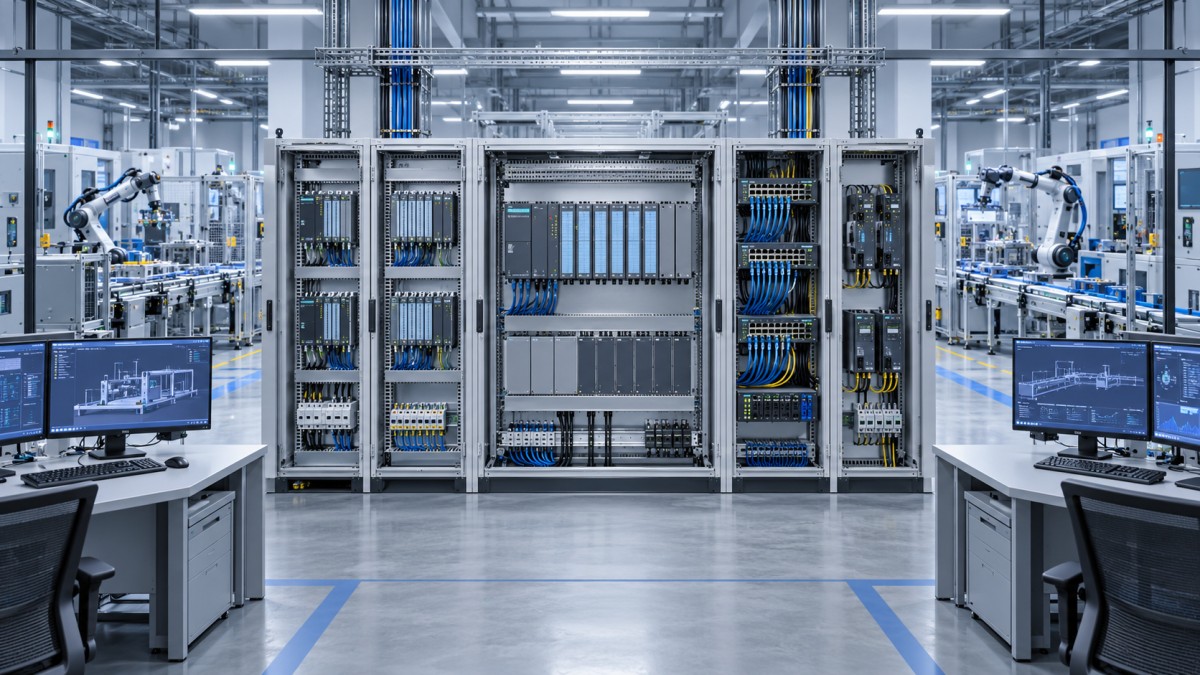
- Physical boundaries: Panel space, cable routing, power capacity, cooling, network cabinet capacity, access routes, and equipment-room layouts should allow for realistic additions or replacements. A cabinet that is full at handover transfers cost into every future modification.
- Control boundaries: The division among safety systems, process control, local equipment controls, and supervisory functions should be documented clearly. Future modifications are safer when teams can identify where a change begins and which functions must remain isolated.
- Data boundaries: Tag naming, data ownership, retention policies, timestamps, event records, and interface specifications determine whether future analytics, digital-twin models, optimization tools, or regulatory reporting can use operational data without a separate data-reconstruction project.
- Commercial boundaries: Licensing rights, source-code access where relevant, configuration ownership, documentation requirements, and service arrangements affect whether the asset owner can obtain support and upgrades from more than one qualified provider.
None of these provisions guarantees a low-cost retrofit. They reduce uncertainty and give the owner more choices when technology, demand, or regulation changes.
A roadmap should connect asset condition to business triggers
Many organizations maintain an automation inventory. Fewer translate that inventory into a lifecycle roadmap tied to operational decisions. A list of installed devices, software versions, warranties, and support dates is necessary, but it does not establish when modernization should occur or what outcome it should produce.
A stronger roadmap links automation components to business triggers. A control system may be technically serviceable but become a priority because a plant expansion requires additional I/O capacity, a new rail signaling interface must be introduced, a smart-building portfolio needs common energy data, or a cybersecurity control cannot be implemented on the existing architecture. Conversely, an old component may remain in service safely when it is isolated, supported by spares, properly documented, and not blocking operational improvement.
This approach helps leadership avoid two costly extremes: replacing equipment simply because it is old, and deferring action until a failure or unsupported software version forces an urgent project. The first wastes usable capital; the second usually removes procurement leverage and forces broad scope under time pressure.
Procurement should evaluate retrofitability, not only compliance at handover
Automation procurement frequently emphasizes functional acceptance: does the system control the equipment, meet safety requirements, produce the specified reports, and pass commissioning tests? Those are essential conditions, but they do not reveal whether the delivered system can be changed at reasonable cost.
Buyers can address this by making lifecycle evidence part of the bid evaluation and contract deliverables. The request should ask suppliers to describe upgrade paths, dependencies on external software, licensing assumptions, supported integration methods, spare-part availability strategy, and procedures for transferring configuration records. A generic assurance that a platform is scalable provides little protection unless the supplier identifies the constraints: maximum capacity, licensing thresholds, architectural changes required for expansion, and functions that cannot be upgraded online.
Documentation deserves the same discipline. Drawings, network maps, I/O schedules, logic narratives, alarm lists, cable records, software backups, and change histories are sometimes treated as closeout paperwork. In a later retrofit, they become the starting point for engineering, outage planning, safety review, and competitive tendering. Incomplete records do not merely slow a project; they encourage contractors to include contingency for unknown conditions, raising cost before site work begins.
It is also sensible to distinguish between a supplier’s proprietary value and the owner’s operational rights. A specialized control algorithm, for example, may remain vendor intellectual property. That does not prevent the owner from requiring accessible operating data, documented interface points, usable backups, and the ability to maintain or replace adjacent systems. The commercial model should reflect the criticality of the asset and the acceptable level of dependency, rather than assuming that all vendor relationships carry the same risk.
Standardization helps, but only when it remains governed
Organizations managing a portfolio of stations, warehouses, buildings, plants, fleets, or municipal systems often pursue automation standardization to simplify maintenance and reduce training requirements. This can be effective, especially where teams need consistent alarm philosophy, cybersecurity controls, remote-support procedures, and spare-part holdings.
However, standardization can create its own retrofit gap when it freezes outdated architecture or becomes a shorthand for purchasing the same components regardless of application. A standard should define approved patterns, interfaces, cybersecurity expectations, data conventions, and exception processes. It should be reviewed when supplier support, operating risks, or business needs change.
For a multi-site owner, the practical unit of planning is often the reference architecture rather than the individual device. Sites may differ in process equipment and local conditions, but they can share a controlled approach to network zones, identity management, historian connectivity, alarm management, remote access, and configuration backup. This reduces engineering variability while allowing site-level upgrades to occur on different schedules.
Do not treat cyber upgrades as a separate lifecycle issue
Cybersecurity frequently exposes the consequences of weak automation lifecycle planning because older operational technology was deployed with assumptions that no longer hold. Remote connectivity, third-party maintenance access, shared networks, unsupported operating systems, and unmanaged interfaces can convert a maintenance decision into a broader risk-management issue.
Adding security controls late may require network redesign, replacement of incompatible devices, revised access procedures, and changes to vendor support arrangements. Planning ahead does not mean installing every available security product at the start. It means defining asset ownership, network segmentation, remote-access control, update responsibilities, logging needs, and recovery procedures so that later controls can be introduced without rebuilding the whole environment.
Leadership teams should ask for a lifecycle view of cyber risk alongside the conventional hardware obsolescence view. Both are tied to the same underlying questions: which assets are connected, who can modify them, how are changes recorded, and what happens when a component can no longer be supported?
Use a staged investment model instead of a single modernization date
Large-scale replacement programs are attractive on paper because they promise a clean end state. They can also concentrate capital demand, operational risk, and implementation complexity into one period. For many asset owners, a staged model is more credible: establish standards and documentation first, resolve the most restrictive architecture gaps, replace high-risk unsupported components, then align broader modernization with planned expansions, renewal works, or scheduled outages.
The sequence must be informed by criticality. A component with no immediate replacement path, no tested backup, and direct impact on safety or service continuity deserves a different response from a low-risk device that can be isolated and supported with stocked spares. The decision should combine technical condition, operational consequence, supply exposure, cyber requirements, and the availability of an outage window.
Automation lifecycle planning earns its value when it turns these choices into an owned management process. The plan should identify decision dates, not just replacement dates: when to review vendor support, when to refresh architecture standards, when to validate backups, when to test recovery procedures, and when to reserve physical and financial capacity for the next upgrade.
The most useful outcome is retained optionality
Enterprise leaders do not need a perfect forecast of automation technology to avoid costly retrofit gaps. They need a disciplined view of what the asset must continue to do, what changes are likely over its life, and which design or procurement choices would make those changes disruptive.
Systems that can be documented, segmented, expanded, secured, and competitively supported give owners room to act before a failure forces the issue. That room is often the difference between a planned investment tied to operational value and a retrofit undertaken under outage pressure, uncertain scope, and limited commercial choice.
Questions about this sector or your project? Contact Sector Deep Dive for expert insights.
We respect your privacy. Your information is strictly confidential.
Get weekly intelligence in your inbox.
No noise. No sponsored content. Pure intelligence.
News Recommendations
 Oct 25, 2026How to prioritize renewals in global infrastructure asset managementHow to prioritize renewals in global infrastructure asset management
 Oct 20, 2026Why do inductors overheat in electronic power supply circuits?Why do inductors overheat in electronic power supply circuits?
 Oct 12, 2026How heavy equipment failure analysis traces recurring pump failuresHow heavy equipment failure analysis traces recurring pump failures
 Oct 12, 2026Using heavy machinery failure analysis to identify fatigue cracksUsing heavy machinery failure analysis to identify fatigue cracks
 Oct 08, 2026Which automated equipment monitoring sensors suit harsh sitesWhich automated equipment monitoring sensors suit harsh sites
 Oct 08, 2026How automation lifecycle planning prevents costly retrofit gapsHow automation lifecycle planning prevents costly retrofit gaps
 Sep 14, 2026When Should You Update Supplier Capability Data? Triggers, Frequency & Audit RequirementsWhen Should You Update Supplier Capability Data? Triggers, Frequency & Audit Requirements
 Sep 14, 2026How should smart devices be maintained in harsh outdoor conditions?How should smart devices be maintained in harsh outdoor conditions?
 Aug 25, 2026Common Wine Tank Cleaning and Corrosion Issues in Fermentation SystemsCommon Wine Tank Cleaning and Corrosion Issues in Fermentation Systems
 Aug 08, 2026How Maintenance Technologies for Railways Reduce Downtime and Track Failure RiskHow Maintenance Technologies for Railways Reduce Downtime and Track Failure Risk
 Jul 14, 2026Predictive Heavy Machinery Analysis: 5 Signals of Early FailurePredictive Heavy Machinery Analysis: 5 Signals of Early Failure
 Jul 10, 2026When Industrial Technology Services Reduce Downtime MostWhen Industrial Technology Services Reduce Downtime Most
 Jul 10, 2026How to Compare Automation Equipment Sensors for Uptime and AccuracyHow to Compare Automation Equipment Sensors for Uptime and Accuracy
 Jul 09, 2026Rail Maintenance Asset Monitoring: Key Failure SignalsRail Maintenance Asset Monitoring: Key Failure Signals
![]() Jul 07, 2026Automation Equipment Supplier Checklist for Stable After-Sales SupportAutomation Equipment Supplier Checklist for Stable After-Sales Support
 Jul 02, 2026Railway Maintenance Systems Equipment: Key Features That Reduce DowntimeRailway Maintenance Systems Equipment: Key Features That Reduce Downtime
 Jun 29, 2026Railway Maintenance Systems: Key Features That Reduce DowntimeRailway Maintenance Systems: Key Features That Reduce Downtime
 Jun 28, 2026Industrial Accessories Checklist for Reducing DowntimeIndustrial Accessories Checklist for Reducing Downtime
 Jun 27, 2026Special Purpose Vehicles and Equipment: Key Maintenance ChecksSpecial Purpose Vehicles and Equipment: Key Maintenance Checks
 Jun 20, 2026Maintenance Technologies for Railways That Reduce Downtime and Repair RiskMaintenance Technologies for Railways That Reduce Downtime and Repair Risk
 Jun 16, 2026Maintenance Technologies for Smart Buildings That Reduce DowntimeMaintenance Technologies for Smart Buildings That Reduce Downtime
 Jun 10, 2026Railway Maintenance Costs: Key Factors That Impact Lifecycle BudgetsRailway Maintenance Costs: Key Factors That Impact Lifecycle Budgets
 Jun 07, 2026Heavy Machinery Maintenance Costs: What Impacts Downtime Most in 2026Heavy Machinery Maintenance Costs: What Impacts Downtime Most in 2026
 Jun 06, 2026Maintenance Technologies for Heavy Equipment That Reduce DowntimeMaintenance Technologies for Heavy Equipment That Reduce Downtime
![]() Jun 04, 20262026 Maintenance Technologies: Which Upgrades Cut Downtime Fastest?2026 Maintenance Technologies: Which Upgrades Cut Downtime Fastest?
 Jun 03, 2026Maintenance Technologies for Heavy Equipment That Cut Downtime in 2026Maintenance Technologies for Heavy Equipment That Cut Downtime in 2026
 Jun 02, 2026Maintenance Technologies That Cut Fleet DowntimeMaintenance Technologies That Cut Fleet Downtime