Which prefabricated construction techniques save the most labor?
Among today’s prefabricated construction techniques, the biggest labor savings come from systems that shorten onsite assembly, reduce rework, and support green engineering solutions. For infrastructure construction companies navigating physical world transformation, understanding which methods deliver faster installation, safer workflows, and lower labor intensity is critical to smarter project planning, cost control, and carbon reduction technologies adoption.
For technical evaluators, procurement teams, project managers, safety leaders, and business decision-makers, labor efficiency is no longer a narrow site-level metric. It affects bid competitiveness, schedule certainty, crane utilization, quality consistency, and even the carbon profile of a project. In prefabricated construction, the question is not simply whether offsite production saves labor, but which techniques save the most labor under real project constraints.
The answer depends on where labor is being consumed: repetitive formwork, onsite wet trades, MEP coordination, vertical transport, finishing rework, or inspection delays. Some prefabricated systems reduce direct labor by 15%–25%, while others can cut onsite manpower demand by 30%–50% when design standardization, logistics planning, and installation sequencing are mature.
This article compares the main prefabricated construction techniques from a B2B decision perspective, focusing on labor-saving impact, implementation conditions, quality risks, and procurement value. The goal is to help infrastructure and building stakeholders choose methods that improve output per worker without creating hidden coordination costs elsewhere in the delivery chain.
Where prefabricated construction saves labor most effectively
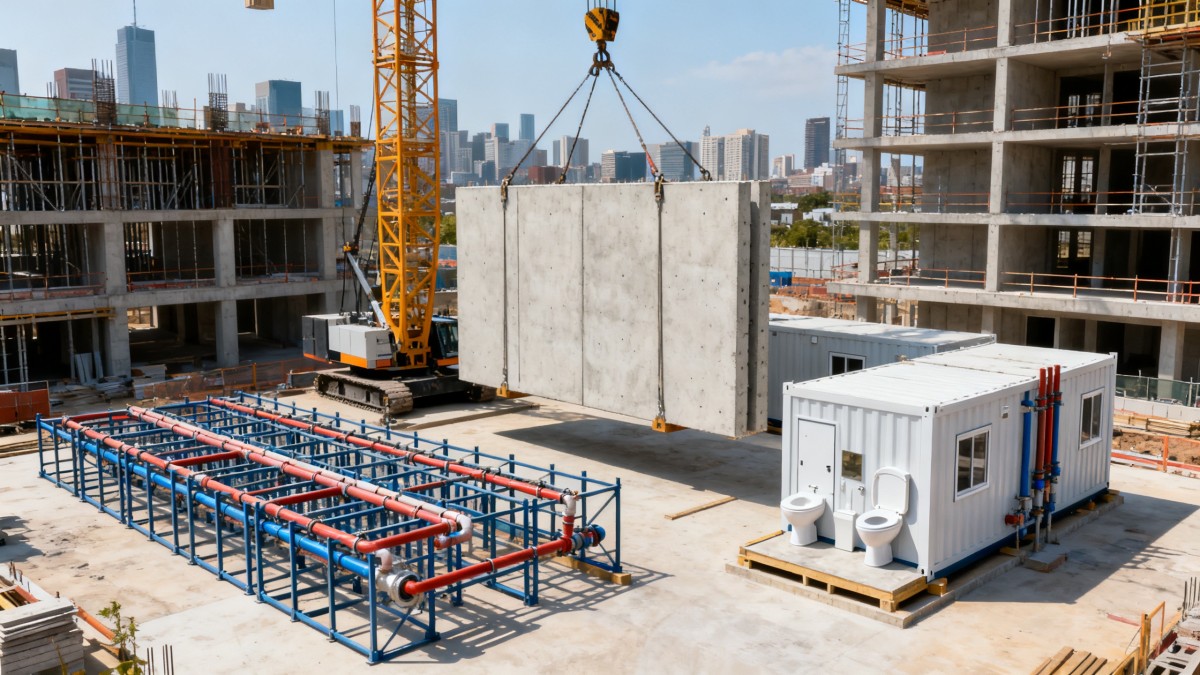
The largest labor savings usually come from shifting repetitive, weather-sensitive, and coordination-heavy tasks from the jobsite into controlled factory workflows. In practical terms, this means fewer onsite workers for formwork, rebar tying, wet finishing, ceiling coordination, wall layout correction, and punch-list repair. The more a system reduces trade overlap onsite, the more visible the labor benefit becomes.
Across commercial buildings, housing, transport hubs, utility structures, and public infrastructure support facilities, three labor pools are commonly affected first: structural assembly crews, MEP installation teams, and finishing workers. If a prefabricated system only accelerates one of these areas while leaving the others unchanged, labor savings may remain moderate. If it compresses all three, labor productivity can improve sharply over a 6–18 month project cycle.
In most markets, the strongest labor-saving candidates are volumetric modular units, large-panel precast systems, prefabricated MEP racks, bathroom or utility pods, and preassembled façade systems. However, the best option depends on project repetition, transport constraints, lifting capacity, tolerance management, and local workforce skill levels. A system with high factory completion may still underperform if crane bottlenecks or connection complexity are underestimated.
The table below compares the main techniques by their typical impact on onsite labor demand, installation speed, and coordination burden.
A clear pattern emerges: the greatest labor savings come from systems that combine several trades into one delivered unit. Volumetric modules and pods perform well because they do not just move materials offsite; they move labor hours, inspections, and quality control into a predictable production environment. By contrast, systems that only prefabricate single components often save labor, but less dramatically.
Why labor savings vary by project type
A hotel, student residence, station service building, worker accommodation block, or hospital ward with 50–200 repeated room types gains more from modular units and pods than a one-off civic building with irregular geometry. Repetition increases factory efficiency, standardizes lifting sequences, and reduces field adjustment work. In low-repetition projects, panelized systems and MEP prefabrication are often more practical than full volumetric modules.
- High repetition: modular rooms, bathroom pods, corridor MEP racks
- Medium repetition: precast walls, slabs, stairs, façade units
- Low repetition: selective MEP prefabrication, plant skids, utility assemblies
Which techniques usually deliver the highest labor reduction
If the goal is maximum reduction in onsite workforce, volumetric modular construction is often the top performer. A module can arrive with internal walls, doors, basic finishes, wiring, pipework, sanitary fittings, and sometimes even tested equipment. Instead of 8–12 separate trade interventions inside one room over several days, installation may be compressed into a few lifting and connection operations completed within hours.
Large-panel precast concrete usually ranks second for labor efficiency in structure-dominant projects. Compared with cast-in-place systems, it reduces scaffolding, shuttering, steel fixing labor, curing delays, and weather disruption. For mid-rise residential blocks, schools, depots, and utility buildings, a precast envelope and structural frame can shorten floor-cycle durations by 20%–40%, especially where repetitive bays are used.
Prefabricated MEP racks deliver especially strong value in data-heavy, equipment-dense, or congested ceilings. They do not always produce the biggest headline labor reduction, but they significantly reduce hidden coordination labor. This is important on infrastructure-related assets such as rail support buildings, treatment plants, logistics hubs, and smart facility nodes, where mechanical and electrical systems often create schedule friction late in the project.
Bathroom pods and utility pods are another high-efficiency option because bathrooms contain many labor-intensive trades in a small footprint of 3–8 square meters. Waterproofing, tiling, plumbing, ventilation, electrical rough-in, fixtures, and testing can all be completed offsite. When layout repetition exceeds 30–50 units, pods often become materially attractive even before considering schedule gains.
Technique ranking by labor-saving profile
The following comparison helps procurement and technical teams distinguish between direct labor reduction and broader coordination savings.
From a labor perspective, the practical winner is usually the system with the highest repeatability and the fewest onsite finishing steps. That is why fully integrated room modules often outperform panel-only systems, while panelized and MEP-prefabricated approaches remain more flexible for mixed-use or complex infrastructure projects.
A common evaluation mistake
Many buyers compare only unit price per square meter or per module. A more useful metric is labor hours avoided per installed unit, plus the number of site interfaces removed. A technique that looks 8% more expensive in supply cost may still be financially stronger if it cuts 25% of onsite labor, reduces punch items, and shortens handover by 2–4 weeks.
How to choose the right labor-saving method for infrastructure and urban projects
Selection should begin with project geometry, repetition rate, logistics access, and site labor pressure. A compact city-center jobsite with restricted laydown space may favor high-completion modules or pods because they minimize material handling and trade stacking. A remote infrastructure project with long haul distances may prefer precast structural elements or plant skids that balance labor savings with simpler transportation.
Technical teams should also assess tolerance strategy early. If the project cannot reliably maintain dimensional control within a narrow range such as ±5 mm to ±10 mm at connection points, labor savings may be eroded by corrective fitting onsite. Prefabrication rewards precise surveying, digital coordination, and stable design freeze milestones. Without those disciplines, labor simply moves from production to troubleshooting.
For procurement and business evaluators, the key is to compare labor-saving potential against delivery risk. A system that removes 40% of site labor but requires a 12–16 week fabrication lead time may not be suitable if final approvals remain uncertain. In contrast, panelized systems and MEP racks can often be phased more flexibly in 4–10 week batches, reducing schedule exposure.
Safety and quality managers should not treat labor reduction as purely a staffing issue. Fewer onsite workers generally mean fewer simultaneous hot work, lifting, wet area, and confined routing activities. That can reduce incident exposure, simplify inspection plans, and improve traceability. In sectors pursuing green engineering and smart jobsite targets, this operational control matters as much as labor cost itself.
Four filters for decision-makers
- Repeatability threshold: Are there at least 20, 50, or 100 similar units or bays to justify factory optimization?
- Transport and lifting feasibility: Can local roads, escorts, crane reach, and lifting windows support the chosen unit size?
- Design maturity: Can architectural, structural, and MEP packages be frozen 6–12 weeks before installation?
- Site labor constraints: Is there an actual shortage, wage pressure, or safety bottleneck that justifies higher prefabrication intensity?
Recommended matching logic
Where room repetition is high and site access is manageable, modular units and pods usually create the best labor outcome. Where structure dominates and layouts are semi-repetitive, large-panel precast is often the most balanced option. Where service density is high or ceilings are congested, MEP prefabrication can unlock labor savings that traditional cost plans often underestimate.
Implementation risks that can erase labor savings
The most common reason prefabricated construction underdelivers is not factory production failure, but poor interface management. If connection details, tolerances, embed positions, transport sequencing, or crane booking are not aligned, the project starts paying labor twice: once in fabrication and again in field correction. Even a 2%–3% rework rate across repeated units can undermine a large share of expected savings.
Another frequent issue is late design change. Prefabricated systems perform best when decisions are made earlier than in conventional construction. Window positions, shaft dimensions, MEP access panels, and finish selections often need sign-off weeks earlier, sometimes 8–12 weeks ahead of installation. Projects with unstable stakeholder approvals should be cautious about going too far toward full volumetric solutions without strong change control.
Logistics can also become the hidden labor trap. If transport routes require special permits, if site unloading zones are undersized, or if delivery sequencing is disrupted by weather or urban access restrictions, crews may spend significant time waiting. In these cases, a slightly less complete prefabricated system with easier handling may produce better net labor efficiency than a fully integrated unit.
Quality management should focus on joints, tolerances, moisture protection, and commissioning interfaces. Labor savings are strongest when inspections are shifted upstream into factory stages, with clear check points before shipping, on arrival, and after installation. A 3-stage inspection model is often more effective than relying on final site checks alone.
Risk control checklist
- Freeze design packages before fabrication release, ideally with coordinated 3D models and signed interface drawings.
- Verify lifting points, crane capacity, and delivery route restrictions at least 2–4 weeks before the first shipment.
- Set acceptance criteria for dimensional tolerances, connection hardware, and factory test records before procurement award.
- Plan contingency for weather, access delays, and temporary storage so modules do not create idle labor on site.
- Use phased mock-ups or pilot zones, especially when the first 5–10 units will determine installation productivity.
What experienced buyers ask suppliers
Strong supplier evaluation goes beyond price and capacity. Decision-makers should ask how many interfaces remain onsite, what percentage of factory completion is included, how defects are recorded before dispatch, what the expected installation crew size is, and how many units or panels can be installed per day under normal site conditions. These answers reveal real labor performance more clearly than brochure claims.
Procurement guidance, delivery planning, and common questions
For procurement teams, labor-saving value should be translated into measurable tender criteria. Instead of using general wording such as “efficient prefabrication,” define expected factory completion scope, installation productivity assumptions, inspection records, packaging requirements, and interface responsibilities. This helps commercial comparisons stay aligned with delivery reality and avoids post-award disputes over what work remains onsite.
A practical procurement framework includes four dimensions: unit completeness, installation rate, quality assurance process, and logistics reliability. For example, the same bathroom pod may appear similar across suppliers, but differences in waterproofing sequence, connection standardization, and pre-shipment testing can have a major effect on site labor. A pod that arrives 95% complete is not operationally equivalent to one that arrives 75% complete.
Project owners and distributors should also consider service support after delivery. Installation training, spare interface kits, digital as-built records, and response time for defects all influence whether labor savings are protected during commissioning. In many projects, the first 30 days after installation are where hidden labor costs either remain controlled or begin to rise.
The table below summarizes a simple procurement and delivery checklist for prefabricated construction techniques with strong labor-saving intent.
The key procurement insight is that labor savings should be bought as a deliverable outcome, not assumed as an automatic feature of prefabrication. The more clearly buyers define site work boundaries and installation expectations, the more likely prefabricated construction techniques will achieve their intended value.
FAQ: practical questions from evaluators and buyers
How early should design be frozen for labor-saving prefabrication?
For panelized systems, a stable design package is often needed 4–8 weeks before fabrication. For volumetric modules and fully integrated pods, 8–12 weeks is more common because architecture, structure, and MEP must align earlier. If approvals are still moving, consider phased prefabrication instead of full modular commitment.
Are labor savings still strong in infrastructure support buildings with complex services?
Yes, especially through prefabricated MEP racks, equipment skids, corridor service modules, and selected precast elements. In rail, utility, mining, and logistics-related buildings, service complexity often makes coordination labor expensive. Prefabricating the service zones can reduce congestion, improve safety, and shorten commissioning sequences.
What is the most common mistake during supplier comparison?
Comparing only supply price without comparing field labor avoided. Buyers should ask how many onsite trade steps remain, what testing is completed in the factory, what crew size is assumed, and how many installations per day are realistic. Those factors usually determine whether the promised savings are real.
Which technique is best when carbon reduction is also a target?
There is no universal answer, but systems that reduce rework, waste, wet trades, and repeated transport of small materials tend to support carbon reduction goals more effectively. In many projects, the best outcome comes from combining precast structure with prefabricated MEP or pods, rather than relying on one technique alone.
The prefabricated construction techniques that save the most labor are usually the ones that remove the greatest number of onsite trade interfaces: volumetric modular units, bathroom or service pods, large-panel precast systems, and prefabricated MEP assemblies. Their real value lies not only in fewer workers on site, but in faster installation, more predictable quality, safer workflows, and better alignment with sustainable infrastructure delivery.
For GIUT’s audience across construction, urban technology, logistics, mining support facilities, and smart infrastructure, the most effective strategy is to match prefabrication intensity to repetition, design maturity, logistics conditions, and service complexity. If you are evaluating labor-saving construction methods for an upcoming project, now is the right time to compare system options, define measurable procurement criteria, and build a delivery plan that protects both schedule and quality.
To explore tailored prefabricated construction solutions, procurement benchmarks, or project-specific implementation pathways, contact us to get a customized plan, discuss technical details, or learn more about labor-efficient infrastructure and smart building strategies.
- infrastructure construction
- prefabricated construction
- green engineering
- sustainable infrastructure
- smart building
- physical world
- carbon reduction
- prefabricated construction techniques
- infrastructure construction companies
- green engineering solutions
- physical world transformation
- carbon reduction technologies
Get weekly intelligence in your inbox.
No noise. No sponsored content. Pure intelligence.
News Recommendations
 Sep 19, 2026How an electronics application guide helps prevent component mismatchHow an electronics application guide helps prevent component mismatch
 Sep 18, 2026When a resource allocation platform improves project deliveryWhen a resource allocation platform improves project delivery
 Sep 17, 2026What to compare when evaluating mineral processing equipment manufacturersWhat to compare when evaluating mineral processing equipment manufacturers
 Sep 16, 2026How mineral separation optimization can reduce concentrate lossesHow mineral separation optimization can reduce concentrate losses
 Sep 15, 2026How to assess lifecycle costs in urban tech procurementHow to assess lifecycle costs in urban tech procurement
 Sep 14, 2026Heavy industry technology trends reshaping capital investment prioritiesHeavy industry technology trends reshaping capital investment priorities
 Sep 14, 2026Global Industrial Equipment Procurement: How Top OEMs Qualify Suppliers for Mining & Infrastructure ProjectsGlobal Industrial Equipment Procurement: How Top OEMs Qualify Suppliers for Mining & Infrastructure Projects
 Sep 14, 2026Industrial & Mining Equipment Procurement: Balancing Local Sourcing, Lead Time, and Certification RequirementsIndustrial & Mining Equipment Procurement: Balancing Local Sourcing, Lead Time, and Certification Requirements
 Sep 14, 2026Infrastructure & Equipment Upgrades: What Procurement Teams Must Verify Before Signing Off on New ContractsInfrastructure & Equipment Upgrades: What Procurement Teams Must Verify Before Signing Off on New Contracts
 Sep 14, 2026Why Infrastructure Equipment Buyers Are Shifting from Catalog-Based to Capability-Based Supplier SelectionWhy Infrastructure Equipment Buyers Are Shifting from Catalog-Based to Capability-Based Supplier Selection
 Sep 14, 2026Process Automation Project Execution: How to Align Supplier Capabilities with PLC Integration, Cybersecurity & Commissioning MilestonesProcess Automation Project Execution: How to Align Supplier Capabilities with PLC Integration, Cybersecurity & Commissioning Milestones
 Sep 14, 2026Are intelligent traffic systems worth the investment for small cities?Are intelligent traffic systems worth the investment for small cities?
 Sep 14, 2026How do intelligent traffic systems handle sensor failures?How do intelligent traffic systems handle sensor failures?
 Sep 14, 2026What should I check before accepting a smart building system?What should I check before accepting a smart building system?
 Sep 14, 2026Is a smart building system worth the maintenance cost?Is a smart building system worth the maintenance cost?
 Sep 14, 2026What data is needed for reliable resource allocation planning?What data is needed for reliable resource allocation planning?
 Sep 14, 2026How can resource allocation software reduce equipment idle time?How can resource allocation software reduce equipment idle time?
 Sep 14, 2026How should smart devices be maintained in harsh outdoor conditions?How should smart devices be maintained in harsh outdoor conditions?
 Sep 14, 2026Do smart devices improve worker safety on construction sites?Do smart devices improve worker safety on construction sites?
 Sep 14, 2026What environmental risks must be assessed before deep-sea mining?What environmental risks must be assessed before deep-sea mining?
 Sep 14, 2026Is deep-sea mining equipment commercially viable in 2026?Is deep-sea mining equipment commercially viable in 2026?
 Sep 14, 2026What Inspection Checks Should Procurement Teams Perform Before Ordering Dredging Equipment in 2026?What Inspection Checks Should Procurement Teams Perform Before Ordering Dredging Equipment in 2026?
 Sep 13, 2026How to verify an industrial product information source before specifying equipmentHow to verify an industrial product information source before specifying equipment
 Sep 12, 2026Which intelligent traffic systems hardware fits an urban intersection?Which intelligent traffic systems hardware fits an urban intersection?
 Sep 11, 2026How pump capacity affects response coverage for municipal fire fighting vehiclesHow pump capacity affects response coverage for municipal fire fighting vehicles
 Sep 10, 2026What to verify before choosing a heavy industry equipment supplierWhat to verify before choosing a heavy industry equipment supplier
 Sep 09, 2026When do adaptive urban traffic control systems reduce corridor delays?When do adaptive urban traffic control systems reduce corridor delays?