Can an urban traffic systems supplier integrate existing controllers?
Yes, an urban traffic systems supplier can integrate existing controllers when the required functions are supported by their interfaces, firmware, and communications links. Retaining the controller fleet is often feasible for status monitoring, alarm collection, and coordinated timing. More demanding functions, such as adaptive control or detailed event streaming, require closer examination. A controller that exchanges basic data successfully might still lack the interface needed for the intended control strategy.
The integration decision should therefore start with the operations that must work at each intersection. “Compatible with existing controllers” is too broad to serve as an acceptance requirement. Compatibility becomes meaningful when it identifies the controller model, firmware revision, enabled features, central software version, and tested operations.
Define the depth of integration before comparing proposals
Reading controller status places different demands on a system than changing timing plans or issuing frequent control commands. A central platform might display an intersection as connected while supporting only a small subset of its functions. That connection could be adequate for maintenance monitoring and inadequate for corridor management.
A useful proposal specifies which capabilities work across the entire fleet and which apply only to particular controller groups. Exceptions should be visible at the intersection level. Otherwise, a platform-wide feature claim can conceal a substantial number of locations where that feature is unavailable.
Protocol support needs a function-by-function match
NTCIP provides standardized interfaces used in traffic control, but a statement of NTCIP support does not establish complete interoperability. Relevant versions, supported objects, access permissions, optional features, and vendor extensions still need to align. Two devices can support the same protocol family while exposing different usable functions.
The strongest evidence combines interface documentation with a demonstrated exchange against the proposed central software. For each required operation, the compatibility record should identify the data read or written, any prerequisites, and the resulting controller behavior. A generic list of supported controller manufacturers leaves these questions unresolved.
Write access deserves particular attention. A platform could read timing values correctly yet fail to update them because the controller requires a different transaction sequence, restricts remote changes, or exposes some parameters through a proprietary interface. A successful write response also needs readback and operational verification: the stored value, active value, and observed signal behavior are separate pieces of evidence.
For example, selecting a coordination plan should be tested through its transition into service. Differences in phase mapping, offset reference, or transition settings can produce unexpected behavior even when the selected plan number is correct. Integration must preserve the meaning of the configuration, not simply transfer matching numbers.
Firmware differences can divide an otherwise identical fleet
Controllers with the same model designation can have different interface behavior because of firmware revisions, installed options, or configuration. A fleet inventory should record those details alongside communications equipment and cabinet connections. Sampling only the newest controller risks missing the units most likely to need additional work.
A firmware update is a separate deployment dependency. Its suitability includes hardware support, configuration conversion, rollback availability, and compatibility with existing detection, priority, or preemption functions. Integration acceptance should use the firmware intended for field deployment, rather than a convenient laboratory version.
Choose the integration route around the controller’s actual limits
Direct communication is attractive when the controller already exposes the required interface over the available network. It reduces intermediary components, but the central platform still needs proven support for that controller implementation. A shared Ethernet connection alone establishes transport availability, not application compatibility.
A gateway offers another route for serial links, legacy protocols, or controllers requiring translation. Its value depends on what it translates and how accurately it preserves behavior. A gateway that exposes alarms and plan selection might provide a useful supervisory connection without supporting timing downloads or advanced control.
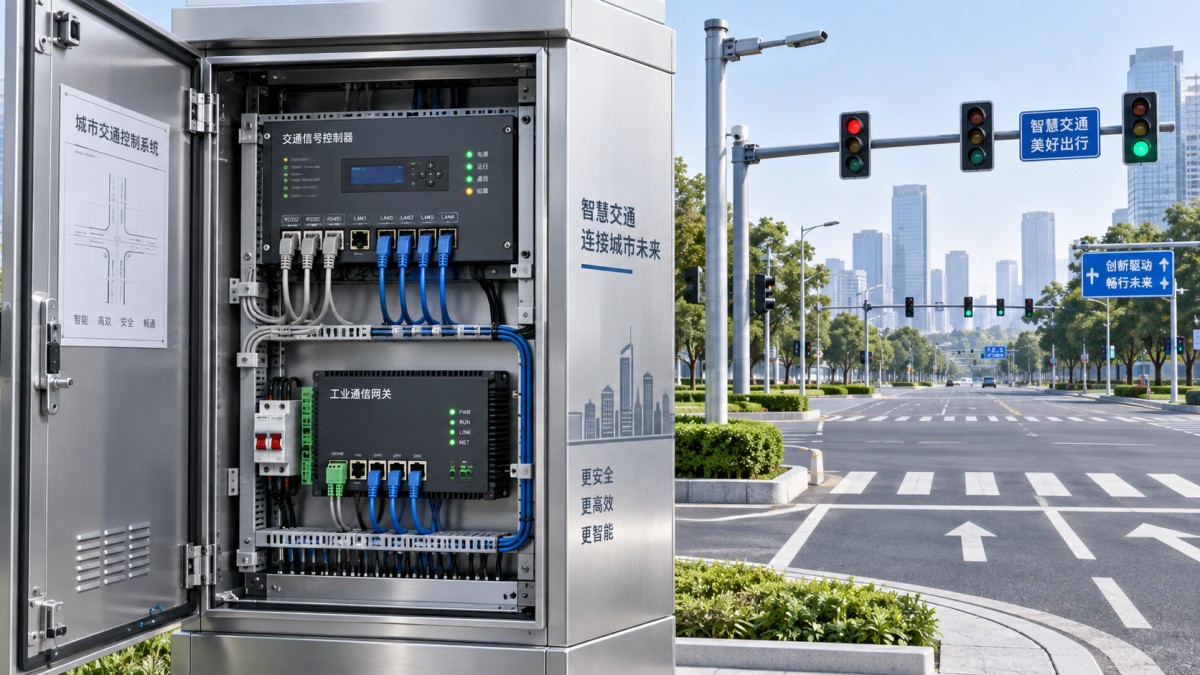
The integration design should identify where protocol conversion, timestamping, command validation, and buffering occur between the central platform and the controller. Those locations determine what happens when a component restarts or a link fails. They also reveal whether reported information comes directly from the controller or has been inferred by an intermediary.
Buffering commands requires particular care. A delayed status record can remain useful if its age is clear; a delayed control command can be inappropriate when it finally arrives. Any queued command needs defined expiry and recovery behavior so that reconnection does not replay obsolete operating instructions.
Retaining an existing central system and connecting through its interface is also possible where that system exposes the necessary functions. This introduces a dependency on its API, licensing, availability, and data model. Controller-level information omitted by the existing central system will not become available merely because another application connects to it.
Selective controller replacement becomes justified when an essential function is unavailable through supported interfaces or when the required firmware and security controls cannot be maintained. The replacement boundary should follow demonstrated limitations. A mixed fleet can remain viable when common operations work consistently and exceptions are clearly managed.
Existing communications must support the intended workload
A link adequate for occasional alarm polling can struggle when the same connection carries frequent detector updates, event retrieval, and configuration transfers. Integration testing needs the expected concurrent workload, including background tasks. Testing a single quiet intersection gives little evidence about behavior during a network-wide polling cycle.
Latency and packet loss matter alongside bandwidth. Frequent supervisory exchanges over a variable wireless connection can create stale information or repeated timeouts without exhausting nominal capacity. Serial multidrop arrangements introduce a different constraint: communication with one device can occupy resources shared by others.
The central platform should distinguish a lost connection from an unchanged controller state. Displays need a visible last-update time and a defined transition to stale or unavailable status. Continuing to show the last known green indication without marking its age creates a misleading operational picture.
Time synchronization also affects interpretation. Controller clocks, gateway timestamps, and server receipt times represent different events. An analysis system must identify which timestamp it uses and account for clock drift and time adjustments. Otherwise, apparent timing irregularities can originate in data handling rather than intersection operation.
Preserve local safety functions and establish control authority
Integration must retain the controller’s local timing protections and the cabinet’s applicable monitoring functions. Central connectivity does not establish that remotely supplied parameters are safe or valid for the intersection. Remote changes need validation against the controller configuration and the approved signal operation.
Local and central authority must be explicit. Scheduled plans, manual commands, adaptive control, transit priority, and emergency preemption can interact. Their precedence and recovery behavior need verification on the actual configuration, particularly when more than one system can issue commands.
Loss of communications should lead to a defined local operating mode. That could involve continuing an approved local schedule or another configured fallback. The appropriate behavior follows the intersection’s operating requirements; it should not emerge accidentally from whichever command happened to arrive last.
Cybersecurity assessment belongs within compatibility assessment because older interfaces can restrict available controls. Where a controller cannot support modern authentication or encryption, network segmentation and a secured access path can reduce exposure. Those measures do not add security capabilities to the controller itself, so the remaining access limitations need to be documented.
The integration should separate monitoring privileges from configuration and control privileges where supported. Remote access requires attributable accounts, restricted network paths, and records of consequential changes. Gateway administration, firmware updates, and remote maintenance connections deserve the same scrutiny as the central application.
Use acceptance testing to expose operational differences
A credible demonstration uses representative combinations of controller model, firmware, interface, and communications path. It includes older configurations and known exceptions. Bench testing establishes basic interoperability; field validation then examines timing transitions, detection inputs, network variability, and interactions with installed equipment.
Acceptance criteria should describe observable outcomes. “The platform supports coordination” leaves too much open. A stronger criterion specifies that a designated plan is requested, the controller enters the expected state, the transition follows the approved configuration, and the central display reports the result within an agreed interval.
Several tests reveal limitations that a normal connectivity demonstration misses:
- Connection loss during an active session: establish local operation, stale-data indication, command expiry, and the behavior after reconnection.
- A configuration change should include readback and confirmation of activation. Partial transfers and rejected values need visible results rather than a generic success message.
- Concurrent command sources. Exercise the actual priority and preemption arrangements alongside central commands, then verify how ordinary operation resumes.
- Restart the gateway or central service with pending work and confirm that configuration, permissions, and operating state recover as specified.
Testing should also confirm that integration traffic does not impair existing communications or controller responsiveness. The expected polling load, event retrieval, and maintenance activity belong in the trial. An integration that works only with other applications disconnected has not demonstrated coexistence.
Make the integration commitment specific enough to enforce
The supplier’s delivery scope should include a compatibility matrix tied to the actual fleet, the supported functions for each configuration, and responsibility for each interface. It should identify whether gateway software, protocol drivers, firmware changes, or third-party access are required. These dependencies affect whether the demonstrated arrangement can be maintained after deployment.
Configuration ownership and export capability also matter. Timing databases, controller mappings, gateway settings, and operational records should remain retrievable in documented forms where supported. If replacing a gateway or changing central software requires reconstructing undocumented mappings, retaining the controllers can still leave a difficult future migration.
A phased rollout can begin with monitoring, advance to controlled configuration changes, and then enable the intended operational functions after acceptance. Each phase needs a rollback path using backed-up configurations and a known local operating state. The final commitment should name the controllers retained, the functions accepted, and the exceptions requiring modification or replacement. That is the evidence needed to decide whether integration truly avoids a network overhaul.
Questions about this sector or your project? Contact Sector Deep Dive for expert insights.
We respect your privacy. Your information is strictly confidential.
Get weekly intelligence in your inbox.
No noise. No sponsored content. Pure intelligence.
News Recommendations
 Oct 14, 2026Can an urban traffic systems supplier integrate existing controllers?Can an urban traffic systems supplier integrate existing controllers?
 Oct 03, 2026What to verify before selecting intelligent transportation suppliersWhat to verify before selecting intelligent transportation suppliers
 Sep 30, 2026What makes a special purpose vehicle road legal for public roads?What makes a special purpose vehicle road legal for public roads?
 Sep 28, 2026How urban traffic upgrades can reduce congestion at busy intersectionsHow urban traffic upgrades can reduce congestion at busy intersections
 Sep 14, 2026Are intelligent traffic systems worth the investment for small cities?Are intelligent traffic systems worth the investment for small cities?
 Sep 14, 2026How do intelligent traffic systems handle sensor failures?How do intelligent traffic systems handle sensor failures?
 Sep 12, 2026Which intelligent traffic systems hardware fits an urban intersection?Which intelligent traffic systems hardware fits an urban intersection?
 Sep 09, 2026When do adaptive urban traffic control systems reduce corridor delays?When do adaptive urban traffic control systems reduce corridor delays?
 Sep 01, 2026How can intelligent traffic systems integration reduce data silos?How can intelligent traffic systems integration reduce data silos?
 Aug 17, 2026When do smart governance platforms for transport deliver ROIWhen do smart governance platforms for transport deliver ROI
 Jul 15, 2026Urban Governance Software: Features That Matter in Daily OperationsUrban Governance Software: Features That Matter in Daily Operations
 Jul 04, 2026How Integrated Urban Technology Solutions Reduce Infrastructure SilosHow Integrated Urban Technology Solutions Reduce Infrastructure Silos
 Jun 21, 2026How Intelligent Transportation Cuts Congestion and Response TimeHow Intelligent Transportation Cuts Congestion and Response Time
 Jun 21, 2026Urban Traffic Control: 5 Signs Your Signal Plan Needs an UpgradeUrban Traffic Control: 5 Signs Your Signal Plan Needs an Upgrade
 Jun 19, 2026Intelligent Transportation Systems: How to Compare Platforms and Integration RisksIntelligent Transportation Systems: How to Compare Platforms and Integration Risks
 Jun 12, 2026Urban Traffic Control: 7 Setup Mistakes to AvoidUrban Traffic Control: 7 Setup Mistakes to Avoid
 Jun 10, 2026Urban Traffic Control Systems: How to Compare Options for Congested CorridorsUrban Traffic Control Systems: How to Compare Options for Congested Corridors
![]() Jun 04, 2026Digital Twin for Smart Cities: Top Use Cases in Traffic ControlDigital Twin for Smart Cities: Top Use Cases in Traffic Control
 May 20, 2026Intelligent Transportation Trends Shaping Urban Traffic in 2026Intelligent Transportation Trends Shaping Urban Traffic in 2026
 May 15, 2026Urban Traffic Control Upgrades That Cut DelaysUrban Traffic Control Upgrades That Cut Delays