
When Prefabricated Solutions Deliver Lower Project Risk Than Site-Built Methods
When Prefabricated Solutions Deliver Lower Project Risk Than Site-Built Methods
For many capital projects, the prefabrication question is no longer “Can it be built off-site?” It is “Which risks become more manageable when it is?” Schedule volatility, skilled-labor shortages, weather exposure, rework, and site congestion have made conventional construction less predictable in many markets. Prefabricated solutions can shift a meaningful share of that uncertainty from an open jobsite into a controlled production environment.
That shift does not automatically make a project safer, faster, or less expensive. It changes where risk sits, when decisions must be made, and which parties need to coordinate earlier. A poorly engineered modular package can create transport constraints, connection failures, or expensive late-stage changes. A well-planned one can protect a critical delivery date and reduce the number of variables that must be managed in the field.
The practical decision is therefore not prefab versus site-built as an ideological choice. It is a risk-allocation decision. Leaders need to identify the work packages with repeatable geometry, stable interfaces, constrained site access, or high consequences of schedule slippage—and then test whether off-site manufacture provides more control than field assembly.
Risk falls when production conditions are more controllable than site conditions
Site-built methods remain appropriate for many foundations, irregular structures, highly bespoke assets, and projects where transport or lifting access is limited. Their advantage is adaptability: teams can respond to field conditions and evolving design information without waiting for a factory production slot. Yet that adaptability often comes with a large coordination burden. Trades compete for space, material deliveries arrive into changing conditions, and inspection points are dispersed across a moving workfront.
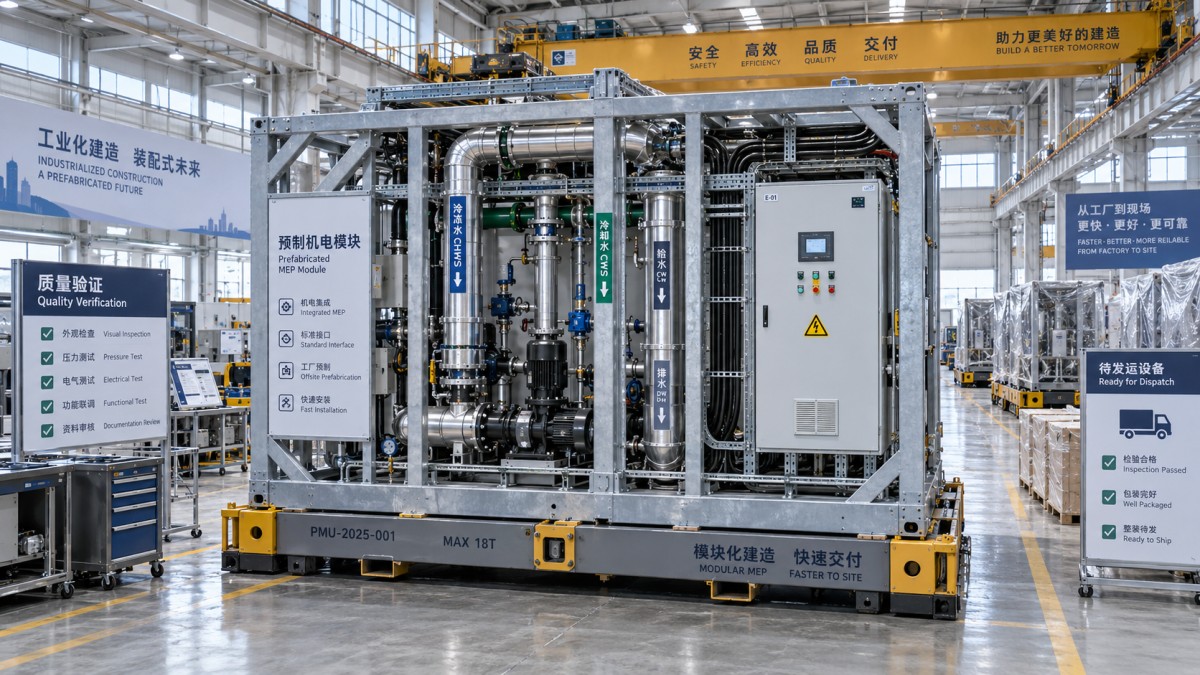
Prefabricated solutions reduce risk most clearly when work can be standardized before construction starts. Structural components, bathroom pods, mechanical skids, electrical rooms, façade panels, utility corridors, rail-system assemblies, and equipment enclosures are common examples. These are not interchangeable products; their risk profile depends on design maturity, factory capability, logistics, and installation sequencing.
The key distinction is control. In a factory, teams can use repeatable jigs, protected storage, fixed workflows, planned quality gates, and more stable labor deployment. On site, the same work may be exposed to rain, temperature variation, access restrictions, overlapping trades, and shifting priorities. When those field conditions are likely to affect a critical path, off-site fabrication can become a risk-control measure rather than simply a productivity initiative.
This matters across infrastructure, smart buildings, mining facilities, railway assets, and specialized equipment programs. A prefabricated electrical or controls room, for example, may simplify commissioning if cable routes, equipment interfaces, testing responsibilities, and installation tolerances are resolved before shipment. If they are not, the same module can concentrate problems in one difficult-to-correct package.
The strongest case is usually schedule certainty, not headline speed
Prefabrication is often presented as a faster way to build. That can be true, but “faster” is too broad to guide an investment decision. The more relevant question is whether off-site work can proceed in parallel with foundations, enabling works, procurement, or site preparation. Parallel activity can compress the overall program when interfaces are ready at the required time.
For a project with a fixed operational deadline, the value may lie in reducing schedule variance rather than reducing the planned duration. A rail maintenance facility, data-intensive urban utility asset, processing plant expansion, or smart-building retrofit may face substantial commercial consequences if access windows are missed. In such cases, a package that arrives tested, documented, and ready for connection may carry less project risk than a sequence of site tasks dependent on scarce labor and short possession periods.
However, schedule certainty only exists if the factory schedule is real. Decision-makers should examine production capacity, committed slots, material lead times, inspection hold points, shipping windows, and recovery options if a component fails quality checks. “Off-site” is not a schedule guarantee. It is a different supply chain, and it must be managed with the same discipline applied to major equipment procurement.
Where prefabricated solutions typically change the risk profile
The table also shows why a simple cost comparison is insufficient. A site-built estimate may appear lower because it treats coordination, delayed access, rework, weather standby, and temporary works as manageable contingencies. A prefabricated package may appear higher because design coordination, engineering, factory testing, and logistics are visible earlier. Decision-makers should compare the expected cost of risk, not just the initial price of each delivery method.
Design maturity is the dividing line
The biggest misconception about prefabrication is that it solves late design. It usually does the opposite: it makes incomplete decisions more expensive sooner. Once components enter production, changes may disrupt drawings, procurement, manufacturing sequences, testing records, transport plans, and installation logic. The earlier a project freezes an interface, the more confidently a manufacturer can build around it.
This does not mean every detail must be finalized before procurement. It means the elements that govern fit, performance, connection, lifting, and service access must be resolved to an appropriate level. For a modular mechanical or electrical assembly, that typically includes incoming and outgoing services, structural support points, fire and acoustic requirements where relevant, controls architecture, access clearances, and responsibility for final commissioning.
A digital model can help, but it is not a substitute for accountable decisions. The useful question is not whether the project has BIM or a digital twin environment. It is whether the model has been used to confirm tolerances, installation sequence, asset information, and ownership of interface clashes. The same principle applies to smart-city systems, rail signaling equipment, processing skids, and intelligent heavy machinery: data continuity is valuable only when it supports a clear physical handover.
Logistics can erase the advantage if it is treated as an afterthought
A module that is easy to manufacture may be difficult to move. Dimensions, mass, center of gravity, lifting points, route clearances, border procedures, storage conditions, and final-site handling all need attention early. In remote mining operations, constrained city centers, rail corridors, and industrial shutdowns, the delivery plan may become as important as the fabrication plan.
Leaders should ask for an installation-led review before committing to module size. Can the asset be unloaded safely? Is there room for a crane and exclusion zone? Does the sequence permit the module to be set without blocking later work? Can it be protected between delivery and connection? These questions sound operational, but they often determine whether prefabricated solutions reduce site risk or merely relocate it to the final mile.
There is also a resilience issue. A site-built method may source certain materials locally and adjust around shortages. Factory production can be more exposed to a small number of specialized suppliers. Procurement teams should therefore identify single-source components, approved substitutions, traceability needs, and the consequences of a missed delivery before treating factory output as inherently secure.
Quality improves when acceptance is planned, not assumed
Controlled manufacturing can improve consistency, but quality is not transferred automatically with the work package. The client, designer, contractor, manufacturer, and commissioning team need a shared definition of completion. Is a unit considered complete after factory assembly, after factory acceptance testing, after site connection, or only after integrated system performance has been demonstrated?
This is especially important for assets that combine physical infrastructure with controls, sensors, communications, or safety systems. A prefabricated enclosure may be mechanically complete while its operational function remains unproven. Inspection and test plans should identify what can be verified at the factory, what must wait for site conditions, which records transfer with the asset, and who closes defects discovered after installation.
The GIUT perspective across construction, urban technology, mining, railways, and special-purpose equipment is useful here: complex projects fail at boundaries more often than within individual disciplines. The physical component, operating data, maintenance workflow, power supply, communications network, and regulatory obligations must meet at the same interface. Prefabrication can make that boundary more visible earlier—which is an advantage if the project acts on it.
A practical decision test before selecting the delivery method
Before approving an off-site strategy, project sponsors should challenge the proposal through a small set of direct questions:
- Which field risks are being removed, and which are simply being transferred to design, manufacturing, or logistics?
- Are the critical interfaces sufficiently defined to release production without creating a large change exposure?
- What evidence will confirm quality before shipment, at installation, and during final commissioning?
- Can the site receive, lift, connect, inspect, and maintain the finished assembly under real operating constraints?
- If factory output is delayed, what are the contractual, scheduling, and technical recovery paths?
If these answers remain vague, the project may be buying apparent certainty rather than actual control. If they are specific, assigned, and reflected in the master schedule, prefabrication may offer a materially lower-risk route than assembling the same scope on site.
Choose prefabrication where it supports the operating model
The best prefabricated solutions are not selected because they look modern or because modular construction is a corporate objective. They are selected because they fit the asset’s lifecycle: how it will be installed, inspected, operated, expanded, repaired, and eventually upgraded. This is particularly relevant where infrastructure is becoming more connected and data-dependent. Physical standardization can simplify future asset management, but only if documentation and interface information remain usable after handover.
For decision-makers, the next step is to assess the candidate package against the actual project constraints: design maturity, schedule exposure, workforce availability, logistics, testing requirements, and long-term service access. That evaluation is more valuable than a generic claim that off-site construction is better. Prefabrication delivers lower project risk when it turns uncertain field work into a controlled, verifiable, and installable process—without creating a more fragile chain somewhere else.
Questions about this sector or your project? Contact Sector Deep Dive for expert insights.
We respect your privacy. Your information is strictly confidential.
Get weekly intelligence in your inbox.
No noise. No sponsored content. Pure intelligence.
News Recommendations
 Oct 12, 2026How to check joint fit in prefabricated construction quality assuranceHow to check joint fit in prefabricated construction quality assurance
 Oct 08, 2026When Prefabricated Solutions Deliver Lower Project Risk Than Site-Built MethodsWhen Prefabricated Solutions Deliver Lower Project Risk Than Site-Built Methods
 Oct 08, 2026What QA Records and Documentation Should Accompany Prefab Assemblies?What QA Records and Documentation Should Accompany Prefab Assemblies?
 Jul 23, 2026How to Evaluate a Prefab Construction Technology Platform for Project DeliveryHow to Evaluate a Prefab Construction Technology Platform for Project Delivery
 Jul 03, 2026Modular Construction Systems: Key Factors for Faster Project DeliveryModular Construction Systems: Key Factors for Faster Project Delivery
![]() Jun 09, 2026Prefabricated Construction Cost: What Drives the Budget?Prefabricated Construction Cost: What Drives the Budget?
 Jun 05, 20262026 Prefabricated Construction Cost: What Drives Budget Overruns?2026 Prefabricated Construction Cost: What Drives Budget Overruns?
![]() Jun 04, 2026Prefabricated Construction Cost in 2026: What Drives Budget Overruns?Prefabricated Construction Cost in 2026: What Drives Budget Overruns?
 May 22, 2026Prefabricated Construction Techniques That Save TimePrefabricated Construction Techniques That Save Time
 May 21, 2026Prefabricated Construction Benefits: Faster Builds, Fewer Site RisksPrefabricated Construction Benefits: Faster Builds, Fewer Site Risks
 May 20, 2026Prefabricated Construction Cost: What Affects ROI MostPrefabricated Construction Cost: What Affects ROI Most
 May 15, 2026Prefabricated Construction Quality Control ChecklistPrefabricated Construction Quality Control Checklist
 Apr 27, 2026Who benefits most from prefabricated construction techniques?Who benefits most from prefabricated construction techniques?
 Apr 27, 2026Which prefabricated construction techniques save the most labor?Which prefabricated construction techniques save the most labor?





