PVC Sheet Pile Standards Guide: What Civil Engineering Buyers Should Verify Before Approving a Project Material
For contractors, municipal project owners, waterfront developers, and procurement teams, sheet pile selection is no longer a matter of comparing only material price and delivery time. When a project team evaluates PVC Sheet Pile, the decision should include engineering documentation, material traceability, profile geometry, interlock quality, installation method, soil and water exposure, long-term deformation risk, and the approval requirements of the destination project. A material that looks acceptable in a product photo may still create problems if the technical documents are incomplete or if the profile is not matched to the site condition.
This standards-focused guide is written for buyers who need to approve polymer sheet piling for retaining, water-stopping, revetment, temporary works, small marine structures, flood-control channels, wastewater areas, and landscape infrastructure. It does not replace a project engineer's calculation, but it gives procurement and technical teams a clearer checklist for supplier evaluation. In civil engineering, a sheet pile is not only a purchased product. It becomes part of a soil-water-structure system, so the purchase file should be strong enough to support design review, site installation, inspection, and future maintenance.
Why Standards Thinking Matters in Sheet Pile Procurement
Polymer sheet piling is often selected because it resists corrosion, has lower handling weight than many metallic alternatives, and can suit water-contact or chemically mild environments where conventional steel may require extra coating or maintenance. Those advantages are useful, but they do not remove the need for engineering discipline. The buyer still needs to confirm whether the supplied profile has adequate section properties, whether interlocks can form a continuous wall, whether material properties are documented, and whether the supplier can provide consistent quality across the full order.
Standards thinking helps buyers avoid vague claims. Instead of accepting broad statements such as "suitable for water projects" or "high strength material," procurement teams should ask for measurable information. This includes profile drawing, wall thickness, section modulus, moment of inertia, tensile properties, impact behavior, UV stabilization information where relevant, and recommended installation guidance. The more the order depends on site performance, the more the buyer should require written technical support.
Material Documentation Buyers Should Request
The first step is to confirm what the material is and how it is controlled. Sheet piles made primarily from polyvinyl chloride are produced through extrusion, and performance depends on resin quality, additives, processing consistency, and profile design. Buyers should request a product data sheet rather than only a catalog page. The data sheet should identify key material properties, physical dimensions, and intended application conditions.
For public or engineered projects, it may also be necessary to request test reports or declarations that align with the project's specification language. The exact documents depend on the country, owner, and project type. A small landscape waterway may require a simpler file than a flood-control or marine retaining project. Still, even basic procurement should include enough information for the site engineer to confirm that the profile can be reviewed against design needs.
Profile Geometry and Interlock Quality
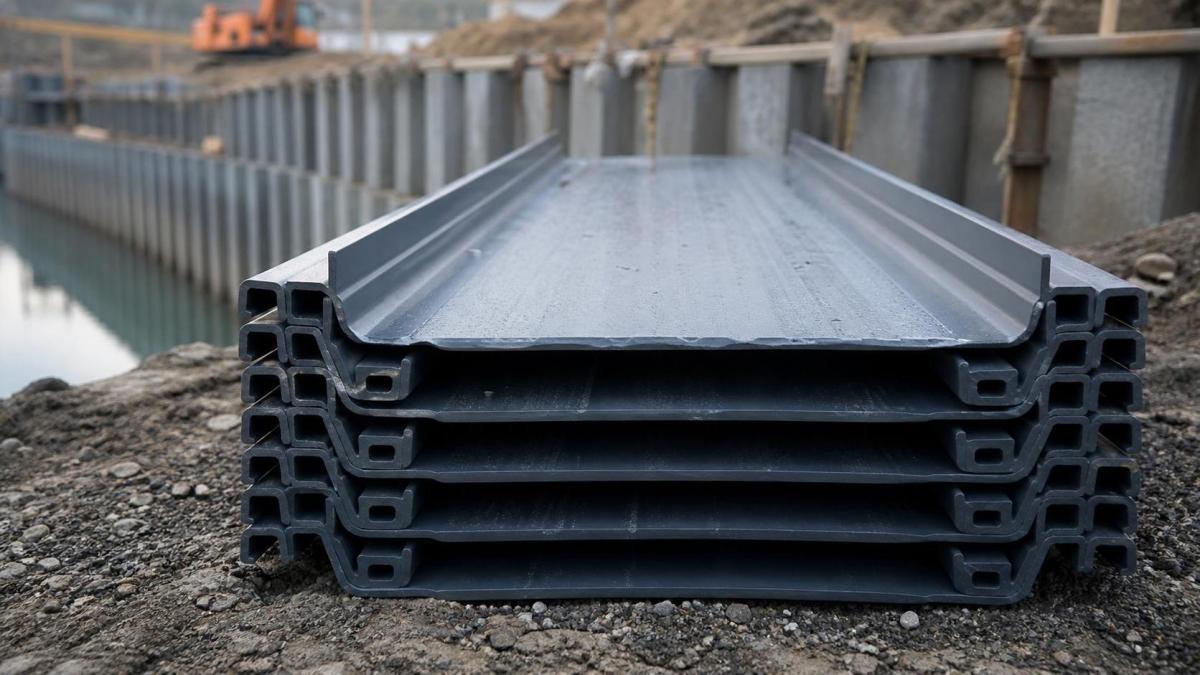
Profile geometry is central to performance. Buyers should review the section shape, effective width, depth, thickness, and interlock design. The purpose of an interlock is to create a continuous barrier or retaining line, but field performance depends on manufacturing tolerance and installation control. If the interlock is too loose, water-tightness and alignment may suffer. If it is too tight, installation may become difficult, especially on long runs or in soils that resist driving.
The supplier should provide clear drawings so the project team can calculate quantities and plan corners, transitions, terminations, and connection details. In many projects, the problem is not the straight wall section but the interface with existing structures, drainage features, anchors, caps, or return walls. A buyer who only orders linear meters without reviewing connection details may face site modifications later.
Site Conditions: Soil, Water, and Loading
Material approval should always be linked to site condition. A light-duty water channel, temporary excavation support, and waterfront retaining wall place different demands on the pile wall. Buyers should share soil type, groundwater condition, expected exposed height, retained soil height, surcharge loads, flow conditions, and whether the wall will be permanent or temporary. Without this information, a supplier can only provide general recommendations.
Polymer profiles are commonly valued for corrosion resistance, but corrosion is not the only engineering issue. Soil pressure, impact from floating debris, installation damage, long-term deflection, ultraviolet exposure, temperature variation, and connection loads can all influence service life. The buyer should confirm that the profile is being selected for the actual load case rather than for a generic application description.
Installation Method and Construction Control
Installation quality can decide whether a technically suitable product performs well. Depending on the site, sheet piles may be installed by vibratory equipment, pressing methods, water jetting support, or other local practices. Buyers should ask the supplier for handling and installation guidance before the order is shipped, especially when the contractor has limited experience with polymer sheet piling.
Important installation topics include storage on site, lifting method, alignment control, driving cap use, protection against impact damage, and checking interlock engagement. Long sheets should be supported to avoid bending during handling. Bundles should be stored on level supports and protected from unnecessary deformation before installation. If the site team treats the material like a generic plastic board, damage can occur before the wall is even built.
Compliance Without Invented Certifications
Buyers often ask suppliers whether a product is "certified," but that question is incomplete unless the project specification identifies the required standard, test method, or approval body. For many civil materials, compliance is project-specific. A supplier may provide test reports, quality declarations, drawings, and production records, while the final acceptance depends on the designer, contractor, owner, or local authority.
To avoid misunderstanding, procurement teams should ask three practical questions. First, what standard or test method is required by the project documents? Second, can the supplier provide documents that match those requirements? Third, who is responsible for final engineering approval in the destination market? This approach prevents both overclaiming and under-documentation. It also protects buyers from accepting impressive but irrelevant certificates.
Inspection Before Shipment and After Arrival
Inspection should cover both documents and physical goods. Before shipment, buyers can request production photos, bundle markings, packing lists, and profile dimension checks. For larger orders, a third-party inspection may be appropriate. After arrival, receiving teams should inspect visible damage, count bundles, verify markings, check a sample of dimensions, and confirm that interlocks are clean and usable.
Because sheet piles are long profiles, transport handling matters. Poor bundling or rough loading can bend or scratch profiles and create site delays. Packaging should protect the interlocks and allow safe unloading. If a project has a tight installation schedule, the receiving inspection should happen immediately so any discrepancy can be addressed before the contractor mobilizes equipment.
How Buyers Can Compare Suppliers Fairly
Supplier comparison should use the same technical assumptions for every quotation. If one supplier quotes a thicker profile with more complete documentation and another quotes a lighter profile with limited data, the lower price may not represent the same project value. Buyers should normalize the comparison by profile size, effective wall width, material grade or formulation information, section properties, packing method, document availability, and technical support.
Communication quality is also part of the decision. A supplier that can answer engineering questions clearly, provide drawings promptly, and explain installation limits reduces project risk. For infrastructure buyers, the best supplier is not only a seller of material. It is a documentation and coordination partner during procurement, shipping, installation, and post-delivery review.
Recommended Approval Checklist
- Confirm project application: retaining, water-stopping, revetment, temporary works, or channel protection.
- Request profile drawings with effective width, thickness, depth, interlock shape, and tolerances.
- Ask for material property documentation and clarify which test methods are relevant to the project.
- Review soil, water, exposure, and loading assumptions with the project engineer before final selection.
- Confirm installation guidance, handling precautions, and whether local equipment is suitable.
- Set inspection points for production, packing, shipment, arrival, and pre-installation storage.
- Keep batch records and supplier documents with the project handover file.
FAQ
Can polymer sheet piling replace steel in every project?
No. It can be a strong option for many corrosion-sensitive or moderate-load applications, but final selection depends on soil pressure, exposed height, impact risk, design life, installation method, and the project engineer's review.
What is the most important document before placing an order?
The profile drawing and product data sheet are usually the starting point. They allow the buyer and engineer to confirm geometry, section properties, material information, and suitability for the intended application.
Should buyers require third-party testing?
It depends on project size, owner requirements, and risk level. For larger public or engineered works, third-party inspection or testing may be useful. For smaller projects, supplier documents and incoming inspection may be enough if accepted by the project team.
Why does installation guidance matter so much?
Even a suitable profile can be damaged by poor handling, incorrect driving methods, bad alignment, or unsupported storage. Installation guidance helps contractors protect interlocks and maintain wall continuity.
Final Engineering Perspective
Sheet pile procurement works best when buyers treat the product as an engineered system rather than a simple commodity. The right approval file should connect material properties, profile geometry, site conditions, installation method, inspection records, and project acceptance requirements. By requesting clear documentation and comparing suppliers on technical evidence, civil engineering buyers can reduce approval delays, avoid unsuitable substitutions, and build a stronger basis for long-term project performance.
Editorial Review Note
This article is buyer-facing guidance for civil engineering material selection. It avoids fabricated prices, unsupported market statistics, invented certifications, and fake case numbers. Final upload should be checked against the destination portal's house style, category setup, and project-specific compliance wording.
Get weekly intelligence in your inbox.
No noise. No sponsored content. Pure intelligence.
News Recommendations
 Sep 19, 2026How an electronics application guide helps prevent component mismatchHow an electronics application guide helps prevent component mismatch
 Sep 18, 2026When a resource allocation platform improves project deliveryWhen a resource allocation platform improves project delivery
 Sep 17, 2026What to compare when evaluating mineral processing equipment manufacturersWhat to compare when evaluating mineral processing equipment manufacturers
 Sep 16, 2026How mineral separation optimization can reduce concentrate lossesHow mineral separation optimization can reduce concentrate losses
 Sep 15, 2026How to assess lifecycle costs in urban tech procurementHow to assess lifecycle costs in urban tech procurement
 Sep 14, 2026Heavy industry technology trends reshaping capital investment prioritiesHeavy industry technology trends reshaping capital investment priorities
 Sep 14, 2026Global Industrial Equipment Procurement: How Top OEMs Qualify Suppliers for Mining & Infrastructure ProjectsGlobal Industrial Equipment Procurement: How Top OEMs Qualify Suppliers for Mining & Infrastructure Projects
 Sep 14, 2026Industrial & Mining Equipment Procurement: Balancing Local Sourcing, Lead Time, and Certification RequirementsIndustrial & Mining Equipment Procurement: Balancing Local Sourcing, Lead Time, and Certification Requirements
 Sep 14, 2026Infrastructure & Equipment Upgrades: What Procurement Teams Must Verify Before Signing Off on New ContractsInfrastructure & Equipment Upgrades: What Procurement Teams Must Verify Before Signing Off on New Contracts
 Sep 14, 2026Why Infrastructure Equipment Buyers Are Shifting from Catalog-Based to Capability-Based Supplier SelectionWhy Infrastructure Equipment Buyers Are Shifting from Catalog-Based to Capability-Based Supplier Selection
 Sep 14, 2026Process Automation Project Execution: How to Align Supplier Capabilities with PLC Integration, Cybersecurity & Commissioning MilestonesProcess Automation Project Execution: How to Align Supplier Capabilities with PLC Integration, Cybersecurity & Commissioning Milestones
 Sep 14, 2026Are intelligent traffic systems worth the investment for small cities?Are intelligent traffic systems worth the investment for small cities?
 Sep 14, 2026How do intelligent traffic systems handle sensor failures?How do intelligent traffic systems handle sensor failures?
 Sep 14, 2026What should I check before accepting a smart building system?What should I check before accepting a smart building system?
 Sep 14, 2026Is a smart building system worth the maintenance cost?Is a smart building system worth the maintenance cost?
 Sep 14, 2026What data is needed for reliable resource allocation planning?What data is needed for reliable resource allocation planning?
 Sep 14, 2026How can resource allocation software reduce equipment idle time?How can resource allocation software reduce equipment idle time?
 Sep 14, 2026How should smart devices be maintained in harsh outdoor conditions?How should smart devices be maintained in harsh outdoor conditions?
 Sep 14, 2026Do smart devices improve worker safety on construction sites?Do smart devices improve worker safety on construction sites?
 Sep 14, 2026What environmental risks must be assessed before deep-sea mining?What environmental risks must be assessed before deep-sea mining?
 Sep 14, 2026Is deep-sea mining equipment commercially viable in 2026?Is deep-sea mining equipment commercially viable in 2026?
 Sep 14, 2026What Inspection Checks Should Procurement Teams Perform Before Ordering Dredging Equipment in 2026?What Inspection Checks Should Procurement Teams Perform Before Ordering Dredging Equipment in 2026?
 Sep 13, 2026How to verify an industrial product information source before specifying equipmentHow to verify an industrial product information source before specifying equipment
 Sep 12, 2026Which intelligent traffic systems hardware fits an urban intersection?Which intelligent traffic systems hardware fits an urban intersection?
 Sep 11, 2026How pump capacity affects response coverage for municipal fire fighting vehiclesHow pump capacity affects response coverage for municipal fire fighting vehicles
 Sep 10, 2026What to verify before choosing a heavy industry equipment supplierWhat to verify before choosing a heavy industry equipment supplier
 Sep 09, 2026When do adaptive urban traffic control systems reduce corridor delays?When do adaptive urban traffic control systems reduce corridor delays?