Steel and Concrete: How to Balance Strength and Cost
In infrastructure planning, choosing between steel and concrete is rarely a simple material decision—it is a strategic balance of structural performance, lifecycle cost, constructability, and project risk. For technical evaluators, understanding how steel and concrete interact under different load, budget, and durability demands is essential to making informed, value-driven decisions.
For most projects, the best answer is not whether steel or concrete is universally superior. The real question is which material system delivers the required strength, service life, construction speed, and cost certainty under specific project conditions.
Technical evaluators are usually asked to translate engineering complexity into a defensible recommendation. That means comparing not only initial material prices, but also span efficiency, foundation impact, maintenance exposure, labor intensity, schedule sensitivity, and long-term operational risk.
In practice, steel and concrete often compete on paper but complement each other in built infrastructure. The most cost-effective solution may be structural steel for long spans, reinforced concrete for mass and durability, or a composite system that captures advantages from both.
What Technical Evaluators Need to Judge First
Before comparing rates per ton or cubic meter, evaluators should define the project’s true performance drivers. These usually include load demand, span length, site constraints, fire rating, corrosion exposure, vibration limits, and required completion date.
A low unit cost does not guarantee a low project cost. A cheaper material can trigger larger foundations, slower erection, higher transport complexity, or more maintenance, which can erase apparent savings during construction or operation.
The most useful early-stage question is this: what is the cost of achieving the required performance? That framing shifts the discussion away from raw material pricing and toward total structural value.
For example, in a warehouse with long clear spans and fast delivery requirements, steel may reduce column count and shorten the program. In a water treatment structure, concrete may provide better durability and lower lifecycle protection costs.
Strength Is Not Just About Capacity
When people discuss steel and concrete, “strength” is often reduced to a simple comparison. In technical evaluation, however, strength includes capacity, stiffness, ductility, fatigue behavior, resilience, and how a system performs under real loading scenarios.
Steel offers high strength-to-weight ratio, making it highly efficient for tall buildings, bridges, industrial frames, and structures requiring long spans. Because it is lighter, steel can also reduce foundation loads, which may matter on weak soils.
Concrete, especially reinforced or prestressed concrete, performs well in compression and provides mass, rigidity, and inherent fire resistance. It is often advantageous where deflection control, durability, vibration damping, or robust enclosure performance are priorities.
Technical evaluators should therefore avoid comparing materials in isolation. They must compare structural systems. A steel frame, a reinforced concrete frame, and a composite deck system solve loads differently and create different cost patterns across the project.
Another important factor is redundancy and failure mode. Steel tends to provide ductile behavior and visible deformation before failure, which can be beneficial in seismic or dynamic conditions. Concrete can be very durable but requires careful detailing to avoid cracking, corrosion, and hidden deterioration.
How to Compare Cost Without Oversimplifying
Initial cost comparisons between steel and concrete are often distorted by incomplete scope definitions. A proper evaluation should include material supply, fabrication, transport, erection, temporary works, foundations, fire protection, finishes, and construction overhead.
Steel pricing can fluctuate significantly with global commodity markets, energy costs, and fabrication demand. Concrete costs may appear more stable, but they are also affected by cement prices, admixtures, reinforcement content, formwork, and local labor availability.
Labor and schedule frequently change the result. Steel can be prefabricated off-site and erected quickly, reducing on-site congestion and shortening program risk. Concrete may require longer curing, more formwork cycles, and tighter weather management.
Foundation cost should never be ignored. Because steel structures are lighter, they can reduce footing sizes or pile demand. On poor ground or urban sites with expensive substructure work, this secondary effect can materially improve steel’s cost position.
At the same time, concrete can reduce finishing and protection requirements in some applications. Exposed structural concrete may serve both structural and architectural roles, while steel may require added fireproofing, coatings, or cladding depending on code and environment.
Evaluators should also separate direct cost from cost certainty. A solution with a slightly higher bid price may still be better if it reduces schedule exposure, procurement risk, interface complexity, or maintenance uncertainty.
Lifecycle Cost Is Often the Deciding Factor
For technical evaluators working on public infrastructure, transport nodes, plants, and long-life civic assets, lifecycle cost usually matters more than headline construction cost. This is where steel and concrete require a more disciplined comparison.
Steel structures may need periodic inspection, repainting, corrosion management, and fire protection maintenance depending on environment and use. In aggressive marine, industrial, or humid settings, protective system performance becomes central to long-term cost.
Concrete structures can appear low-maintenance, but durability failures are expensive when they occur. Chloride ingress, carbonation, freeze-thaw damage, alkali-silica reaction, and reinforcement corrosion can create major rehabilitation costs if specifications or workmanship are weak.
The right choice depends on exposure category and maintenance strategy. If a project owner has strong asset management capability, steel may remain attractive. If long-term maintenance access is difficult, a durable concrete solution may be more practical.
Service life modeling should include inspection intervals, repair cycles, downtime implications, and residual value. For transport infrastructure or industrial facilities, disruption cost can exceed the repair cost itself, making durability and maintainability critical selection factors.
Project Conditions That Often Favor Steel
Steel tends to be favored when projects require long spans, lighter dead load, rapid erection, future modification, or high prefabrication content. These conditions are common in logistics centers, stations, airports, factories, and complex urban retrofits.
It is also advantageous where site access is constrained and on-site wet trades need to be minimized. Off-site fabrication can improve quality control and reduce neighborhood disruption, which is increasingly important in dense city environments.
For vertical expansion or rooftop additions, steel’s lower self-weight can reduce strengthening needs in the existing structure. This can make adaptive reuse projects more feasible both technically and financially.
In seismic regions, well-detailed steel systems may provide desirable ductility and energy dissipation. However, connection design, fabrication quality, and erection precision become essential to achieving the expected performance.
Project Conditions That Often Favor Concrete
Concrete is often the stronger option when durability, mass, fire resistance, acoustic separation, and robust enclosure performance are key. It remains highly competitive for basements, retaining systems, cores, water structures, tunnels, and heavy civil works.
Where local supply chains strongly favor cementitious construction and labor is familiar with cast-in-place methods, concrete may offer better cost control. In some markets, this advantage is structural, not temporary.
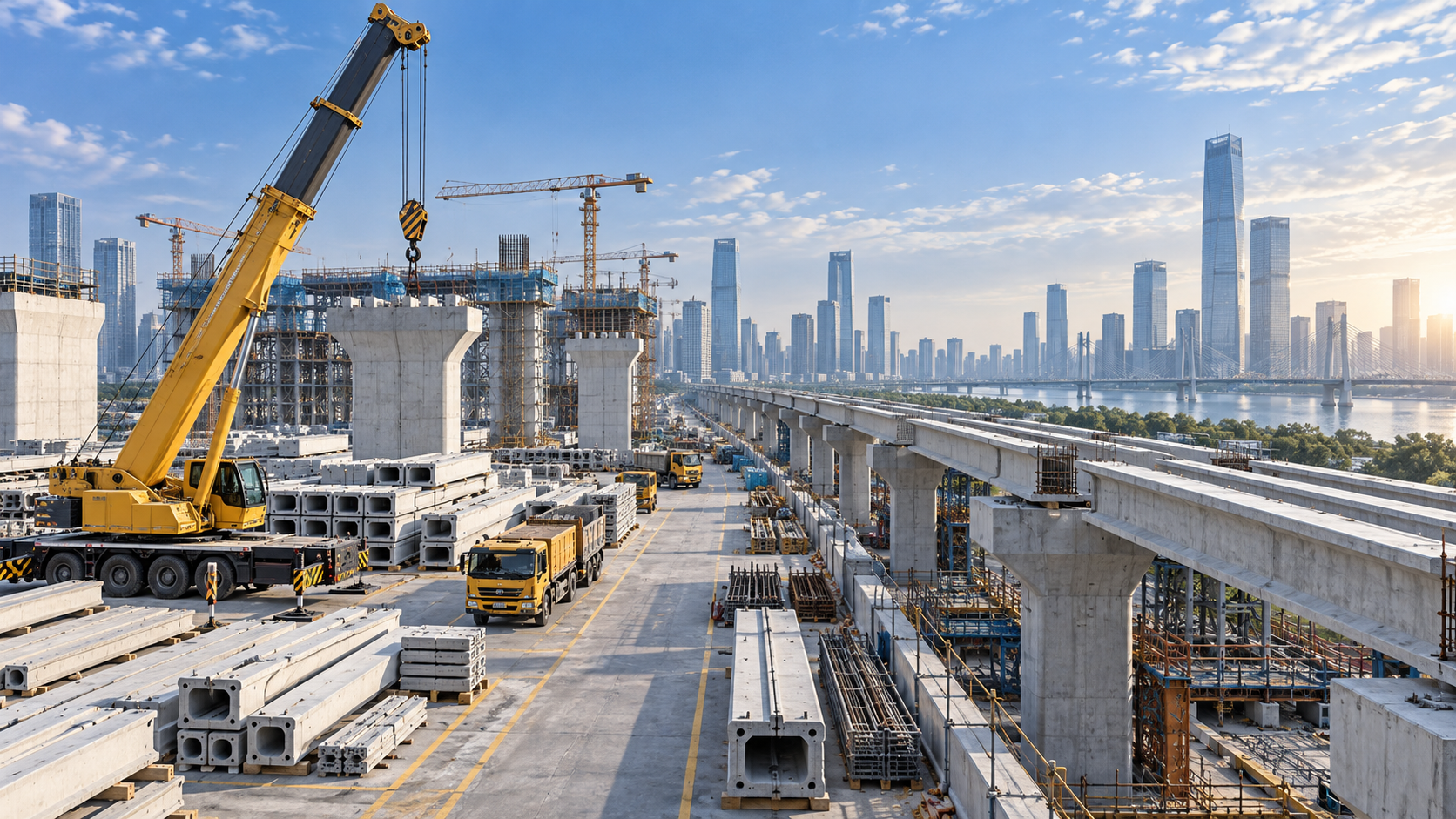
Concrete can also perform well in projects with repetitive geometry, especially when formwork cycles are optimized or precast elements are used. Precast concrete can narrow the schedule gap with steel while preserving durability and stiffness benefits.
For infrastructure exposed to impact, moisture, and demanding service conditions, concrete’s inherent mass and resistance profile may simplify long-term protection strategies. That is one reason it remains dominant in many public works applications.
Why Composite Solutions Often Deliver the Best Balance
Many of the strongest project outcomes do not come from choosing steel or concrete exclusively. Composite systems frequently provide the best balance of strength and cost by assigning each material to the role it performs most efficiently.
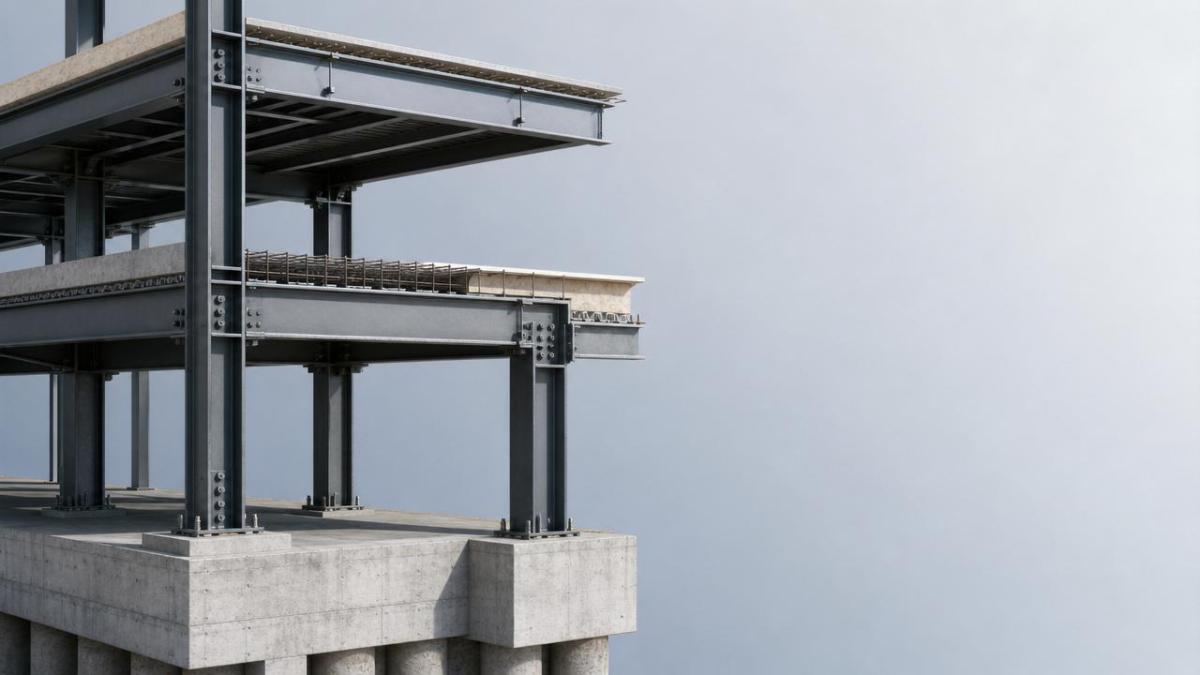
Examples include steel beams with concrete slabs, concrete cores with steel perimeter framing, or prestressed concrete elements paired with steel connectors and support frames. These systems can improve span capability, construction speed, and overall material efficiency.
Composite approaches can also reduce embodied carbon when optimized properly, because they avoid overdesign in either material. For evaluators, this matters as carbon reporting increasingly becomes part of capital approval and procurement scoring.
The tradeoff is coordination complexity. Composite systems require close attention to interfaces, tolerances, connection sequencing, and contractor capability. A theoretically efficient design can lose value if the delivery team lacks execution experience.
A Practical Evaluation Framework for Decision-Making
For technical evaluators, a useful decision model starts with six weighted criteria: structural performance, capital cost, construction speed, lifecycle cost, risk exposure, and adaptability. Projects can then compare steel and concrete against the same business and engineering objectives.
First, define the governing constraints. Is the project controlled by span, floor loading, vibration, corrosion, seismic demand, or delivery date? If one condition dominates, it often narrows the viable structural options quickly.
Second, estimate total installed cost instead of material-only cost. Include secondary steel, reinforcement density, formwork, fireproofing, coatings, cranage, transport, curing time, and temporary works. Many poor decisions begin with partial scope pricing.
Third, test lifecycle assumptions. What inspections are required? How difficult is access? What is the cost of shutdown during repair? Which failure modes are most probable in the project environment? This step often changes the recommendation.
Fourth, assess market readiness. The best technical option on paper may not be the best commercial option if local fabricators, precast suppliers, or specialist contractors are limited. Supply-chain maturity directly affects cost, quality, and schedule reliability.
Finally, document sensitivity. If steel price rises by ten percent, does the recommendation change? If schedule compression becomes critical, does steel gain value? If the exposure class becomes more severe, does concrete become preferable? Sensitivity analysis creates defensible decisions.
Common Mistakes in Steel and Concrete Comparisons
One common mistake is comparing steel and concrete using only first cost per square meter. This ignores structural depth, span efficiency, erection method, and downstream effects on building services, facade design, and usable space.
Another mistake is treating durability as automatic. Neither material is inherently low-risk without correct detailing, specification, and quality control. Poor drainage, weak cover design, bad coating systems, or uncontrolled cracking can undermine any material strategy.
Evaluators also sometimes underestimate schedule value. A faster structure can accelerate revenue, reduce financing pressure, and lower disruption to adjacent operations. In commercial or transport projects, time can be as important as direct construction cost.
The last major error is ignoring future flexibility. Steel may support easier modifications, while concrete may better support mass and permanence. The right answer depends on whether the asset is expected to evolve, expand, or remain fixed for decades.
Conclusion: Balance Performance, Cost, and Risk—Not Just Materials
The decision between steel and concrete should never be reduced to a simple strength-versus-price debate. For technical evaluators, the real task is to identify which structural system delivers required performance with the best total value across construction and service life.
Steel often wins where long spans, speed, low weight, and adaptability matter most. Concrete often wins where durability, mass, fire resistance, and civil robustness define project success. Composite systems frequently outperform both when properly detailed and delivered.
The most reliable evaluation method is therefore holistic: define performance requirements, calculate installed and lifecycle cost, test project risks, and account for local delivery capability. When that framework is applied well, balancing steel and concrete becomes a strategic decision rather than a material argument.
For infrastructure and urban development teams, that shift in perspective leads to better capital allocation, stronger asset resilience, and more defensible engineering outcomes. In the end, the best balance of steel and concrete is the one that fits the project, not the market cliché.
Get weekly intelligence in your inbox.
No noise. No sponsored content. Pure intelligence.
News Recommendations
 Sep 19, 2026How an electronics application guide helps prevent component mismatchHow an electronics application guide helps prevent component mismatch
 Sep 18, 2026When a resource allocation platform improves project deliveryWhen a resource allocation platform improves project delivery
 Sep 17, 2026What to compare when evaluating mineral processing equipment manufacturersWhat to compare when evaluating mineral processing equipment manufacturers
 Sep 16, 2026How mineral separation optimization can reduce concentrate lossesHow mineral separation optimization can reduce concentrate losses
 Sep 15, 2026How to assess lifecycle costs in urban tech procurementHow to assess lifecycle costs in urban tech procurement
 Sep 14, 2026Heavy industry technology trends reshaping capital investment prioritiesHeavy industry technology trends reshaping capital investment priorities
 Sep 14, 2026Global Industrial Equipment Procurement: How Top OEMs Qualify Suppliers for Mining & Infrastructure ProjectsGlobal Industrial Equipment Procurement: How Top OEMs Qualify Suppliers for Mining & Infrastructure Projects
 Sep 14, 2026Industrial & Mining Equipment Procurement: Balancing Local Sourcing, Lead Time, and Certification RequirementsIndustrial & Mining Equipment Procurement: Balancing Local Sourcing, Lead Time, and Certification Requirements
 Sep 14, 2026Infrastructure & Equipment Upgrades: What Procurement Teams Must Verify Before Signing Off on New ContractsInfrastructure & Equipment Upgrades: What Procurement Teams Must Verify Before Signing Off on New Contracts
 Sep 14, 2026Why Infrastructure Equipment Buyers Are Shifting from Catalog-Based to Capability-Based Supplier SelectionWhy Infrastructure Equipment Buyers Are Shifting from Catalog-Based to Capability-Based Supplier Selection
 Sep 14, 2026Process Automation Project Execution: How to Align Supplier Capabilities with PLC Integration, Cybersecurity & Commissioning MilestonesProcess Automation Project Execution: How to Align Supplier Capabilities with PLC Integration, Cybersecurity & Commissioning Milestones
 Sep 14, 2026Are intelligent traffic systems worth the investment for small cities?Are intelligent traffic systems worth the investment for small cities?
 Sep 14, 2026How do intelligent traffic systems handle sensor failures?How do intelligent traffic systems handle sensor failures?
 Sep 14, 2026What should I check before accepting a smart building system?What should I check before accepting a smart building system?
 Sep 14, 2026Is a smart building system worth the maintenance cost?Is a smart building system worth the maintenance cost?
 Sep 14, 2026What data is needed for reliable resource allocation planning?What data is needed for reliable resource allocation planning?
 Sep 14, 2026How can resource allocation software reduce equipment idle time?How can resource allocation software reduce equipment idle time?
 Sep 14, 2026How should smart devices be maintained in harsh outdoor conditions?How should smart devices be maintained in harsh outdoor conditions?
 Sep 14, 2026Do smart devices improve worker safety on construction sites?Do smart devices improve worker safety on construction sites?
 Sep 14, 2026What environmental risks must be assessed before deep-sea mining?What environmental risks must be assessed before deep-sea mining?
 Sep 14, 2026Is deep-sea mining equipment commercially viable in 2026?Is deep-sea mining equipment commercially viable in 2026?
 Sep 14, 2026What Inspection Checks Should Procurement Teams Perform Before Ordering Dredging Equipment in 2026?What Inspection Checks Should Procurement Teams Perform Before Ordering Dredging Equipment in 2026?
 Sep 13, 2026How to verify an industrial product information source before specifying equipmentHow to verify an industrial product information source before specifying equipment
 Sep 12, 2026Which intelligent traffic systems hardware fits an urban intersection?Which intelligent traffic systems hardware fits an urban intersection?
 Sep 11, 2026How pump capacity affects response coverage for municipal fire fighting vehiclesHow pump capacity affects response coverage for municipal fire fighting vehicles
 Sep 10, 2026What to verify before choosing a heavy industry equipment supplierWhat to verify before choosing a heavy industry equipment supplier
 Sep 09, 2026When do adaptive urban traffic control systems reduce corridor delays?When do adaptive urban traffic control systems reduce corridor delays?