2026 Civil Engineering Solutions: Cost Risks to Check Early
In 2026, civil engineering solutions will be judged not only by technical performance but by how early they expose cost risks that can derail budgets, delay approvals, and weaken long-term returns. For financial decision-makers, identifying hidden variables in materials, labor, compliance, and lifecycle maintenance is essential to funding infrastructure projects with greater confidence, control, and strategic value.
What Financial Approvers Need to Know Before Backing Civil Engineering Solutions
When finance teams evaluate civil engineering solutions, the real question is rarely whether a design can be built. The real question is whether cost risk is visible early enough to protect capital.
In 2026, that distinction matters more than ever. Inflation volatility, labor shortages, carbon compliance, procurement delays, and lifecycle obligations can turn an acceptable budget into a stressed balance sheet.
For approval leaders, the strongest proposals are not the cheapest on paper. They are the options that quantify uncertainty, define cost triggers, and show how the project remains viable under changing conditions.
That means early-stage cost review must move beyond headline estimates. It should test assumptions, compare scenarios, and identify where engineering complexity could later become a funding problem.
Organizations that treat cost risk as a design input, not a post-bid surprise, tend to secure better vendor alignment, faster approvals, and stronger long-term asset performance.
What Is the Core Search Intent Behind “2026 Civil Engineering Solutions”?
The likely search intent is practical and evaluative. Readers are not looking for a basic definition of civil engineering solutions. They want to know which solutions are financially safer and how to assess them early.
For finance-oriented readers, this includes questions about budget reliability, hidden cost exposure, return on investment, operating burden, contract structure, and whether new methods actually reduce long-term spending.
They also want decision support. A useful article must help them distinguish between technically attractive proposals and financially disciplined ones, especially before procurement commitments become difficult to reverse.
That is why the most valuable content is not broad industry theory. It is a framework for checking early cost risks across design, materials, labor, regulation, delivery, and asset lifecycle planning.
The Biggest Cost Risks Often Appear Before Construction Starts
Many infrastructure overruns begin long before the first machine arrives on site. Early assumptions made during concept design, scope definition, and procurement planning often shape the entire financial outcome.
One common problem is incomplete scope maturity. If drainage interfaces, utility relocation, foundation conditions, or traffic management needs are underdefined, later revisions can trigger expensive change orders.
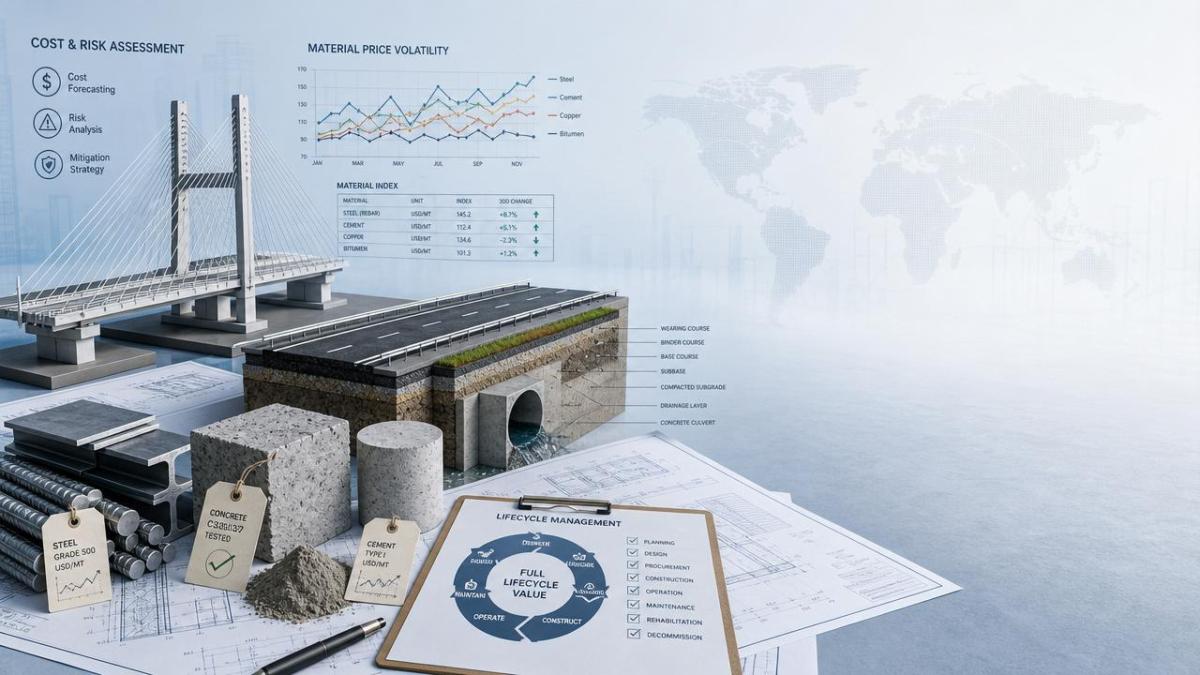
Another issue is unrealistic baseline pricing. A budget built on outdated supplier rates or stable logistics assumptions may fail quickly when steel, cement, fuel, or imported components move unpredictably.
Ground conditions are another high-impact blind spot. Geotechnical uncertainty can alter excavation methods, piling needs, dewatering requirements, and structural design, all of which affect direct and indirect costs.
Permitting timing also matters. Delays tied to environmental review, land access, emissions controls, or community mitigation can increase preliminaries, financing costs, and contractor claims without improving the final asset.
For financial approvers, early warning value comes from asking which project assumptions are still provisional, which are validated, and what contingency level is tied to each uncertainty category.
Material Price Exposure Should Be Reviewed as a Strategic Risk, Not a Procurement Detail
In 2026, material selection is no longer only an engineering choice. It is a major financial variable that affects capex certainty, schedule resilience, maintenance cost, and even future regulatory compliance.
Concrete mix design, structural steel specifications, prefabricated elements, piping systems, and imported electrical components each carry different exposure to inflation, energy prices, and supply chain disruption.
Financial approvers should ask whether the chosen civil engineering solutions depend on single-source materials, long-lead imports, or volatile commodity inputs that could undermine estimate reliability.
It is also important to examine substitution flexibility. If one material becomes unavailable or too expensive, can the design adapt without major redesign, testing delays, or new approval cycles?
Sustainable materials deserve extra scrutiny as well. Low-carbon alternatives may create reputational and regulatory benefits, but they should still be assessed for availability, installer familiarity, and performance risk.
A strong proposal presents not just quantities and unit rates, but also price sensitivity ranges, sourcing assumptions, escalation clauses, and fallback options if the supply market tightens.
Labor and Productivity Assumptions Can Quietly Distort the Entire Business Case
Labor risk is often underestimated because initial estimates focus on wage rates rather than productivity reality. Yet labor shortages, skill gaps, and site constraints can alter output far more than hourly pay changes.
For example, a project may appear affordable in estimate form, but still become expensive if specialized crews are scarce, overtime becomes necessary, or remote logistics reduce productive working hours.
Modern civil engineering solutions may promise efficiency through modular construction, digital layout tools, or automated monitoring. Finance teams should still test whether those efficiencies are proven in comparable environments.
Questions worth asking include: Has the contractor delivered this method before? Are training needs included? Is local labor capable of executing the design without heavy rework or dependence on external specialists?
Productivity assumptions should also reflect weather exposure, urban access limits, traffic staging, safety controls, and coordination with utilities or adjacent infrastructure. These factors directly influence labor efficiency and schedule cost.
If labor assumptions are weak, even a technically advanced solution can lose its financial advantage. That makes workforce realism a core part of early budget approval, not a downstream execution issue.
Compliance, Carbon, and Public-Sector Requirements Now Carry Real Budget Weight
Regulatory compliance is no longer a side note in project finance. In many markets, environmental, safety, accessibility, resilience, and carbon reporting obligations now carry material cost and schedule implications.
For civil engineering solutions in transport, urban, and utility projects, approval risk may depend on flood resilience standards, embodied carbon thresholds, waste handling protocols, and digital reporting obligations.
These requirements can affect design choices, documentation workloads, testing scope, construction methods, and approved supplier lists. If they are recognized late, the project may need expensive redesign or added mitigation.
Financial decision-makers should ask whether compliance costs are fully priced, whether policy changes are being monitored, and whether the delivery team has experience meeting the latest standards in practice.
This is particularly important for public-sector or mixed-funded projects, where oversight, auditability, community obligations, and social value requirements can create hidden administrative and contractual burdens.
The best proposals translate regulation into numbers. They show the budget impact of compliance pathways rather than simply stating that the project will meet all applicable rules.
Lifecycle Cost Matters More Than Low Entry Price
A low initial contract value can still produce weak asset economics if maintenance, downtime, energy use, inspection frequency, and rehabilitation costs are not understood from the start.
That is why financial approvers should evaluate civil engineering solutions through total cost of ownership, not just first-cost competitiveness. An asset that costs less to build may cost more to operate for decades.
Key variables include pavement durability, corrosion resistance, drainage performance, spare parts availability, access for inspection, digital monitoring capability, and ease of future upgrades.
For example, a cheaper drainage system may increase blockage risk and maintenance labor. A lower-cost structural detail may raise inspection difficulty and shorten intervention cycles over the asset lifespan.
Lifecycle visibility is especially important when budgets are approved centrally but maintenance is carried by another department. Without whole-life analysis, cost can simply be shifted rather than reduced.
Approvers should look for net present value models, maintenance interval assumptions, energy consumption scenarios, and sensitivity testing that connects design choices to long-term financial obligations.
How to Judge Whether a Proposal Is Financially Mature Enough for Approval
Finance teams do not need to validate every engineering detail themselves. They do need a disciplined way to test whether a proposal is ready for capital commitment.
First, review estimate maturity. Is the budget conceptual, preliminary, or construction-ready? A single number without a maturity label creates false confidence and weakens governance.
Second, separate base cost from contingency. Contingency should not be a vague buffer. It should be tied to identifiable risks such as ground uncertainty, procurement volatility, interface complexity, or approval timing.
Third, request scenario analysis. What happens if material prices rise ten percent, permitting slips by three months, or utility relocation proves more complex than expected? Serious teams can answer this clearly.
Fourth, evaluate contract strategy. Lump-sum, design-build, alliance, and framework models allocate risk differently. A low headline bid may conceal higher exposure if risk transfer is incomplete or unrealistic.
Fifth, check reporting capability. If the project cannot provide ongoing cost, schedule, and change visibility after approval, early confidence may quickly erode during execution.
Questions Financial Approvers Should Ask Before Signing Off
Several targeted questions can reveal whether a project team has truly understood cost risk. These questions often matter more than broad presentations or polished visuals.
Ask which three assumptions have the greatest budget sensitivity. If the team cannot answer, the estimate may be more fragile than it appears.
Ask what has been validated through market engagement and what remains theoretical. Supplier quotes, contractor feedback, and site investigations create a stronger basis than desk-based assumptions alone.
Ask how the design performs under maintenance and regulatory stress, not just construction stress. Many assets fail economically because operating burdens were overlooked during approval.
Ask what would force a scope change after approval. Hidden interfaces, land constraints, utility conflicts, stakeholder objections, and phased access issues are frequent causes of late cost escalation.
Finally, ask how digital tools are being used. Cost modeling, BIM coordination, digital twins, and predictive maintenance systems can improve certainty, but only if the data is decision-ready and updated consistently.
Why Better Early Risk Visibility Creates Strategic Value Beyond Cost Control
Early cost-risk visibility does more than prevent overruns. It improves the quality of capital allocation across the entire infrastructure portfolio.
When decision-makers can compare civil engineering solutions using consistent assumptions, they can prioritize projects with stronger resilience, better lifecycle economics, and lower exposure to disruption.
This also strengthens negotiations with contractors, consultants, and suppliers. A buyer that understands its cost drivers is less likely to accept weak contingencies, unclear exclusions, or mispriced delivery risk.
Better visibility supports faster internal approvals as well. Finance committees, boards, and public stakeholders are more willing to support funding when uncertainty is explained rather than hidden.
In an environment shaped by sustainability targets, aging infrastructure, and constrained capital, this discipline becomes a competitive advantage. It helps organizations fund the right assets with more confidence.
Conclusion: In 2026, the Best Civil Engineering Solutions Make Cost Risk Visible Early
For financial approvers, the most valuable civil engineering solutions are not simply innovative, sustainable, or technically sound. They are financially transparent from the earliest decision stage.
That means looking beyond initial estimates and testing the assumptions behind materials, labor, compliance, delivery, and lifecycle performance. Hidden risk is rarely cheap; it is usually just delayed.
Projects with strong early risk definition are easier to approve, easier to defend, and more likely to deliver stable long-term returns. They also create a better bridge between engineering ambition and financial discipline.
In 2026, funding confidence will increasingly depend on one principle: if a project cannot explain its cost risks early, it is not ready to claim full value.
Get weekly intelligence in your inbox.
No noise. No sponsored content. Pure intelligence.
News Recommendations
 Sep 19, 2026How an electronics application guide helps prevent component mismatchHow an electronics application guide helps prevent component mismatch
 Sep 18, 2026When a resource allocation platform improves project deliveryWhen a resource allocation platform improves project delivery
 Sep 17, 2026What to compare when evaluating mineral processing equipment manufacturersWhat to compare when evaluating mineral processing equipment manufacturers
 Sep 16, 2026How mineral separation optimization can reduce concentrate lossesHow mineral separation optimization can reduce concentrate losses
 Sep 15, 2026How to assess lifecycle costs in urban tech procurementHow to assess lifecycle costs in urban tech procurement
 Sep 14, 2026Heavy industry technology trends reshaping capital investment prioritiesHeavy industry technology trends reshaping capital investment priorities
 Sep 14, 2026Global Industrial Equipment Procurement: How Top OEMs Qualify Suppliers for Mining & Infrastructure ProjectsGlobal Industrial Equipment Procurement: How Top OEMs Qualify Suppliers for Mining & Infrastructure Projects
 Sep 14, 2026Industrial & Mining Equipment Procurement: Balancing Local Sourcing, Lead Time, and Certification RequirementsIndustrial & Mining Equipment Procurement: Balancing Local Sourcing, Lead Time, and Certification Requirements
 Sep 14, 2026Infrastructure & Equipment Upgrades: What Procurement Teams Must Verify Before Signing Off on New ContractsInfrastructure & Equipment Upgrades: What Procurement Teams Must Verify Before Signing Off on New Contracts
 Sep 14, 2026Why Infrastructure Equipment Buyers Are Shifting from Catalog-Based to Capability-Based Supplier SelectionWhy Infrastructure Equipment Buyers Are Shifting from Catalog-Based to Capability-Based Supplier Selection
 Sep 14, 2026Process Automation Project Execution: How to Align Supplier Capabilities with PLC Integration, Cybersecurity & Commissioning MilestonesProcess Automation Project Execution: How to Align Supplier Capabilities with PLC Integration, Cybersecurity & Commissioning Milestones
 Sep 14, 2026Are intelligent traffic systems worth the investment for small cities?Are intelligent traffic systems worth the investment for small cities?
 Sep 14, 2026How do intelligent traffic systems handle sensor failures?How do intelligent traffic systems handle sensor failures?
 Sep 14, 2026What should I check before accepting a smart building system?What should I check before accepting a smart building system?
 Sep 14, 2026Is a smart building system worth the maintenance cost?Is a smart building system worth the maintenance cost?
 Sep 14, 2026What data is needed for reliable resource allocation planning?What data is needed for reliable resource allocation planning?
 Sep 14, 2026How can resource allocation software reduce equipment idle time?How can resource allocation software reduce equipment idle time?
 Sep 14, 2026How should smart devices be maintained in harsh outdoor conditions?How should smart devices be maintained in harsh outdoor conditions?
 Sep 14, 2026Do smart devices improve worker safety on construction sites?Do smart devices improve worker safety on construction sites?
 Sep 14, 2026What environmental risks must be assessed before deep-sea mining?What environmental risks must be assessed before deep-sea mining?
 Sep 14, 2026Is deep-sea mining equipment commercially viable in 2026?Is deep-sea mining equipment commercially viable in 2026?
 Sep 14, 2026What Inspection Checks Should Procurement Teams Perform Before Ordering Dredging Equipment in 2026?What Inspection Checks Should Procurement Teams Perform Before Ordering Dredging Equipment in 2026?
 Sep 13, 2026How to verify an industrial product information source before specifying equipmentHow to verify an industrial product information source before specifying equipment
 Sep 12, 2026Which intelligent traffic systems hardware fits an urban intersection?Which intelligent traffic systems hardware fits an urban intersection?
 Sep 11, 2026How pump capacity affects response coverage for municipal fire fighting vehiclesHow pump capacity affects response coverage for municipal fire fighting vehicles
 Sep 10, 2026What to verify before choosing a heavy industry equipment supplierWhat to verify before choosing a heavy industry equipment supplier
 Sep 09, 2026When do adaptive urban traffic control systems reduce corridor delays?When do adaptive urban traffic control systems reduce corridor delays?