
When does a smart jobsite improve project management visibility?
A smart jobsite for project management improves visibility when it closes a specific gap between what is happening in the field and what the management team believes is happening. The value does not come from installing cameras, sensors, or dashboards by themselves. It comes when those tools turn scattered site activity into information that is current enough, reliable enough, and connected enough to support a decision.
For a project manager, visibility usually breaks down in predictable places: the schedule shows planned progress but not actual installed work; equipment is booked but its operating status is unclear; labor attendance is recorded separately from productivity; safety observations sit in paper forms; and cost reports arrive after the work that created the variance is already complete. A smart jobsite becomes useful when these disconnected signals can reveal an exception early and assign someone to act on it.
That distinction matters. A digital site with more data is not necessarily a more visible project. If progress updates are late, location data is imprecise, or subcontractors use parallel reporting methods, the dashboard may look polished while the project remains difficult to control.
Visibility improves when decisions are being made with stale or incomplete field information
The strongest case for a smart jobsite is not simply a large project. It is a project where management decisions depend on conditions that change faster than the reporting cycle. This often happens on multi-trade builds, linear infrastructure works, industrial sites with active equipment, and projects with several work fronts operating at once.
Consider a concrete pour that affects follow-on structural work. A weekly report may confirm that the pour was planned, but it may not show whether the area was released late, whether the required crew was diverted, whether a pump was unavailable, or whether the next activity can still start on time. A connected field update, combined with equipment status and the short-term schedule, gives the project team a more useful view: not merely that work occurred, but whether the sequence remains viable.
Visibility is especially valuable when a project has one or more of these conditions:
- Several subcontractors work in the same area and handoffs are difficult to verify.
- Managers oversee multiple sites or cannot make frequent site visits.
- Critical plant, vehicles, or lifting equipment are shared across crews.
- Progress claims depend on installed quantities, inspections, or approved milestones.
- Safety, quality, and schedule issues need to be linked to the exact work area and time period.
- Changes in design, access, materials, or weather regularly disrupt the original plan.
In these environments, the practical benefit is earlier intervention. A manager can see a blocked work front, an overdue inspection, repeated equipment idle time, or a missed handoff while alternative actions still exist. That is more useful than receiving a complete explanation after a delay has already moved into the monthly report.
A dashboard only helps when the underlying data answers operational questions
Construction teams sometimes start with the dashboard because it is the most visible part of the system. The better starting point is a list of decisions that are currently slow, disputed, or based on assumptions. The data collected on site should support those decisions directly.
The most effective systems make the relationship between these signals clear. For example, a low production quantity means little on its own. It becomes actionable when the team can see that the work area was released late, one delivery was missed, and the assigned excavator was moved to an urgent task elsewhere. The aim is not to monitor every movement. It is to establish enough context to identify the cause of a deviation.
The right level of technology depends on the visibility problem
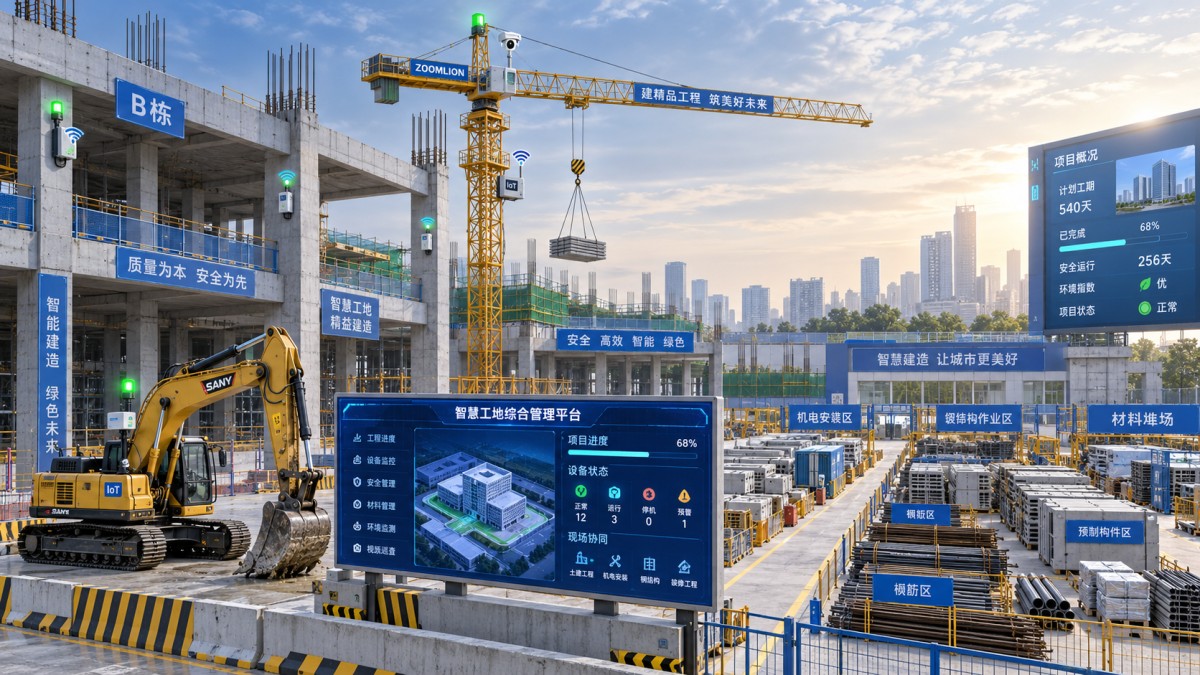
“Smart jobsite” can describe a broad mix of tools: mobile field apps, BIM-linked workflows, machine telematics, RFID or QR material tracking, drones, cameras, environmental sensors, workforce access systems, and digital twin platforms. A project does not need all of them. Selecting technology by novelty often creates data that no one owns or uses.
For a site struggling with delayed daily reporting and inconsistent records, mobile forms, photo evidence, simple location tagging, and a disciplined issue workflow may provide the biggest improvement. The site needs a common record of progress, constraints, inspections, and actions before it needs advanced automation.
For a project where heavy equipment availability affects production, telematics and digital maintenance records can be more important than visual progress tools. For complex coordination in enclosed or highly sequenced work areas, a model-linked view of work zones, changes, and inspection status may be the stronger investment. For remote or spread-out works, aerial capture and site imagery can give managers a practical way to confirm access, stockpiles, and physical progress between visits.
Technology should therefore follow the management bottleneck. Ask: Which decision would improve if we knew the answer one shift, one day, or one week earlier? Then determine the smallest dependable set of field signals needed to answer it.
What has to be in place before visibility becomes trustworthy
A smart jobsite for project management is most effective when the project has agreed definitions for progress, ownership, and timing. Without those foundations, digitizing the process can simply make conflicting reports appear faster.
One definition of “complete”
Different teams may use “complete” to mean installed, inspected, tested, accepted, or ready for the next trade. Those are not interchangeable. Define completion at the work-package level and connect it to the schedule logic. A task should not appear green merely because a partial physical activity occurred if a required inspection or handover still prevents follow-on work.
A practical reporting rhythm
Real-time data is useful only where the work requires it. Many decisions can be supported by a reliable daily update. Others, such as a lift plan, a safety exclusion zone, or equipment failure, require immediate escalation. Set the reporting rhythm according to the decision deadline, not according to the technical ability to collect continuous data.
Clear data ownership
Every critical signal needs an owner: a supervisor confirms production records, an equipment lead resolves telematics exceptions, a quality lead closes inspection actions, and the project controls team connects approved progress to forecasts. When ownership is vague, dashboards become a collection of observations rather than a management tool.
Integration with existing control processes
Field data should connect to the systems the project already uses for planning, document control, procurement, cost management, and quality. Full integration is not always necessary on day one, but teams need a controlled method for matching work packages, locations, asset IDs, and document revisions. If each system uses different naming conventions, visibility stops at the boundary between them.
Do not confuse surveillance with management visibility
A common mistake is to assume that more cameras, wearable devices, or location tracking automatically improve control. They may document activity, but they do not explain whether that activity supports the plan. They also introduce practical concerns around workforce acceptance, privacy, data access, and the effort needed to review alerts.
Use visual and location-based tools where they resolve a real uncertainty: verifying remote progress, monitoring a restricted area, confirming material movement, or investigating a safety event. Avoid collecting granular information simply because it is available. Excess data creates alert fatigue and can distract managers from constraints that actually threaten delivery.
Another mistake is relying on a single executive dashboard as the source of truth. Senior leaders need concise indicators, but site supervisors need operational detail: which drawing revision applies, what prerequisite is missing, where an issue sits, who owns it, and when it must be resolved. Good visibility moves from an overall project status to the specific action required, without forcing each role to navigate the same screen.
Start with a controlled use case, then test whether it changes decisions
A broad “digital transformation” rollout makes it hard to prove what is working. A focused use case is easier to adopt and measure in operational terms. Suitable starting points include short-term schedule constraint management, equipment utilization on a critical work front, inspection and handover tracking, or verified quantity capture for progress reporting.
- Choose one recurring decision that is currently delayed, disputed, or based on manual consolidation.
- Map the field events that determine the answer, including who records them and when.
- Set a simple baseline for the current process: late updates, unresolved constraints, rework loops, or time spent reconciling reports.
- Build the workflow around exceptions, not around collecting every possible data point.
- Review whether the new information led to earlier action, clearer accountability, or fewer conflicting versions of progress.
This approach also exposes whether the main issue is technology or process discipline. If crews do not have time to record essential events, simplify the form. If records are entered but never reviewed, define an escalation meeting and accountable owner. If the data is accurate but cannot be tied to a work package, fix the coding structure before adding more sensors.
When a smart jobsite may not be the immediate answer
Not every project needs a heavily connected environment. A small, stable project with a short duration, limited interfaces, and daily in-person management may gain little from complex instrumentation. Basic mobile reporting and disciplined coordination can be sufficient.
It is also premature to deploy advanced tools when the schedule is not broken into manageable work packages, subcontractor responsibilities are unclear, or site connectivity and device support are unresolved. In those cases, the first improvement is often a clearer operating model: standardized daily records, a usable look-ahead plan, defined approval routes, and a shared issue register.
GIUT’s coverage of construction and smart building reflects this practical distinction: smart jobsite capability is most meaningful when digital tools reinforce how work is planned, verified, and coordinated in the physical environment. The goal is not a more impressive control room. It is a project team that can see emerging problems early enough to change the outcome.
Before choosing a platform or deploying connected devices, identify the one or two visibility failures that most often create delay, cost uncertainty, or avoidable risk. A smart jobsite earns its place when it makes those failures visible in time for the team to respond.
Questions about this sector or your project? Contact Sector Deep Dive for expert insights.
We respect your privacy. Your information is strictly confidential.
Get weekly intelligence in your inbox.
No noise. No sponsored content. Pure intelligence.
News Recommendations
 Oct 31, 2026How does an engineering data model support project handover?How does an engineering data model support project handover?
 Oct 12, 2026How to keep smart construction site sensors working without Wi-FiHow to keep smart construction site sensors working without Wi-Fi
 Oct 12, 2026Can smart construction sites detect schedule delays early enough?Can smart construction sites detect schedule delays early enough?
 Oct 11, 2026When does a smart jobsite improve project management visibility?When does a smart jobsite improve project management visibility?
 Oct 08, 2026Why Builder Quality Checklists Fail—and How Site Teams Close Inspection GapsWhy Builder Quality Checklists Fail—and How Site Teams Close Inspection Gaps
 Oct 08, 2026Can Site IQ digital twin improve coordination across active sitesCan Site IQ digital twin improve coordination across active sites
 Oct 08, 2026When digital site and operations solutions reduce reporting delaysWhen digital site and operations solutions reduce reporting delays
 Sep 14, 2026How to Compare Vendor Specifications Across Industrial Equipment Categories — A Framework for EngineersHow to Compare Vendor Specifications Across Industrial Equipment Categories — A Framework for Engineers
 Sep 14, 2026What data is needed for reliable resource allocation planning?What data is needed for reliable resource allocation planning?
 Sep 14, 2026How can resource allocation software reduce equipment idle time?How can resource allocation software reduce equipment idle time?
 Aug 30, 2026When does a smart infrastructure integrator reduce project risk?When does a smart infrastructure integrator reduce project risk?
 Aug 29, 2026How smart devices integration reduces delays on active construction sitesHow smart devices integration reduces delays on active construction sites
 Aug 24, 2026When does construction technology for contractors pay off on site?When does construction technology for contractors pay off on site?
 Aug 22, 2026When do heavy equipment technology systems deliver real gains on site?When do heavy equipment technology systems deliver real gains on site?
 Aug 21, 2026When does jobsite automation for contractors pay off on site?When does jobsite automation for contractors pay off on site?
 Aug 09, 2026How Smart Construction Solutions in Asia Reduce Delays on Large ProjectsHow Smart Construction Solutions in Asia Reduce Delays on Large Projects
 Jul 13, 2026Digital City Integration Challenges: What Fails First in Real ProjectsDigital City Integration Challenges: What Fails First in Real Projects
 Jul 11, 2026How AI Smart Governance Platforms Reduce Risk in Multi-Site OperationsHow AI Smart Governance Platforms Reduce Risk in Multi-Site Operations
 Jul 09, 2026Smart Jobsite Monitoring: What Actually Prevents DelaysSmart Jobsite Monitoring: What Actually Prevents Delays
 Jul 06, 2026Construction Technology for Contractors: What Delivers ROI in 2026Construction Technology for Contractors: What Delivers ROI in 2026
 Jul 03, 2026Customization Options for Smart Devices That Improve User ExperienceCustomization Options for Smart Devices That Improve User Experience
 Jun 28, 2026Construction and Smart Building Trends to Watch in 2026Construction and Smart Building Trends to Watch in 2026
 Jun 27, 2026Smart Jobsites: 7 Deployment Mistakes That Delay Site PerformanceSmart Jobsites: 7 Deployment Mistakes That Delay Site Performance
 Jun 25, 2026Supporting Technologies That Improve Smart Building System IntegrationSupporting Technologies That Improve Smart Building System Integration
 Jun 24, 2026Smart Jobsites: 7 Metrics That Expose Hidden DelaysSmart Jobsites: 7 Metrics That Expose Hidden Delays
 Jun 23, 2026How Smart Building Solutions Cut Energy and Upgrade CostsHow Smart Building Solutions Cut Energy and Upgrade Costs
 Jun 22, 2026Construction Technology Trends Reshaping Jobsite Efficiency in 2026Construction Technology Trends Reshaping Jobsite Efficiency in 2026


