Smart Grids Technology: Cost vs ROI in 2026 Upgrades
For 2026 infrastructure planning, smart grids technology has moved from pilot discussion to investment discipline. Budget pressure is real, but so is the cost of delayed modernization.
Utilities, cities, transport systems, campuses, and industrial networks now face a sharper question. How much should be spent today, and when will returns become visible?
The answer is not universal. Smart grids technology can produce strong ROI, yet results depend on grid maturity, data integration, outage exposure, tariff structure, and execution quality.
This analysis reviews where costs rise, what creates measurable value, and how to assess smart grids technology with financial clarity across complex infrastructure portfolios.
2026 signals show smart grids technology entering a capital-efficiency phase
The market tone has changed. Earlier projects emphasized innovation narratives. Current upgrades focus on resilience, controllability, and lower total lifecycle cost.
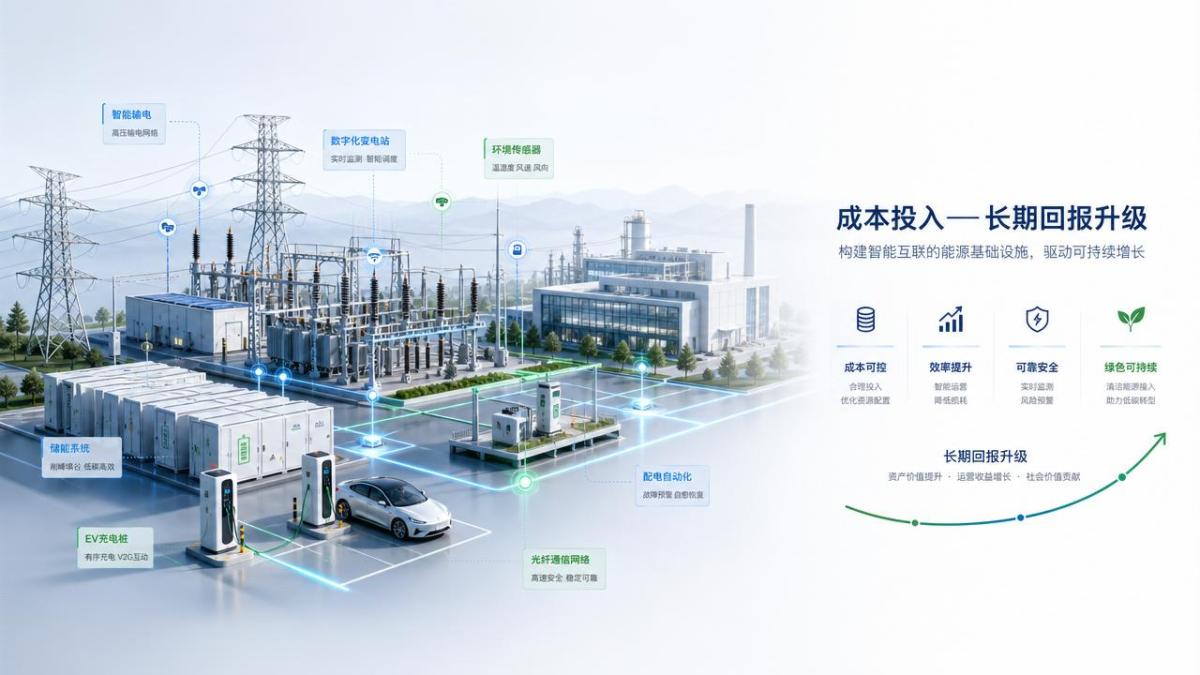
This shift matters across the broader infrastructure economy. Construction, rail, logistics, mining, and smart city platforms all depend on more stable and intelligent power systems.
At the same time, electrification is expanding. EV charging, distributed solar, battery storage, heat pumps, and digital buildings add volatility to legacy distribution networks.
That is why smart grids technology is increasingly judged against avoided losses, not only technical performance. Every prevented outage or deferred expansion has financial meaning.
For integrated infrastructure operators, the question is broader than utility billing. Power quality affects signaling systems, pumping stations, data centers, safety equipment, and automated facilities.
Why costs are rising and why investment logic is still strengthening
Upfront costs can look substantial because smart grids technology combines physical upgrades with software, communications, analytics, and cybersecurity controls.
However, the same convergence creates multiple return channels. The value case becomes stronger when projects are designed as operational platforms rather than isolated equipment replacements.
The strongest projects connect these drivers to clear operating outcomes. Without that linkage, smart grids technology can look expensive and under-justified on paper.
Where smart grids technology typically generates measurable ROI
Returns usually emerge through five financial paths. Some appear quickly, while others build over several budget cycles.
1. Energy efficiency and loss reduction
Smart grids technology improves load visibility and balancing. That reduces technical losses, identifies abnormal consumption, and supports more accurate energy optimization.
2. Outage avoidance and resilience value
A single avoided outage may justify meaningful investment where service continuity is critical. Rail corridors, hospitals, tunnels, ports, and high-density urban districts show this clearly.
3. Lower operations and maintenance cost
Remote diagnostics reduce unnecessary site visits. Condition-based maintenance also limits premature replacement and helps crews focus on high-risk assets.
4. Deferred capital expansion
Better demand management can postpone transformer, feeder, or substation expansion. In constrained urban areas, this deferral value can be very significant.
5. New flexibility and revenue opportunities
Integrated storage, distributed energy resources, and dynamic tariffs can create new value streams. These may include demand response participation or optimized power procurement.
- Fast ROI items often include automated fault detection and meter data analytics.
- Medium-term returns often come from maintenance savings and lower peak demand charges.
- Long-term returns often depend on deferred expansion and resilience performance.
The impact spreads across infrastructure operations, not only power utilities
In the comprehensive infrastructure sector, smart grids technology affects far more than electricity distribution. It changes how physical assets are governed and optimized.
Smart buildings benefit from occupancy-aware power control and better equipment health. Urban governance platforms gain more reliable lighting, traffic control, and public safety systems.
Rail and logistics networks see stronger continuity for signaling, warehousing, and cold-chain operations. Mining and resource sites gain better load management for remote, high-risk environments.
Heavy equipment ecosystems also benefit indirectly. Electrified fleets, charging hubs, and maintenance depots depend on smarter distribution visibility and stable energy orchestration.
What deserves the closest attention before approving a 2026 upgrade
Financially sound programs usually start with tighter scoping. The goal is not maximum digitization, but highest-value modernization.
- Baseline the current cost of outages, losses, truck rolls, and peak demand.
- Separate mandatory compliance spending from optional performance upgrades.
- Model ROI by asset cluster, not only at enterprise level.
- Check interoperability with legacy SCADA, BMS, GIS, and ERP systems.
- Include cybersecurity lifecycle cost, not only installation cost.
- Evaluate data governance, ownership, and analytics readiness early.
- Use staged deployment to validate assumptions before full roll-out.
This discipline prevents a common mistake. Many organizations buy smart grids technology features that exceed their current operational maturity or data capabilities.
A better way to judge cost versus ROI is through staged decision gates
A phased framework improves confidence and protects capital. It also helps compare smart grids technology options across different asset classes.
- Diagnose the load profile, outage history, and maintenance burden.
- Prioritize high-loss, high-risk, or high-growth zones first.
- Build scenario models for conservative, base, and accelerated returns.
- Pilot automation and analytics where benefits are easiest to measure.
- Scale only after KPI proof on reliability, savings, and response speed.
This approach reflects a broader smart city reality. The value of smart grids technology rises when digital and physical infrastructure evolve together.
The strongest 2026 strategy is not cheapest procurement, but highest verified value
Cost discipline still matters. Yet the lowest bid often misses integration, analytics, resilience, and cyber requirements that determine long-term returns.
In 2026, successful smart grids technology programs will be those tied to measurable business cases. They will translate engineering gains into lower risk and stronger asset productivity.
A practical next step is to launch a cross-functional review of high-cost power pain points, then rank upgrade opportunities by payback, resilience impact, and scalability.
For infrastructure leaders shaping smarter cities and more reliable industrial systems, smart grids technology is best treated as a strategic platform investment, not a standalone hardware purchase.
Get weekly intelligence in your inbox.
No noise. No sponsored content. Pure intelligence.
News Recommendations
 Sep 19, 2026How an electronics application guide helps prevent component mismatchHow an electronics application guide helps prevent component mismatch
 Sep 18, 2026When a resource allocation platform improves project deliveryWhen a resource allocation platform improves project delivery
 Sep 17, 2026What to compare when evaluating mineral processing equipment manufacturersWhat to compare when evaluating mineral processing equipment manufacturers
 Sep 16, 2026How mineral separation optimization can reduce concentrate lossesHow mineral separation optimization can reduce concentrate losses
 Sep 15, 2026How to assess lifecycle costs in urban tech procurementHow to assess lifecycle costs in urban tech procurement
 Sep 14, 2026Heavy industry technology trends reshaping capital investment prioritiesHeavy industry technology trends reshaping capital investment priorities
 Sep 14, 2026Global Industrial Equipment Procurement: How Top OEMs Qualify Suppliers for Mining & Infrastructure ProjectsGlobal Industrial Equipment Procurement: How Top OEMs Qualify Suppliers for Mining & Infrastructure Projects
 Sep 14, 2026Industrial & Mining Equipment Procurement: Balancing Local Sourcing, Lead Time, and Certification RequirementsIndustrial & Mining Equipment Procurement: Balancing Local Sourcing, Lead Time, and Certification Requirements
 Sep 14, 2026Infrastructure & Equipment Upgrades: What Procurement Teams Must Verify Before Signing Off on New ContractsInfrastructure & Equipment Upgrades: What Procurement Teams Must Verify Before Signing Off on New Contracts
 Sep 14, 2026Why Infrastructure Equipment Buyers Are Shifting from Catalog-Based to Capability-Based Supplier SelectionWhy Infrastructure Equipment Buyers Are Shifting from Catalog-Based to Capability-Based Supplier Selection
 Sep 14, 2026Process Automation Project Execution: How to Align Supplier Capabilities with PLC Integration, Cybersecurity & Commissioning MilestonesProcess Automation Project Execution: How to Align Supplier Capabilities with PLC Integration, Cybersecurity & Commissioning Milestones
 Sep 14, 2026Are intelligent traffic systems worth the investment for small cities?Are intelligent traffic systems worth the investment for small cities?
 Sep 14, 2026How do intelligent traffic systems handle sensor failures?How do intelligent traffic systems handle sensor failures?
 Sep 14, 2026What should I check before accepting a smart building system?What should I check before accepting a smart building system?
 Sep 14, 2026Is a smart building system worth the maintenance cost?Is a smart building system worth the maintenance cost?
 Sep 14, 2026What data is needed for reliable resource allocation planning?What data is needed for reliable resource allocation planning?
 Sep 14, 2026How can resource allocation software reduce equipment idle time?How can resource allocation software reduce equipment idle time?
 Sep 14, 2026How should smart devices be maintained in harsh outdoor conditions?How should smart devices be maintained in harsh outdoor conditions?
 Sep 14, 2026Do smart devices improve worker safety on construction sites?Do smart devices improve worker safety on construction sites?
 Sep 14, 2026What environmental risks must be assessed before deep-sea mining?What environmental risks must be assessed before deep-sea mining?
 Sep 14, 2026Is deep-sea mining equipment commercially viable in 2026?Is deep-sea mining equipment commercially viable in 2026?
 Sep 14, 2026What Inspection Checks Should Procurement Teams Perform Before Ordering Dredging Equipment in 2026?What Inspection Checks Should Procurement Teams Perform Before Ordering Dredging Equipment in 2026?
 Sep 13, 2026How to verify an industrial product information source before specifying equipmentHow to verify an industrial product information source before specifying equipment
 Sep 12, 2026Which intelligent traffic systems hardware fits an urban intersection?Which intelligent traffic systems hardware fits an urban intersection?
 Sep 11, 2026How pump capacity affects response coverage for municipal fire fighting vehiclesHow pump capacity affects response coverage for municipal fire fighting vehicles
 Sep 10, 2026What to verify before choosing a heavy industry equipment supplierWhat to verify before choosing a heavy industry equipment supplier
 Sep 09, 2026When do adaptive urban traffic control systems reduce corridor delays?When do adaptive urban traffic control systems reduce corridor delays?