Excavator Pontoon Procurement: Evaluating Compatibility and Documentation
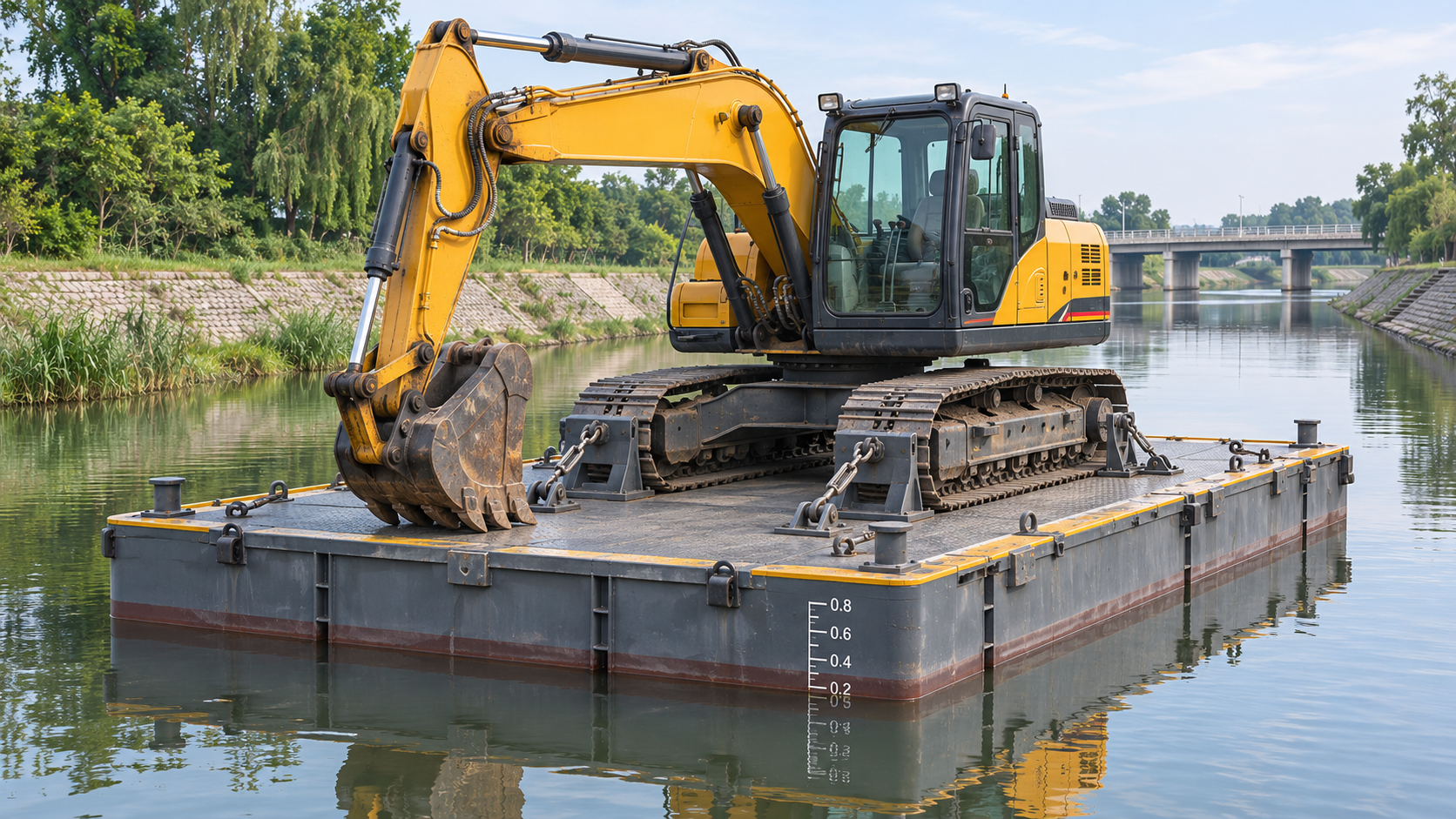
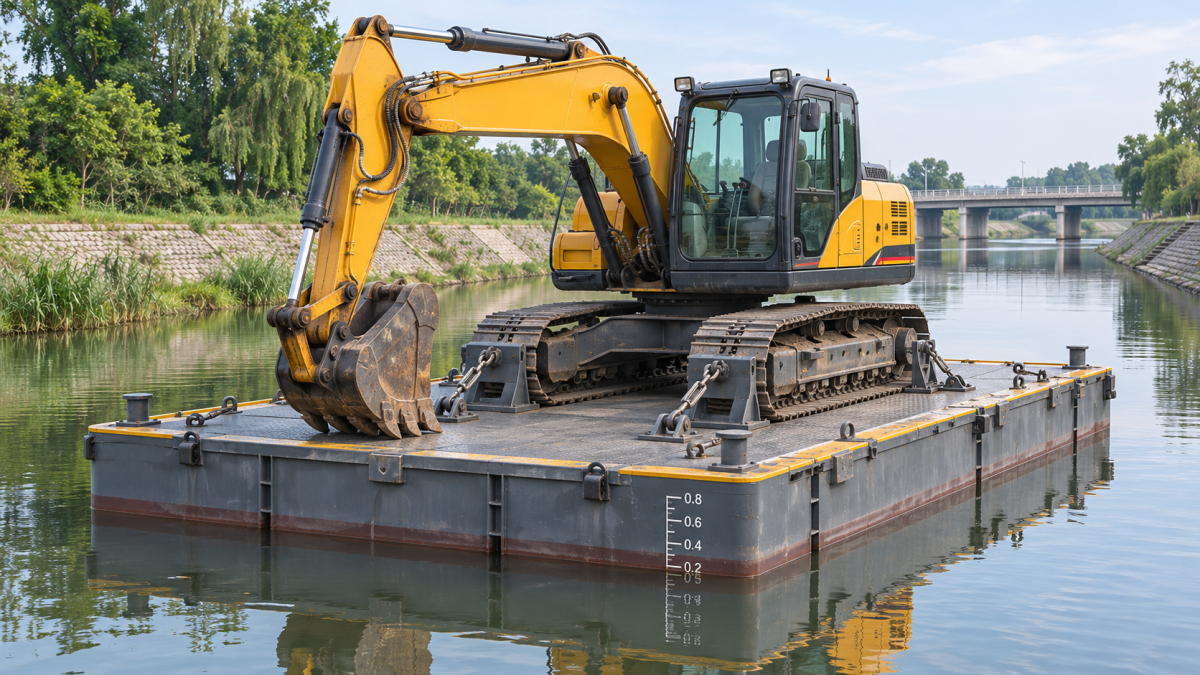
A pontoon can fit beneath an excavator and still be unsuitable for the work. The machine may sit too high, the mounting points may not transfer loads as intended, or the combined unit may lack an approved operating envelope for the canal. Procurement should therefore treat the excavator, attachments, pontoon and proposed work method as one configuration—not as separate purchases connected only by machine weight.
The most useful supplier submission is not a single buoyancy figure. It is a documented description of what the assembly can do, under which conditions, and how those limits were established. For canal work, that means examining stability during excavation and slewing as well as clearance, water depth, bank conditions, transport and recovery.
Define the complete working configuration
Begin with the exact excavator model and its operating configuration. The supplier needs the machine’s actual operating mass, undercarriage dimensions, track spacing, center-of-gravity information where available, and details of any changes from the manufacturer’s standard specification. A heavier counterweight, different boom, quick coupler or added protection can affect both mounting and stability.
List every attachment expected to be used, including its mass and the material it may retain. A dredging bucket full of saturated sediment can impose a different load from an empty grading bucket. The working reach, digging depth and intended direction of operation also matter: a configuration acceptable when working over the front may have a different stability margin when slewed to the side.
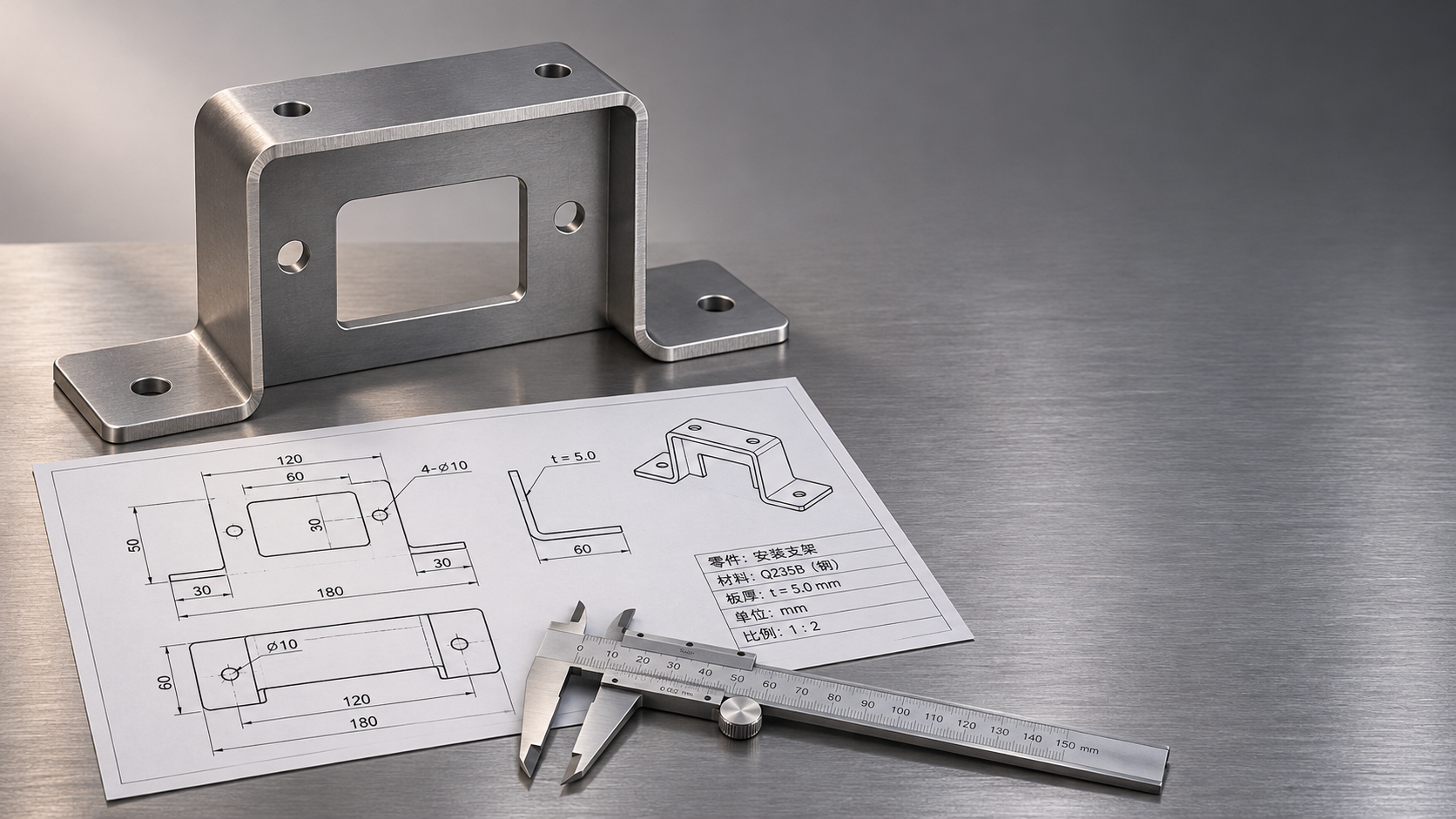
For an excavator pontoon, request drawings that show how the excavator is positioned and restrained, rather than accepting a statement that the platform is compatible with a particular weight class. The drawings should identify interfaces, attachment points, clearance around tracks and access to service areas. Any required modification to the excavator should be reviewed with the excavator manufacturer or an appropriately qualified engineer before it becomes a contractual assumption.
Describe how the unit will move and work. Will it travel between locations by water, be towed, or be dismantled for road transport? Will operators excavate continuously from a floating position, work while grounded, or use a separate anchoring or mooring arrangement? These modes can require different analyses and equipment; a floating operating condition should not be assumed to cover transport or grounding.
Check canal constraints before comparing quotations
A canal’s nominal width is not necessarily its usable working width. Banks may slope, vegetation or structures may reduce clearance, and a floating unit can move as the boom slews. Ask the project team to identify the narrowest relevant passage, bridge and overhead restrictions, bends, access points and any areas where vessels must pass. Compare these with the assembled dimensions and the proposed method for positioning the equipment.
Water depth deserves the same treatment. The buyer should provide expected depth and credible variations, including shallow sections, silt accumulation and any restrictions on disturbing the bed. The supplier should state draft for defined loading conditions and identify any minimum clearance needed for the intended operation. Draft alone does not establish that the unit can safely work in shallow water: the consequences of partial grounding, uneven bottom contact and changing water levels must also be considered in the operating plan.
Bank strength and nearby assets can affect the choice of moorings or anchors. A proposed attachment point may be unavailable, and canal walls, buried utilities or other infrastructure may limit where loads can be applied. Procurement can reduce late redesign by recording these constraints in the inquiry and making unresolved site assumptions visible in the quotation.
Make stability evidence configuration-specific
Floating equipment stability involves more than whether the pontoons displace enough water to support the total mass. Load distribution, freeboard, the height of the combined center of gravity and the forces generated by excavation all influence behavior. The U.S. Army Corps of Engineers’ EM 385-1-1, Safety and Health Requirements Manual, addresses floating plant and marine operations; its applicability depends on the contract and jurisdiction. It is a useful reference for identifying the breadth of issues that a project’s safety review may need to address, not a substitute for an engineered assessment.
Ask for a stability assessment prepared or reviewed by a suitably qualified naval architect or engineer for the actual assembly and intended operating modes. The assessment should identify the design basis, methods, applicable criteria and assumptions, rather than merely declaring the platform stable. Depending on the project, the buyer, operator, insurer, owner or relevant authority may need to agree on the criteria and review the evidence.
The submission should make it possible to trace each conclusion back to a defined condition. Request that it address, as applicable:
- Loading: excavator and attachment masses, fuel and other consumables, personnel, equipment, retained material and their positions.
- Operating geometry: boom and stick position, working radius, slew direction and any limits on lifting or digging loads.
- Environmental conditions: current, wind, vessel movement and water-level assumptions relevant to the site.
- Floating condition: draft, freeboard and heel or trim for assessed cases, with acceptance criteria stated.
- Compartment condition: the basis for any assessment of leakage or flooding, including whether a damaged condition has been evaluated.
- Other modes: towage, transit, assembly, maintenance and any intended grounded operation, each separately identified where relevant.
Excavator lift charts are an important input, but a chart for a machine on firm, level ground should not automatically be treated as a rating for a floating platform. Ask how the excavator manufacturer’s instructions and the pontoon assessment are reconciled, and who will issue the combined operating limits. If the analysis excludes a task—such as lifting a submerged object, working across the pontoon or operating in current—that exclusion belongs in the work plan and commercial evaluation.
Field checks should verify the assumptions rather than replace the engineering. Before work, the operator can confirm loading, closures, visible damage, moorings, water depth and the permitted working area against the approved documents. Any operational trial should follow a written, risk-assessed procedure with defined conditions and stop criteria; it should not be used to improvise the maximum safe load.
Separate structural capacity from buoyancy
A pontoon may have sufficient displacement while its deck, local supports or excavator connections are unsuitable for the loads applied. Request the structural design basis for the mounting system, including how forces travel from the excavator into the pontoon structure. Details should cover restraints against shifting, lifting and overturning, as well as the loads considered during working and transport.
Review the proposed connection arrangement with whoever will install it. If tracks sit on supports, drawings should show contact areas and any required packing or stops. If clamps, bolts or welded components are used, identify the installation procedure, inspection requirements and whether the connection can be removed without damaging the excavator. A generic drawing that omits the machine-specific interface leaves a significant acceptance question open.
Compartment layout also affects inspection and maintenance. Ask for a plan showing watertight boundaries, access covers, vents, drains and means of checking for water ingress. The buyer should understand which compartments can be inspected, how leaks would be detected and whether repairs are practical at the intended site. Coating specifications and corrosion allowances, where used in the design, should reflect the expected water and maintenance conditions rather than an unspecified promise of corrosion resistance.
Turn documentation into purchase-order deliverables
Documents are most useful when the purchase order specifies their content, timing and acceptance route. A certificate submitted after shipment cannot resolve an incompatible mounting arrangement discovered during installation. Require preliminary drawings and the design basis early enough for the buyer and operator to review assumptions before fabrication proceeds.
Specify the applicable standards and inspection scope in the contract rather than assuming that a supplier’s standard practice matches the project’s needs. For example, ISO 3834 sets out quality requirements for fusion welding of metallic materials; a claim that fabrication follows it should be accompanied by clarification of the applicable part, scope and supporting evidence. Refer to the relevant edition and confirm contractual applicability with the project’s quality team. The ISO standard itself does not automatically establish the pontoon’s fitness for a particular canal operation.
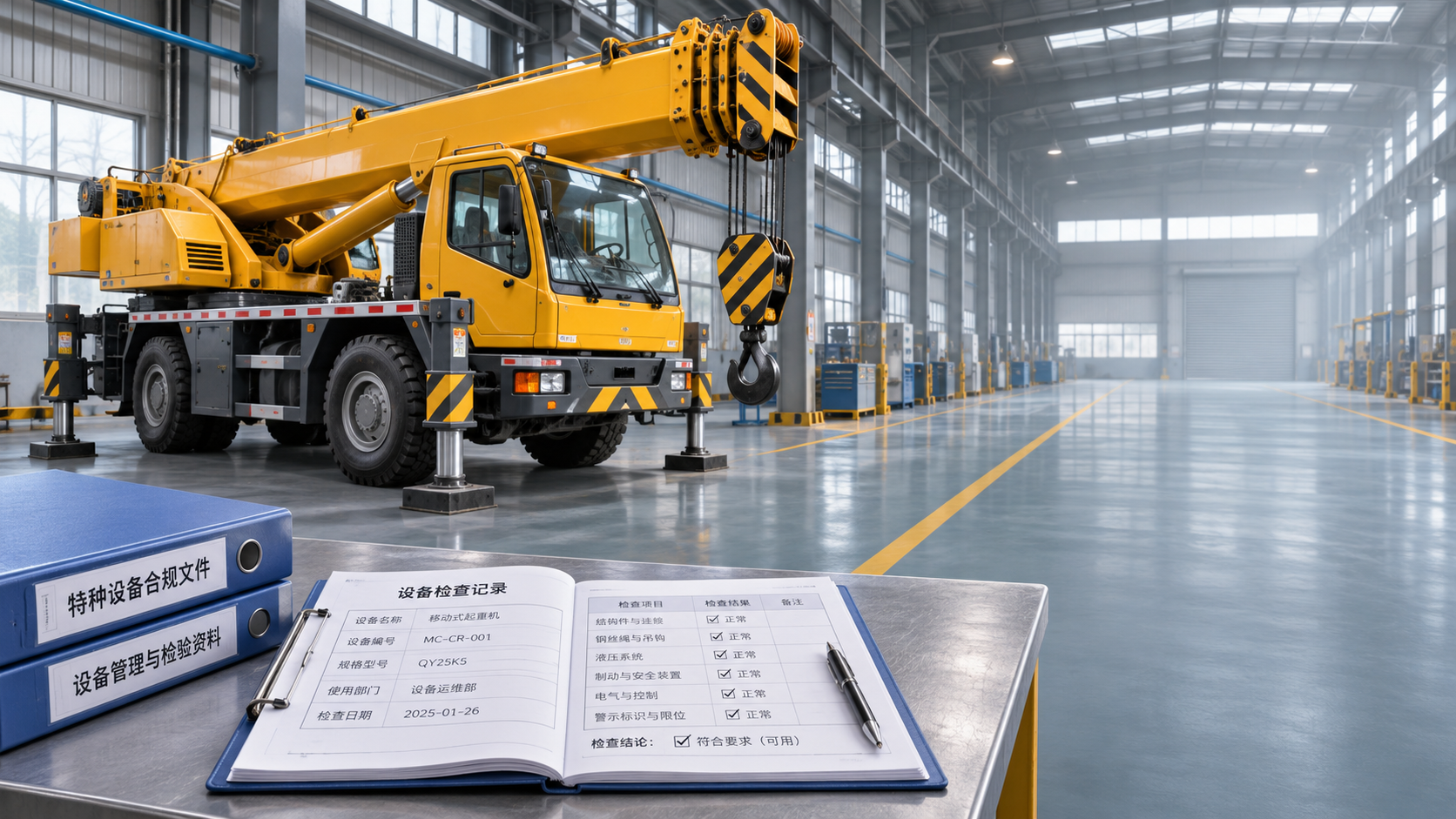
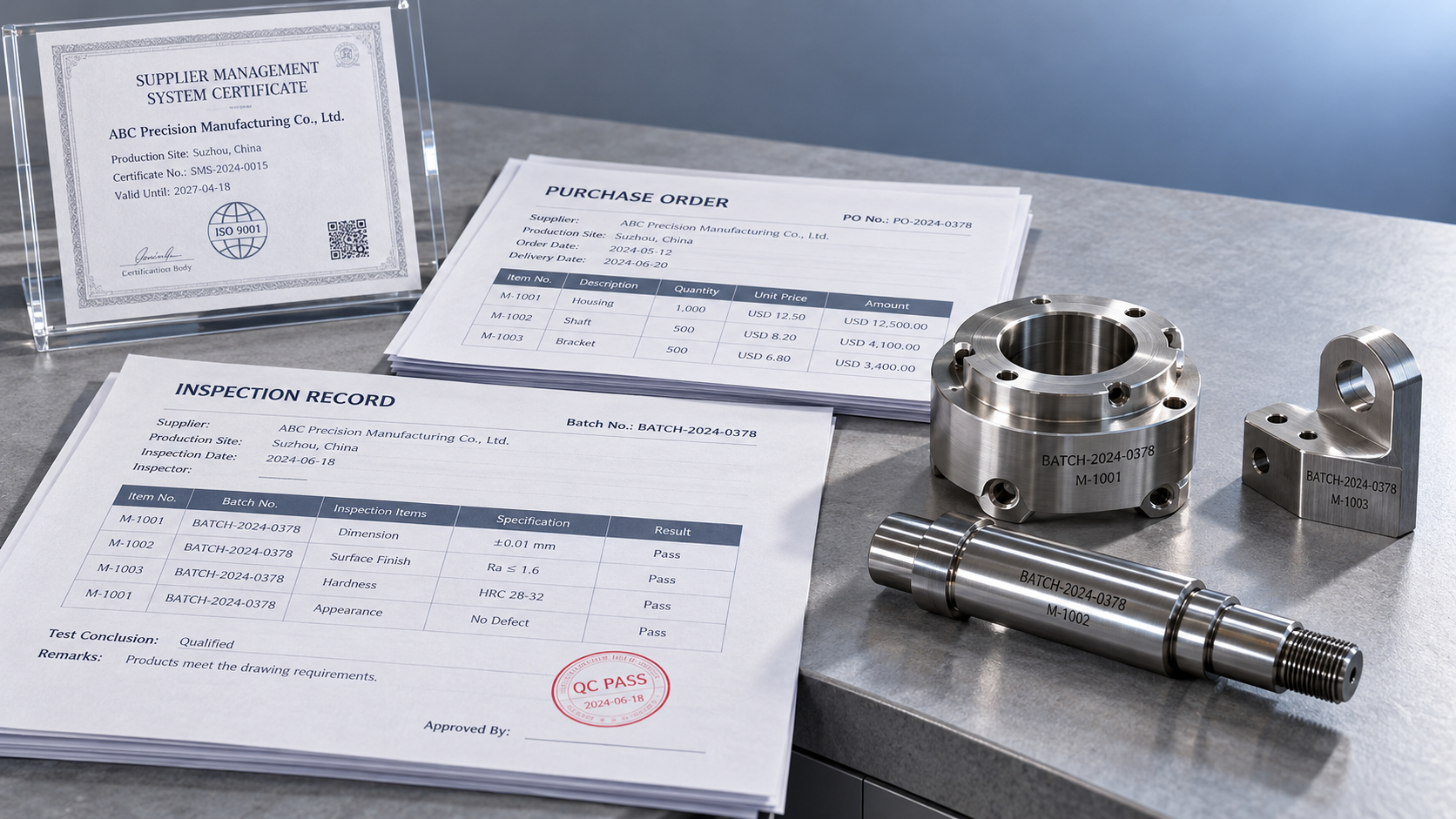
Similarly, agree on what inspection records will show and who can witness the work. Material certificates, welding records, dimensional checks and compartment leak-test records can support acceptance when the contract identifies the items to be inspected, the method and acceptance criteria. A document labeled “certificate” is less useful if it does not identify the equipment, test performed and result.
Compare bids on assumptions, not headline capacity
Two quotations can appear equivalent while covering different risks. One may include the machine-specific mounting design and commissioning support; another may price only a floating structure and leave interface engineering to the buyer. One may assess a loaded bucket at the intended working reach, while another excludes excavation forces. Normalize these differences before comparing prices.
Ask each bidder to identify buyer-supplied information, exclusions, required third-party reviews and expected revisions if the excavator or attachment changes. Include transport preparation, lifting arrangements, site assembly, spare seals or fasteners where appropriate, and the cost of inspections or surveys in the evaluation. Consider downtime exposure as well: an inexpensive arrangement that requires extensive disassembly to inspect compartments may impose a practical maintenance burden.
Set hold points for resolving open technical issues. A conditional award can preserve commercial progress while preventing fabrication of the interface until machine dimensions and the design basis are approved. Clarify ownership of design changes and the process for approving substitutions, especially for connection hardware and structural details.
Accept the delivered assembly against the agreed configuration
At delivery, match equipment identification and as-built drawings to the purchase order. Inspect for transport damage, verify the mounting components and check that required access points, closures and markings are present. The installation team should record deviations rather than compensating for a poor fit with unapproved site modifications.
Commissioning should bring the excavator, pontoon, attachments and operating documentation together. Confirm that the installed machine and ballast or other specified loads match the assessed configuration, and that operators have the applicable limits and inspection instructions. Any change in excavator, attachment, operating method or loading should trigger a review of whether the original assessment remains valid. Acceptance is strongest when the buyer can connect the equipment on the water to the assumptions, drawings and limits used to approve it.
Questions about this sector or your project? Contact Sector Deep Dive for expert insights.
We respect your privacy. Your information is strictly confidential.
Get weekly intelligence in your inbox.
No noise. No sponsored content. Pure intelligence.
News Recommendations
 Nov 23, 2026Excavator Pontoon Procurement: Evaluating Compatibility and DocumentationExcavator Pontoon Procurement: Evaluating Compatibility and Documentation
 Nov 22, 2026Can deep-sea mining equipment operate profitably in 2026?Can deep-sea mining equipment operate profitably in 2026?
 Nov 16, 2026What are the main arteries of a logistics network?What are the main arteries of a logistics network?
 Nov 15, 2026How to build a resource allocation model for multiple projectsHow to build a resource allocation model for multiple projects
 Nov 14, 2026Industrial compliance guide to identifying applicable regulationsIndustrial compliance guide to identifying applicable regulations
 Nov 08, 2026Which industrial equipment categories suit material handling?Which industrial equipment categories suit material handling?
 Nov 06, 2026How much does it cost to invest in urban technology?How much does it cost to invest in urban technology?
 Nov 04, 2026How to choose packaging for heavy industrial productsHow to choose packaging for heavy industrial products
 Nov 03, 2026How to prepare component specifications that suppliers can quote accuratelyHow to prepare component specifications that suppliers can quote accurately
 Nov 01, 2026How much does an engineering data platform cost to implement?How much does an engineering data platform cost to implement?
 Oct 27, 2026How to verify ISO compliance references in supplier documentsHow to verify ISO compliance references in supplier documents
 Oct 26, 2026Can an industrial technology platform connect legacy equipment?Can an industrial technology platform connect legacy equipment?
 Oct 26, 2026Buying or Renting a Slurry Dredger for Short-Term Sand RemovalBuying or Renting a Slurry Dredger for Short-Term Sand Removal
 Oct 24, 2026How to choose a product comparison database with reliable dataHow to choose a product comparison database with reliable data
 Oct 19, 2026An industrial buyer's guide to comparing equipment lifecycle costsAn industrial buyer's guide to comparing equipment lifecycle costs
 Oct 19, 2026Comparing Ductile Iron Pipe Quotes Beyond the Price per MetreComparing Ductile Iron Pipe Quotes Beyond the Price per Metre
 Oct 19, 2026Water Pipeline Ball Valve Procurement: What to Specify in an RFQWater Pipeline Ball Valve Procurement: What to Specify in an RFQ
 Oct 18, 2026How to prepare project specifications that make bids comparableHow to prepare project specifications that make bids comparable
 Oct 17, 2026How to select industrial equipment for continuous-duty operationHow to select industrial equipment for continuous-duty operation
 Oct 16, 2026How to evaluate long-term software support when choosing electronicsHow to evaluate long-term software support when choosing electronics
 Oct 13, 2026How to verify an industrial compliance information platform's accuracyHow to verify an industrial compliance information platform's accuracy
 Oct 12, 2026What to look for in a processing services guide before outsourcingWhat to look for in a processing services guide before outsourcing
 Oct 09, 2026How to source urban technology solutions without vendor lock-inHow to source urban technology solutions without vendor lock-in
 Oct 08, 2026Which customization options add value to OEM projects?Which customization options add value to OEM projects?
 Oct 08, 2026Best practices for digital twin ROI start with measurable use casesBest practices for digital twin ROI start with measurable use cases
 Oct 08, 2026What to map before starting an automation planning processWhat to map before starting an automation planning process
 Oct 08, 2026Supply Checks for a YLCSD200 Cutter Suction Dredger Procurement PlanSupply Checks for a YLCSD200 Cutter Suction Dredger Procurement Plan