
How to verify ISO compliance references in supplier documents
An ISO compliance reference is verified only when the cited requirement, the organization making the claim, and the supporting evidence agree. A certificate attached to a quotation does not establish that a particular material, machine, or service meets the purchase specification. Begin by identifying exactly what the reference claims, then trace it to an authoritative record and evidence covering the supplied item or activity.
Keep three questions separate: Is the document authentic? Does its scope cover the relevant organization, location, and work? Does it demonstrate the conformity required by the order? A genuine certificate can answer the first question while leaving the other two unresolved.
Identify the claim before reviewing the certificate
Supplier documents often place several different statements under an “ISO compliance” heading. Their evidential value differs substantially.
ISO 9001 certification concerns a quality management system. It does not certify the load capacity of lifting equipment, the strength of a steel batch, or the electrical protection of a control cabinet. Likewise, environmental or occupational health and safety management system certification does not establish product performance.
Wording such as “ISO registered,” “ISO approved,” or “meets international standards” needs clarification when it omits the standard, scope, or issuing organization. ISO develops standards; it does not issue supplier management system certificates. A claim that ISO itself certified a factory therefore requires correction and independent verification.
Resolve the standard, edition, and acceptance criteria
Record the complete standard designation, including any part number, edition, and applicable amendment. Confirm its title and publication status through the official ISO catalogue or the relevant national standards body. Similar titles can cover different products, test methods, or operating conditions.
A national adoption can carry additional prefixes or a different publication date. Establish whether it is technically equivalent to the required international document and whether any national provisions affect acceptance. Similar numbering alone does not establish equivalence.
The controlling reference is the requirement incorporated into the contract, drawing, technical specification, or approved inspection plan. A newer edition does not automatically replace the edition specified in an existing order. Conversely, an older edition on a current certificate needs investigation when certification transition arrangements or the contract require an update.
Separate a test method from a product acceptance standard. A report can correctly follow an ISO test procedure while showing a result below the required limit. If the cited document only defines how to measure a property, locate the acceptance threshold in the product specification or purchase requirement.
For equipment, establish which configuration the reference covers. A test performed on one assembly does not automatically support a modified version with different materials, controls, protective devices, or operating limits. Record the technical basis for extending results across variants.
Match the certificate to the actual supply route
Read the complete certificate, including schedules and site annexes. Capture the legal entity, certificate number, standard, scope, locations, issuing body, issue date, and expiry date. Where several sites share a certificate, the annex often determines whether the relevant factory or service location is included.
Compare these details with the purchase order, manufacturing records, and shipping documentation. A trading company, parent organization, and manufacturing subsidiary can have closely related names while holding different responsibilities. Certification of one entity cannot simply be assigned to another through shared ownership or branding.
Scope wording deserves particular attention. “Distribution of industrial components” provides different coverage from “design and manufacture of industrial components.” A supplier presenting a distribution certificate for a fabricated assembly still needs evidence identifying the manufacturer and the controls applied to production.
For a fabricated structure, outsourced cutting, welding, coating, and final assembly can involve several locations. Establish which activities fall within the certified system and how external processes are controlled. An outsourced processor does not necessarily need its own management system certificate unless required by the contract; its work still needs appropriate qualification, inspection, and traceable records.
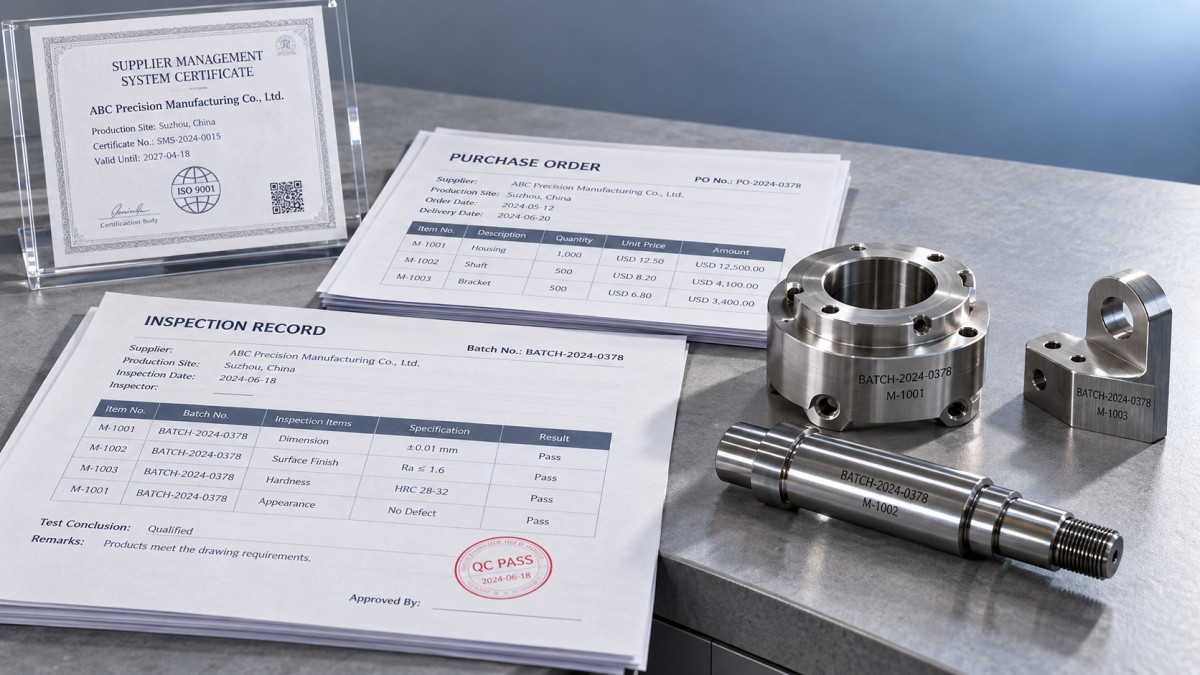
A useful review map connects the order to the contracting entity, the manufacturing or service location, the certification scope, and the delivery records. Any break in that chain identifies a specific documentation gap.
Validate the issuer and current status independently
Use the certification body’s official directory or contact details obtained independently from its official website. Search by certificate number and legal entity, then compare the directory entry with the supplied document. A QR code or hyperlink printed on a certificate is only a route to investigate; it is not independent confirmation.
Where accredited certification is required, verify the certification body through the accreditation body’s official directory. Confirm that accreditation covers the relevant certification activity and standard, including any applicable sector limitations. An accreditation logo on a PDF is insufficient evidence by itself.
Certification and accreditation serve different functions. The certification body assesses the supplier’s management system. The accreditation body assesses the certification body’s competence for specified activities. Neither step replaces product inspection or testing required by the order.
A certificate without accreditation is not automatically fraudulent, but it does not satisfy a requirement for accredited certification. Likewise, the absence of a record from one search platform does not conclusively establish invalidity. Directory coverage and publication arrangements differ. An unresolved search should lead to direct confirmation from the issuer.
Printed expiry dates also require context. A certificate can be suspended or withdrawn before that date. If the directory shows conflicting information, request confirmation of current status and relevant historical status directly from the certification body. For an older delivery, distinguish status at manufacture or service execution from status at the present review.
Retain a dated record of the verification source and result. If a certificate has been transferred or reissued, request evidence connecting the earlier and current records where continuity matters to acceptance.
Connect supporting records to the delivered item
Once the management system claim is established, follow the product evidence. Material certificates, inspection reports, calibration records, and test reports need identifiers that connect them to the supplied goods. Useful identifiers include heat numbers, batch numbers, serial numbers, drawing revisions, and equipment model designations.
For steel components, compare the material grade and heat identification on the material record with the fabrication traceability record. If cutting or processing removed the original marking, the transfer record must preserve the connection. A valid material report becomes insufficient when nothing links it to the delivered parts.
For machinery, compare the tested configuration with the supplied assembly and its documented operating limits. A component test report does not establish the performance of the complete machine. Installation conditions also matter when performance depends on anchoring, supply voltage, ventilation, or integration with external controls.
Laboratory evidence requires its own review. If an ISO/IEC 17025 accreditation claim is presented, confirm that the laboratory’s published accreditation scope covers the relevant method and any stated limitations. A laboratory can be accredited for some activities while reporting other work outside that scope.
Read the report beyond its accreditation mark. Establish who selected the sample, where it came from, its condition, the method used, and whether deviations were recorded. Testing a supplier-selected sample establishes results for that sample; batch acceptance requires an appropriate sampling basis and traceability.
Where a pass or fail statement relies on measurement near an acceptance limit, review the applicable decision rule and treatment of measurement uncertainty. A reported value alone can leave acceptance unresolved when the specification and laboratory apply different rules.
Turn discrepancies into precise document requests
Requests for “an updated ISO certificate” often produce another document without resolving the actual issue. State the mismatch and identify the evidence needed to close it.
- Unlisted production location: Request the applicable site annex or confirmation from the certification body. If the site is outside certification coverage, assess the separate manufacturing controls against the order requirements.
- A report cites only a test method. Identify the missing acceptance criterion and obtain the specification or approved inspection requirement that defines it.
- Different legal names appear across records: Obtain documentation explaining the relationship and assigning responsibility for manufacture, testing, and supply. Corporate affiliation alone does not extend certification scope.
- Results refer to a different batch or configuration. Require traceable evidence for the delivered item, or an approved technical justification demonstrating why the existing evidence applies.
Formatting anomalies, inconsistent certificate numbers, altered scope text, or links to unrelated domains justify further investigation. They are indicators, not conclusive proof of forgery. Preserve the received file and seek confirmation through an independently established contact route.
Record an approval decision with clear boundaries
The verification record should identify the requirement reviewed, the evidence examined, the verification date, and any unresolved limitation. Keep management system certification status separate from product or service acceptance so that a valid certificate cannot conceal missing technical evidence.
Distinguish an unresolved authenticity question from a confirmed technical nonconformity. The former requires reliable verification; the latter requires disposition against the specification. Conditional acceptance needs an authorized basis and clearly defined limits, especially where missing evidence concerns safety functions, structural performance, or material identity.
Close each gap with the document, confirmation, or technical assessment that resolves it. Preserve the original submission alongside the accepted revision so later reviews can establish exactly which evidence supported release of the delivery.
Questions about this sector or your project? Contact Sector Deep Dive for expert insights.
We respect your privacy. Your information is strictly confidential.
Get weekly intelligence in your inbox.
No noise. No sponsored content. Pure intelligence.
News Recommendations
 Nov 03, 2026How to prepare component specifications that suppliers can quote accuratelyHow to prepare component specifications that suppliers can quote accurately
 Nov 01, 2026How much does an engineering data platform cost to implement?How much does an engineering data platform cost to implement?
 Oct 27, 2026How to verify ISO compliance references in supplier documentsHow to verify ISO compliance references in supplier documents
 Oct 26, 2026Can an industrial technology platform connect legacy equipment?Can an industrial technology platform connect legacy equipment?
 Oct 26, 2026Buying or Renting a Slurry Dredger for Short-Term Sand RemovalBuying or Renting a Slurry Dredger for Short-Term Sand Removal
 Oct 24, 2026How to choose a product comparison database with reliable dataHow to choose a product comparison database with reliable data
 Oct 19, 2026An industrial buyer's guide to comparing equipment lifecycle costsAn industrial buyer's guide to comparing equipment lifecycle costs
 Oct 19, 2026Comparing Ductile Iron Pipe Quotes Beyond the Price per MetreComparing Ductile Iron Pipe Quotes Beyond the Price per Metre
 Oct 19, 2026Water Pipeline Ball Valve Procurement: What to Specify in an RFQWater Pipeline Ball Valve Procurement: What to Specify in an RFQ
 Oct 18, 2026How to prepare project specifications that make bids comparableHow to prepare project specifications that make bids comparable
 Oct 17, 2026How to select industrial equipment for continuous-duty operationHow to select industrial equipment for continuous-duty operation
 Oct 16, 2026How to evaluate long-term software support when choosing electronicsHow to evaluate long-term software support when choosing electronics
 Oct 13, 2026How to verify an industrial compliance information platform's accuracyHow to verify an industrial compliance information platform's accuracy
 Oct 12, 2026What to look for in a processing services guide before outsourcingWhat to look for in a processing services guide before outsourcing
 Oct 09, 2026How to source urban technology solutions without vendor lock-inHow to source urban technology solutions without vendor lock-in
 Oct 08, 2026Which customization options add value to OEM projects?Which customization options add value to OEM projects?
 Oct 08, 2026Best practices for digital twin ROI start with measurable use casesBest practices for digital twin ROI start with measurable use cases
 Oct 08, 2026What to map before starting an automation planning processWhat to map before starting an automation planning process
 Oct 08, 2026Supply Checks for a YLCSD200 Cutter Suction Dredger Procurement PlanSupply Checks for a YLCSD200 Cutter Suction Dredger Procurement Plan
 Oct 07, 2026How procurement planning lead time affects project delivery riskHow procurement planning lead time affects project delivery risk
 Oct 06, 2026When does procurement planning support reduce project cost overruns?When does procurement planning support reduce project cost overruns?
 Oct 05, 2026What makes an industrial machinery information platform reliable?What makes an industrial machinery information platform reliable?
 Oct 02, 2026What makes a mining equipment information platform reliable for sourcing?What makes a mining equipment information platform reliable for sourcing?
 Sep 27, 2026What drives deep-sea mining cost estimates before project approval?What drives deep-sea mining cost estimates before project approval?
 Sep 25, 2026Which logistics technology software features reduce manual shipment updates?Which logistics technology software features reduce manual shipment updates?
 Sep 22, 2026How to compare total landed cost in industrial solutions procurementHow to compare total landed cost in industrial solutions procurement
 Sep 21, 2026When do logistics technology solutions reduce warehouse picking errors?When do logistics technology solutions reduce warehouse picking errors?


