
Can an industrial technology platform connect legacy equipment?
Yes—an industrial technology platform can connect legacy equipment, provided there is a usable way to extract the required signals. That connection may use an existing controller interface, an industrial gateway, a supervisory system, or added sensors. Equipment age alone does not determine compatibility; the decisive factors are accessible interfaces, documented data, acceptable communication loads, and permission to modify the installation.
The more important distinction is between connecting a machine and obtaining dependable information from it. Reading a register does not establish what the value means, whether it is current, or whether collecting it affects production. A sound selection decision therefore starts with a defined operational requirement and evidence that the complete connection path can satisfy it—not simply a platform’s list of supported protocols.
Define what the connection must accomplish
“Connect the equipment” is too broad to serve as an acceptance criterion. Displaying a pump’s running status, calculating energy per production batch, and detecting bearing deterioration require different signals, sampling methods, and levels of integration.
A useful requirement identifies the measurement, its source, the necessary update rate, acceptable delay, and the action it will support. For example, a running-hours counter may support maintenance scheduling without continuous high-frequency collection. Vibration analysis may require a dedicated acquisition device because a controller’s exposed values do not contain the waveform needed for diagnosis.
Separate monitoring from control at the outset. Read-only collection can support dashboards, reporting, and condition monitoring. Changing setpoints or issuing commands introduces additional requirements for authorization, interlocks, command confirmation, and safe behavior during communication failures. A platform suitable for collecting equipment data is not automatically suitable for controlling that equipment.
This distinction also prevents unnecessary retrofits. If the requirement is daily energy reporting, replacing a functioning controller to obtain richer machine data may offer little benefit. If the requirement is accurate event sequencing across several machines, a slow polling interface may be inadequate even though it connects successfully.
The available interface determines the practical route
Before comparing platforms, establish what each asset actually exposes. Relevant evidence includes controller model and firmware, installed communication modules, electrical drawings, protocol documentation, register maps, existing supervisory connections, and vendor access restrictions. An Ethernet socket is not proof of accessible operational data, just as a serial port is not proof that a supported protocol is available.
Using an existing supervisory system can avoid adding another direct client to a constrained controller. However, it creates a dependency on that system’s configuration and availability. It may also provide processed or compressed values rather than the original measurements. The choice should follow the data requirement, not a preference for direct connectivity.
Where no usable interface exists, independent sensing can still make integration worthwhile. A current sensor can indicate electrical load; a vibration sensor can capture mechanical behavior. Neither automatically exposes the machine’s production count, fault code, or operating recipe. Those distinctions must remain visible in the resulting data model.
A gateway solves transport problems—not every compatibility problem
A gateway can translate between supported protocols, aggregate device connections, buffer readings, and present data to an industrial technology platform through a supported interface. It cannot reliably reconstruct undocumented machine logic or create measurements that the equipment never exposes.
Even familiar protocol names leave important questions unanswered. Modbus access still requires correct register addresses, data types, scaling, byte order, and function support. OPC UA access requires inspection of the available information model, security configuration, and subscription behavior. MQTT provides a messaging mechanism, but useful integration still depends on agreed payload structures, timestamps, quality indicators, and topic organization.
Converting serial traffic into Ethernet traffic is also not necessarily protocol conversion. A serial device server may transport bytes while leaving the platform responsible for understanding the original device protocol. A gateway that actively polls equipment has different configuration and diagnostic responsibilities.
The connection path should therefore be explicit: equipment interface, acquisition driver, edge processing, network boundary, platform ingestion, and application. Every translation point needs an owner and a defined response to failure.
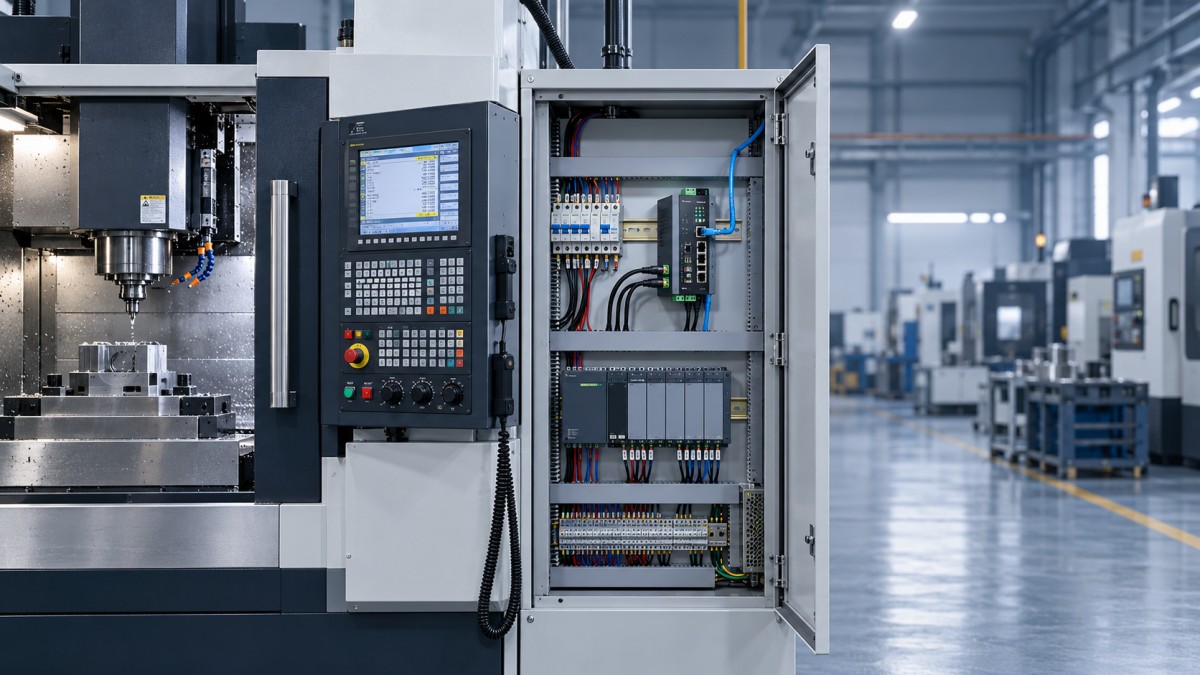
Claims of “read-only” access deserve similar scrutiny. A connector may be configured to read data while its underlying driver still supports writes. Stronger protection combines restricted permissions, appropriate network controls, and configuration that prevents unauthorized commands. On serial networks, adding another polling master may be incompatible with the existing arrangement; an approved intermediary or a different acquisition route may be necessary.
Prove that the data remains meaningful and usable
Legacy equipment can expose technically valid values that are unsuitable for the intended calculation. A counter might reset on restart, wrap at its maximum value, or record machine cycles rather than accepted products. A temperature value might represent a setpoint rather than a measured temperature. These are semantic issues, not communication faults.
For every critical signal, establish:
- Meaning and units: what the value represents, including scaling and valid range.
- Origin: whether it is measured, calculated, manually entered, or inferred.
- Time basis: whether its timestamp represents measurement, gateway receipt, or platform ingestion.
- Quality: how invalid, stale, disconnected, or substituted values are identified.
- Reset behavior: what happens after power loss, maintenance, counter rollover, or configuration changes.
Timestamp handling becomes particularly important when combining sources. A gateway can timestamp receipt accurately while the underlying measurement is already old. Synchronizing gateway clocks does not remove delays introduced by sequential polling or slow device updates. If the application depends on the order of closely spaced events, source-level event recording may be necessary.
Collection frequency must also match both the process and the equipment’s capacity. Polling faster than a controller updates a value produces repeated readings, not additional insight. Polling many registers individually can generate more communication overhead than grouped reads, where supported. The proposed load needs validation against controller behavior and existing HMI or supervisory traffic.
For intermittent networks, require defined local buffering behavior. The relevant questions include how long records are retained, whether timestamps survive an outage, what happens when storage fills, and how replayed records are distinguished from live data. A restored connection should not silently turn historical readings into apparently current operating conditions.
Keep integration outside the machine’s safety and control assumptions
A legacy controller may have been installed on an isolated network without the security capabilities expected of modern connected systems. Making its data accessible should not mean making the controller broadly reachable.
A defensible architecture separates equipment networks from enterprise services, permits only necessary communication paths, and uses controlled access between zones. Where supported, an edge device can initiate an authenticated connection toward an upstream service without requiring unsolicited inbound access to the controller network. Encryption protects that connection, but does not compensate for unrestricted access on the equipment side.
Platform evaluation should include gateway hardening, certificate renewal, credential storage, software updates, audit records, and remote-support controls. For an asset that cannot support modern authentication, protective controls must sit around it. A gateway does not eliminate the underlying device’s limitations.
Physical modifications require equal care. Connecting acquisition hardware to an existing analog loop can affect its electrical behavior if the installation is incorrectly designed. Work inside machinery panels may require isolation, qualified installation, and review of applicable equipment requirements. Safety-related circuits should not become convenient data sources without an appropriate engineering assessment.
Failure behavior is a useful dividing line. If the platform, gateway, or external network stops working, the machine should retain its intended local operation. Where remote commands are required, loss of communication and stale commands need explicitly defined responses. Cloud connectivity should not be assumed suitable for time-critical or safety-related control.
Ask for evidence on the difficult assets
A demonstration using a modern controller proves little about a mixed legacy estate. A meaningful proof of concept includes the assets most likely to challenge the proposed architecture: an undocumented device, a heavily used communication link, a remote installation, or equipment with restricted access.
Acceptance criteria should connect technical performance to the intended use. Suitable evidence includes:
- Required values agree with a trusted local reference across relevant operating states.
- Measured update rates and end-to-end delays meet the application’s requirements.
- Communication faults create visible quality changes rather than frozen “healthy” values.
- Equipment and existing supervisory functions remain within approved operating limits.
- Power and network interruptions produce the agreed recovery and buffering behavior.
- Write restrictions and access boundaries operate as designed.
- Configuration can be backed up, restored, and transferred to replacement hardware.
Tests should include starts, stops, fault states, and relevant mode changes—not only steady operation. Counter interpretation and missing status mappings can remain invisible during an uneventful demonstration. Intrusive tests belong in an approved maintenance window or representative test environment, with a rollback procedure agreed beforehand.
Connector support also needs a precise definition. Ask whether the supplier supports the device-specific driver, only the gateway runtime, or merely the platform’s ingestion endpoint. A working custom script can demonstrate feasibility while leaving a substantial maintenance obligation unresolved.
Select for maintainable coverage, not the largest protocol list
The integration cost extends beyond a platform license and gateway hardware. It can include documentation recovery, driver engineering, signal mapping, panel work, network changes, commissioning downtime, security maintenance, and recurring configuration updates. Compare alternatives against the same required signals and service expectations; otherwise, a cheaper proposal may simply deliver less usable information.
A platform is a stronger fit when supported connectors cover the actual equipment, data quality remains visible, deployment does not disturb control functions, and maintenance responsibilities are clear. Exportable data and configuration, documented interfaces, and replaceable edge hardware reduce dependence on a single implementation.
Partial connectivity can be the right decision. Connecting the signals needed for a defined operational task may be more defensible than attempting to expose every internal tag. Conversely, if essential data requires undocumented workarounds, unacceptable production risk, or extensive custom support, a targeted controller upgrade may be preferable to adding layers of conversion.
The practical answer is therefore yes—but approval should attach to a verified connection path for a specified purpose. The strongest evidence is not that a platform can display a legacy machine’s value. It is that the value remains correct, timely, secure, and maintainable without undermining the equipment that produces it.
Questions about this sector or your project? Contact Sector Deep Dive for expert insights.
We respect your privacy. Your information is strictly confidential.
Get weekly intelligence in your inbox.
No noise. No sponsored content. Pure intelligence.
News Recommendations
 Nov 03, 2026How to prepare component specifications that suppliers can quote accuratelyHow to prepare component specifications that suppliers can quote accurately
 Nov 01, 2026How much does an engineering data platform cost to implement?How much does an engineering data platform cost to implement?
 Oct 27, 2026How to verify ISO compliance references in supplier documentsHow to verify ISO compliance references in supplier documents
 Oct 26, 2026Can an industrial technology platform connect legacy equipment?Can an industrial technology platform connect legacy equipment?
 Oct 26, 2026Buying or Renting a Slurry Dredger for Short-Term Sand RemovalBuying or Renting a Slurry Dredger for Short-Term Sand Removal
 Oct 24, 2026How to choose a product comparison database with reliable dataHow to choose a product comparison database with reliable data
 Oct 19, 2026An industrial buyer's guide to comparing equipment lifecycle costsAn industrial buyer's guide to comparing equipment lifecycle costs
 Oct 19, 2026Comparing Ductile Iron Pipe Quotes Beyond the Price per MetreComparing Ductile Iron Pipe Quotes Beyond the Price per Metre
 Oct 19, 2026Water Pipeline Ball Valve Procurement: What to Specify in an RFQWater Pipeline Ball Valve Procurement: What to Specify in an RFQ
 Oct 18, 2026How to prepare project specifications that make bids comparableHow to prepare project specifications that make bids comparable
 Oct 17, 2026How to select industrial equipment for continuous-duty operationHow to select industrial equipment for continuous-duty operation
 Oct 16, 2026How to evaluate long-term software support when choosing electronicsHow to evaluate long-term software support when choosing electronics
 Oct 13, 2026How to verify an industrial compliance information platform's accuracyHow to verify an industrial compliance information platform's accuracy
 Oct 12, 2026What to look for in a processing services guide before outsourcingWhat to look for in a processing services guide before outsourcing
 Oct 09, 2026How to source urban technology solutions without vendor lock-inHow to source urban technology solutions without vendor lock-in
 Oct 08, 2026Which customization options add value to OEM projects?Which customization options add value to OEM projects?
 Oct 08, 2026Best practices for digital twin ROI start with measurable use casesBest practices for digital twin ROI start with measurable use cases
 Oct 08, 2026What to map before starting an automation planning processWhat to map before starting an automation planning process
 Oct 08, 2026Supply Checks for a YLCSD200 Cutter Suction Dredger Procurement PlanSupply Checks for a YLCSD200 Cutter Suction Dredger Procurement Plan
 Oct 07, 2026How procurement planning lead time affects project delivery riskHow procurement planning lead time affects project delivery risk
 Oct 06, 2026When does procurement planning support reduce project cost overruns?When does procurement planning support reduce project cost overruns?
 Oct 05, 2026What makes an industrial machinery information platform reliable?What makes an industrial machinery information platform reliable?
 Oct 02, 2026What makes a mining equipment information platform reliable for sourcing?What makes a mining equipment information platform reliable for sourcing?
 Sep 27, 2026What drives deep-sea mining cost estimates before project approval?What drives deep-sea mining cost estimates before project approval?
 Sep 25, 2026Which logistics technology software features reduce manual shipment updates?Which logistics technology software features reduce manual shipment updates?
 Sep 22, 2026How to compare total landed cost in industrial solutions procurementHow to compare total landed cost in industrial solutions procurement
 Sep 21, 2026When do logistics technology solutions reduce warehouse picking errors?When do logistics technology solutions reduce warehouse picking errors?


