
Which customization options add value to OEM projects?
A procurement review can go off track when a proposed OEM configuration looks impressive on a specification sheet but adds little to the operating environment it will enter. A customized control panel may be unnecessary if operators already use a standard interface; a non-standard enclosure may complicate maintenance; a branded exterior may matter less than a revised mounting pattern that shortens installation time. The valuable customization options for OEM projects are the ones that improve fit, reduce identifiable project risk, or lower lifecycle burden without making the product harder to build, approve, service, or replace.
For business evaluators, the first decision is not “How much can this supplier customize?” It is which changes solve a defined operational, commercial, or compliance problem. In infrastructure, urban technology, rail, mining, construction equipment, and special-purpose vehicles, the highest-value changes usually affect interfaces, duty performance, safety, integration, maintainability, and controlled product identity. Decorative or highly bespoke features should only proceed when they support a measurable project requirement.
Start with the operating condition, not the option list
Customization discussions often begin with a catalog of possible variations: dimensions, materials, sensors, colors, software functions, connectors, labels, and packaging. That list is useful, but it does not establish value. A stronger evaluation starts with the conditions that the finished equipment must withstand and the parties who will interact with it over its service life.
Consider a component being integrated into a roadside cabinet, a rail maintenance vehicle, a smart-building control assembly, or a resource-handling machine. The relevant questions are different in each setting. Will it be exposed to vibration, moisture, dust, heat, salt air, electrical noise, frequent washdown, or repeated shock loads? Does it need to connect to an existing controller? Can a field technician access it with ordinary tools? Is downtime expensive? Does the end user require common spare parts across several equipment types?
A customization option adds value when it answers one of those conditions directly. It creates avoidable cost when it is selected because it is available, because it resembles a previous project, or because its benefit has not been linked to acceptance criteria.
Interface customization is often the most commercially valuable
In OEM projects, integration failures are frequently more costly than limitations in the underlying component. A technically capable unit can still delay commissioning if its mounting points, cable routing, power input, communication protocol, hydraulic connection, or physical clearance do not match the host system. This is why interface customization deserves early attention.
Mechanical fit and installation access
Changes to mounting-hole patterns, bracket geometry, footprint, service clearance, lifting points, and cable-entry direction can have a direct effect on assembly labor and future replacement. These changes are especially valuable when the host equipment has a constrained enclosure, standardized chassis, or fixed installation sequence.
However, evaluators should separate a sensible adaptation from a complete redesign. Altering a mounting plate while retaining the supplier’s proven core housing is generally easier to validate than changing the housing structure itself. Ask whether the requested modification affects load paths, sealing surfaces, cooling paths, vibration behavior, or access to internal components. A small dimensional revision can have wider consequences than it first appears.
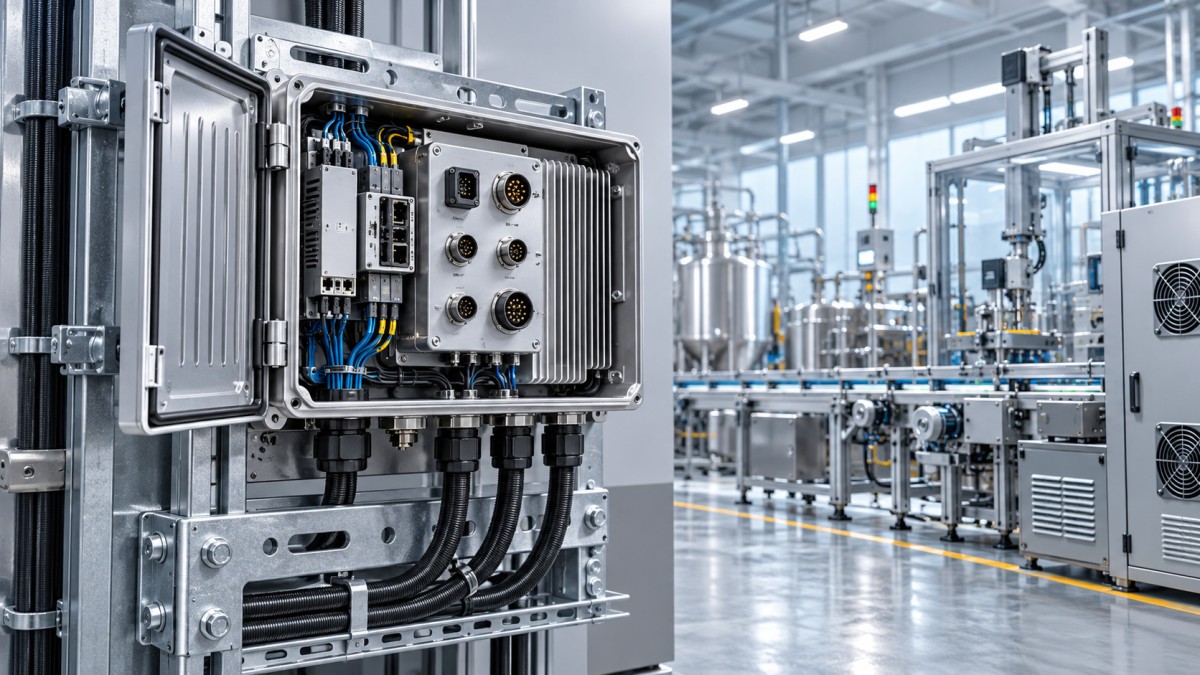
Electrical, fluid, and data connections
Connector selection, voltage range, pin assignments, hose fittings, communication interfaces, and diagnostic access are often worth customizing when they remove adapters or reduce wiring complexity. Adapters can be appropriate during development or low-volume deployment, but permanent stacks of converters and non-standard harnesses introduce more connection points to inspect and more parts to stock.
For connected equipment, compatibility is not limited to whether data can technically pass between systems. Clarify message formats, polling intervals, alarm priorities, time synchronization, remote-update controls, and the location of data ownership. A sensor package that provides useful readings but cannot deliver them in a form the project’s control environment can use may become an expensive isolated feature.
Performance options should be tied to the actual duty cycle
A common evaluation error is choosing the highest-rated motor, pump, battery, controller, cooling package, or structural material without confirming the duty pattern. Higher capacity can improve resilience, but it can also increase power draw, weight, heat generation, procurement lead time, or service complexity. The correct configuration depends on peak load, sustained load, cycle frequency, ambient conditions, start-stop behavior, and expected degradation over time.
For example, an upgraded thermal package may be valuable where equipment operates in enclosed spaces, high ambient temperatures, or continuous cycles. It may offer little benefit where the actual load is intermittent and airflow is adequate. Similarly, a more robust corrosion-resistant finish is a strong choice in coastal, chemical, wet, or washdown settings, while an over-specified finish can add cost and repair constraints in sheltered indoor use.
The supplier should be able to explain the design boundary between a standard option, a configurable option, and an engineered exception. That distinction matters because it affects validation effort, production repeatability, warranty treatment, and lead-time predictability. A high-value custom feature is not necessarily one that is unique; it may simply be a controlled option that has already been designed for repeatable use.
Controls and software should improve decisions or maintenance
Smart-control features can add genuine value, especially when they help operators act earlier, help maintenance teams identify faults, or allow the host system to coordinate equipment safely. Yet connected functions should not be approved merely because a project is described as intelligent, digital, or automated.
Useful control customization normally has a defined user action behind it. An alarm should identify a condition, indicate its urgency, and lead to a clear response. A dashboard should show information needed for operation, maintenance planning, energy management, safety supervision, or asset reporting. Remote access should have clear permission levels and a fallback mode if communications are unavailable.
During assessment, request clarity on the following points:
- Which parameters are measured, and which are estimated or derived?
- What conditions trigger alarms, warnings, shutdowns, or maintenance notices?
- Can threshold settings be adjusted, and who is authorized to change them?
- How will firmware changes be controlled and documented across deployed units?
- Will the customized interface expose diagnostics needed by field teams, or only high-level status?
- What happens locally if a network, gateway, or cloud connection is unavailable?
A bespoke user interface can be justified where it reduces training burden across a fleet or aligns with an established operating philosophy. It should still preserve access to essential diagnostic information. Hiding fault detail behind a highly simplified display may make the equipment easier to demonstrate but harder to restore during an outage.
Compliance and safety adaptations deserve separate scrutiny
Some customization requests arise because an OEM product must fit a jurisdiction, owner standard, site rule, or application-specific safety process. These may include labeling, documentation language, emergency-stop placement, guarding, electrical protection, access controls, fire-related provisions, traceability markings, or environmental restrictions on materials.
These changes can be essential, but they should not be treated as simple cosmetic revisions. An altered enclosure, cable gland, access panel, protective guard, or safety logic can affect the original design assumptions. The evaluator should determine whether the requested configuration remains within the supplier’s established design scope and what evidence will accompany delivery. The relevant question is not simply whether a component is described as compliant; it is whether the assembled, customized product can be accepted in its intended installed condition.
Documentation is part of the value. Updated drawings, wiring diagrams, parts lists, configuration records, operating instructions, and maintenance procedures help prevent confusion when equipment changes hands from design teams to installers, operators, and service providers. A customized product without configuration-specific documentation may create problems long after the original purchase decision has been forgotten.
Branding and appearance have value, but usually after functional fit
Private labeling, color matching, decals, control-panel language, packaging, and product-family styling can be commercially important. They may support a consistent fleet appearance, simplify handover to an end user, or allow an equipment manufacturer to present a coherent offer across sourced subsystems. In public-facing urban equipment or specialized vehicles, visual consistency can also affect acceptance and operational identification.
These options should be reviewed alongside maintenance realities. Labels must remain legible in the relevant environment. Branding should not obscure safety markings, serial information, access points, or inspection instructions. Custom colors and finishes should be specified in a way that permits touch-up and replacement over the asset’s life. A distinctive appearance that cannot be practically maintained may create unnecessary cost for operations teams.
Lifecycle support determines whether customization remains an asset
The strongest customization options for OEM projects do not create a service trap. Before approval, examine what will happen when the unit needs repair, a replacement is required, or the host product evolves. A custom board, enclosure, harness, or software build may work well at launch but become difficult to support if it depends on unique tools, undocumented settings, or low-volume parts.
Ask the supplier to identify which elements remain standard, which are configurable, and which are exclusive to the project. This makes it easier to judge spare-parts exposure. It also helps distinguish a controlled variant from a one-off design that could require fresh engineering work for every future order.
Useful lifecycle questions include:
- Can key wear parts and service items be replaced without changing the full customized assembly?
- Are part numbers, revision levels, and configuration records visible on delivered documentation?
- Will service personnel need specialized tools, software access, or calibration procedures?
- Can a later production batch remain interoperable with the first batch?
- What design changes require revalidation of the host equipment?
- Is there a practical route to substitute a discontinued component without redesigning the interface?
Evaluators should also consider scale. A custom configuration that is appropriate for a stable, repeatable equipment platform may not be appropriate for a pilot deployment with uncertain volumes. In the latter situation, modularity and reversibility often carry more value than a tightly optimized bespoke design.
A practical way to prioritize customization requests
When several options are being considered, assign each one to a clear value category: mandatory fit, risk reduction, operational improvement, commercial identity, or preference. Then test it against its added cost, lead-time effect, validation requirement, supply-chain dependency, and service consequence. An option that serves mandatory fit or reduces a credible safety, integration, or downtime risk will normally rank above a feature selected mainly for preference.
The most useful customization options for OEM projects are usually those that preserve a proven core product while adapting the points where it meets the real world: the mounting surface, electrical architecture, communication environment, operating climate, user workflow, and maintenance process. That approach avoids the false choice between a rigid standard product and a fully bespoke redesign. It focuses investment on the modifications that help the equipment be installed correctly, operate predictably, and remain supportable throughout its intended life.
Questions about this sector or your project? Contact Sector Deep Dive for expert insights.
We respect your privacy. Your information is strictly confidential.
Get weekly intelligence in your inbox.
No noise. No sponsored content. Pure intelligence.
News Recommendations
 Nov 03, 2026How to prepare component specifications that suppliers can quote accuratelyHow to prepare component specifications that suppliers can quote accurately
 Nov 01, 2026How much does an engineering data platform cost to implement?How much does an engineering data platform cost to implement?
 Oct 27, 2026How to verify ISO compliance references in supplier documentsHow to verify ISO compliance references in supplier documents
 Oct 26, 2026Can an industrial technology platform connect legacy equipment?Can an industrial technology platform connect legacy equipment?
 Oct 26, 2026Buying or Renting a Slurry Dredger for Short-Term Sand RemovalBuying or Renting a Slurry Dredger for Short-Term Sand Removal
 Oct 24, 2026How to choose a product comparison database with reliable dataHow to choose a product comparison database with reliable data
 Oct 19, 2026An industrial buyer's guide to comparing equipment lifecycle costsAn industrial buyer's guide to comparing equipment lifecycle costs
 Oct 19, 2026Comparing Ductile Iron Pipe Quotes Beyond the Price per MetreComparing Ductile Iron Pipe Quotes Beyond the Price per Metre
 Oct 19, 2026Water Pipeline Ball Valve Procurement: What to Specify in an RFQWater Pipeline Ball Valve Procurement: What to Specify in an RFQ
 Oct 18, 2026How to prepare project specifications that make bids comparableHow to prepare project specifications that make bids comparable
 Oct 17, 2026How to select industrial equipment for continuous-duty operationHow to select industrial equipment for continuous-duty operation
 Oct 16, 2026How to evaluate long-term software support when choosing electronicsHow to evaluate long-term software support when choosing electronics
 Oct 13, 2026How to verify an industrial compliance information platform's accuracyHow to verify an industrial compliance information platform's accuracy
 Oct 12, 2026What to look for in a processing services guide before outsourcingWhat to look for in a processing services guide before outsourcing
 Oct 09, 2026How to source urban technology solutions without vendor lock-inHow to source urban technology solutions without vendor lock-in
 Oct 08, 2026Which customization options add value to OEM projects?Which customization options add value to OEM projects?
 Oct 08, 2026Best practices for digital twin ROI start with measurable use casesBest practices for digital twin ROI start with measurable use cases
 Oct 08, 2026What to map before starting an automation planning processWhat to map before starting an automation planning process
 Oct 08, 2026Supply Checks for a YLCSD200 Cutter Suction Dredger Procurement PlanSupply Checks for a YLCSD200 Cutter Suction Dredger Procurement Plan
 Oct 07, 2026How procurement planning lead time affects project delivery riskHow procurement planning lead time affects project delivery risk
 Oct 06, 2026When does procurement planning support reduce project cost overruns?When does procurement planning support reduce project cost overruns?
 Oct 05, 2026What makes an industrial machinery information platform reliable?What makes an industrial machinery information platform reliable?
 Oct 02, 2026What makes a mining equipment information platform reliable for sourcing?What makes a mining equipment information platform reliable for sourcing?
 Sep 27, 2026What drives deep-sea mining cost estimates before project approval?What drives deep-sea mining cost estimates before project approval?
 Sep 25, 2026Which logistics technology software features reduce manual shipment updates?Which logistics technology software features reduce manual shipment updates?
 Sep 22, 2026How to compare total landed cost in industrial solutions procurementHow to compare total landed cost in industrial solutions procurement
 Sep 21, 2026When do logistics technology solutions reduce warehouse picking errors?When do logistics technology solutions reduce warehouse picking errors?


