Can deep-sea mining equipment operate profitably in 2026?
Is deep-sea mining equipment commercially viable in 2026? Potentially—but a successful machine trial is not the same as a profitable mining operation. For a business evaluator, the investment case depends on the entire chain: legal access to a deposit, reliable collection and transport, mineral recovery, financing, environmental obligations and a buyer willing to pay for the product.
The practical conclusion is cautious. Equipment may be technically capable of collecting material while the project remains unfinanceable or unable to operate at a competitive cost. In 2026, treat profitability as a project-specific claim to verify, not an established characteristic of the equipment category.
Start with the mining system, not the collector
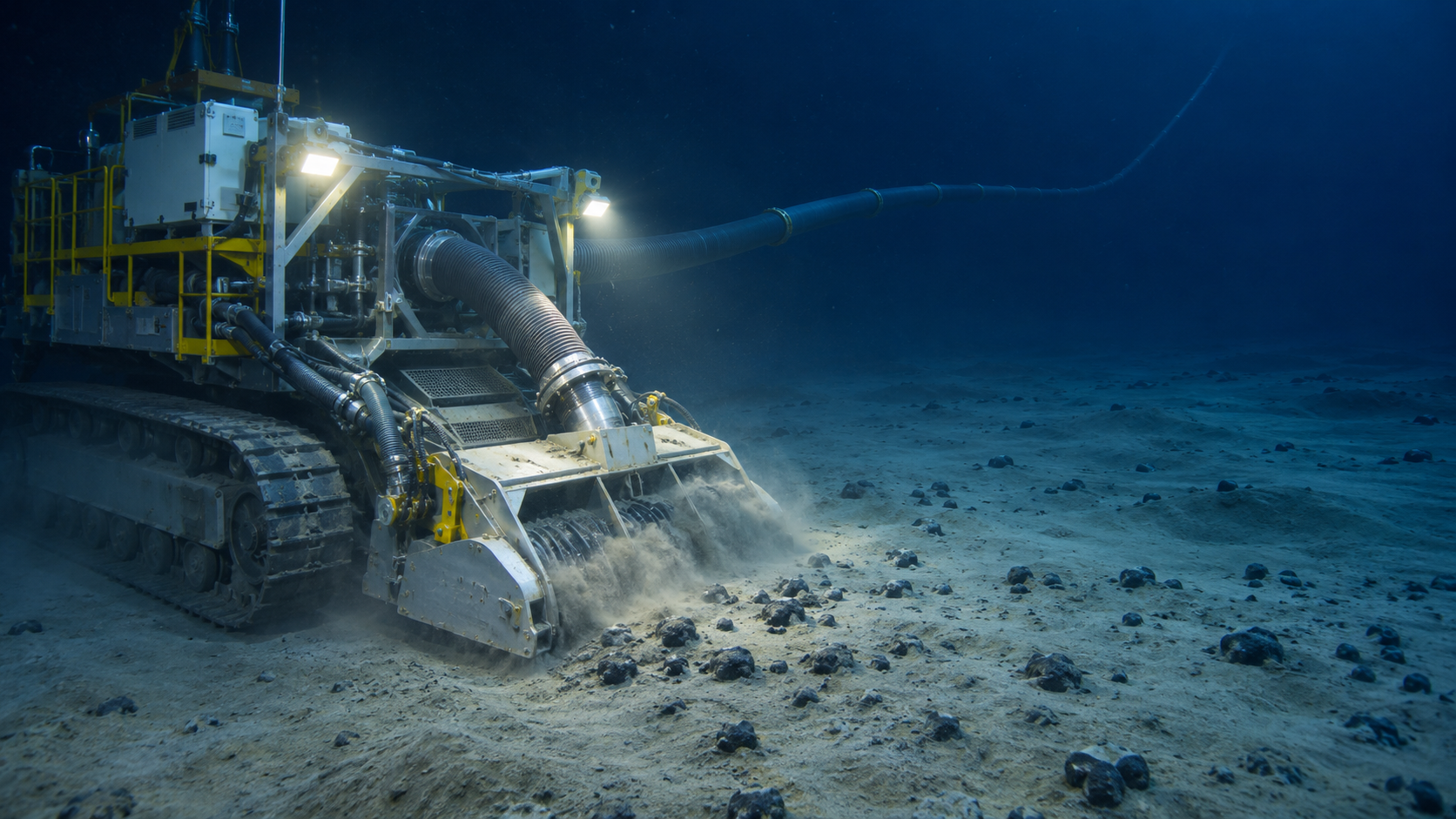
For polymetallic nodules, a proposed operation typically combines a seabed collector, a riser and lift system, a surface support vessel, offshore handling, transport and onshore processing. Sulfide deposits and cobalt-rich crusts present different geological and engineering conditions; a machine designed for nodules should not be assumed suitable for those resources.
A collector that performs well in isolation can still sit inside an uneconomic system. Riser blockages, vessel downtime, difficult material handling or poor processing recoveries can erase the benefit of an attractive collection rate. The International Seabed Authority (ISA) describes these mineral resources and their distinct settings in its overview of deep-sea minerals. Source: ISA, “Deep-sea minerals,” https://www.isa.org.jm/deep-seabed-minerals/.
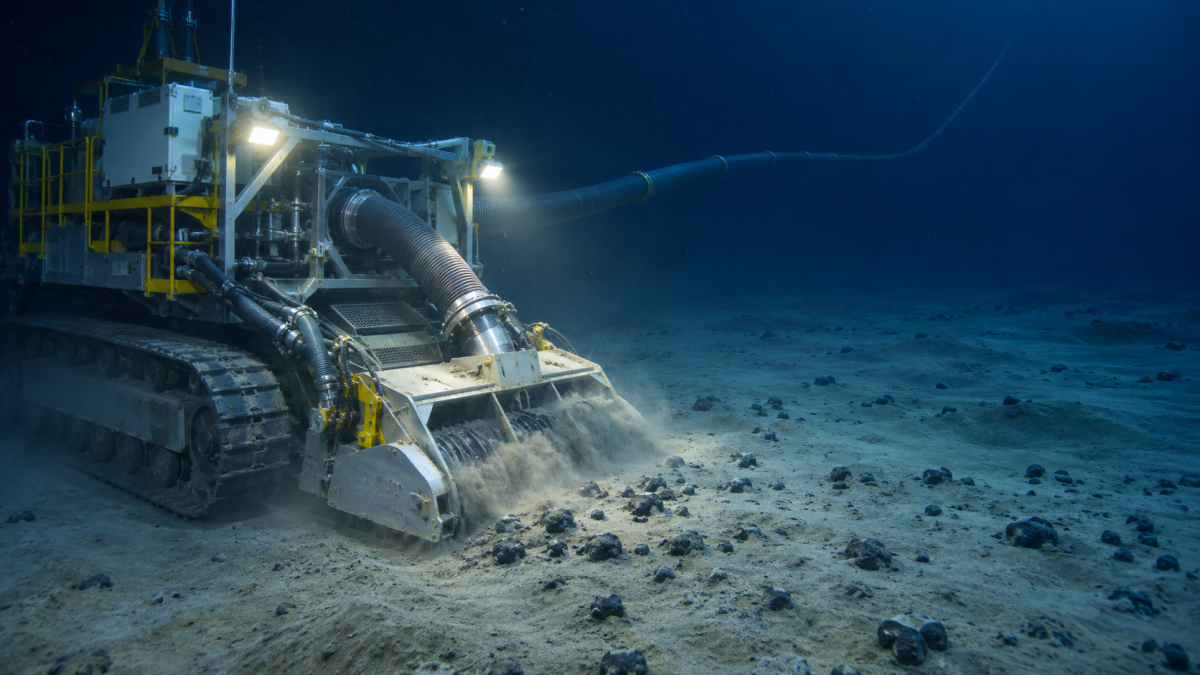
Selection implication: compare complete operating configurations on a common basis. Ask each vendor to define the deposit, water depth, support vessels, operating season, maintenance concept and downstream process assumed in its performance claim.
Is deep-sea mining equipment commercially viable in 2026 under your jurisdiction?
Legal access is a threshold condition, not a line item to be resolved after equipment selection. The applicable route depends on where the deposit lies and which state or international authority has jurisdiction. Exploration rights should not be treated as automatic permission to conduct commercial exploitation.
For mineral resources in the international seabed area beyond national jurisdiction, the ISA administers exploration contracts and is developing exploitation regulations. The applicable approval process and the status of those regulations must be checked against current ISA decisions before committing capital. Source: ISA, “The Mining Code,” https://www.isa.org.jm/the-mining-code/.
Projects within national jurisdiction are subject to the relevant state’s laws and permitting decisions. A prospective operator should obtain jurisdiction-specific legal advice on rights, environmental approvals, vessel operations, liability, financial assurance and any restrictions on commercial activity. Government positions and rules can change; a general industry announcement is not a substitute for a project-specific legal opinion.
- Verify the right: Identify the license holder, permitted activity, geographic area, term and conditions for transfer or renewal.
- Map the approvals: Separate exploration, test mining, exploitation, marine operations and onshore processing permissions.
- Test the schedule: Include consultation, environmental review, possible challenges and financing conditions—not just equipment delivery.
- Check exit exposure: Determine who pays for removal, remediation, monitoring and outstanding obligations if the project stops.
Build the profitability model from recovered, saleable metal
A headline capacity measured in wet tonnes collected per day is a weak basis for valuation. Revenue depends on the quantity and quality of saleable products delivered to customers, after operational losses and processing. The model should follow material from the seabed to the point of sale, with each conversion and cost visible.
A defensible calculation starts with dry feed delivered to the processing plant. Apply representative grades and metallurgical recoveries to estimate payable product, then use the relevant contractual price and deductions. Subtract operating costs, sustaining capital, royalties and taxes as applicable; assess the timing of initial capital and future cash flows through a discounted cash-flow model.
Avoid counting recovery twice: if an estimate already represents recovered payable metal, do not apply the same processing recovery again. Conversely, do not assume that metal contained in collected material is fully saleable. Present revenue and cost assumptions separately for each product where the commercial terms differ.
For an equipment-only purchase, extend the same logic to incremental project cash flow: compare the proposed system with the realistic alternative, including installation, integration, financing and end-of-life costs. A cheaper machine is not necessarily cheaper per unit of saleable metal.
Stress-test the variables that interact
Run a base case, a downside case and an integrated severe case. The last should combine related problems: for example, lower utilization can increase unit cost while a delayed permit pushes revenue further into the future. Include at least:
- Lower production: Reduced collection efficiency, more maintenance, longer transit and processing bottlenecks.
- Weaker net pricing: Lower realized prices, less favorable payability and higher freight or treatment charges.
- Higher capital needs: Vessel modifications, integration changes, spare riser components and financing during delay.
- Additional obligations: Extended monitoring, mitigation, insurance or financial assurance required by the final authorization.
Report the break-even realized price or break-even annual saleable output alongside net present value. State the discount rate and financing assumptions. If the project survives only when several optimistic assumptions occur together, the equipment has not yet demonstrated an investable commercial case.
Compare equipment using evidence gates
Vendor specifications are useful for screening, but the decisive question is whether the complete system can deliver repeatable output in the intended conditions. Use the same evidence requirements for competing suppliers, and distinguish observed performance from simulation or design estimates.
Ask for raw or independently reviewable test data where commercially possible, including unsuccessful runs. A short demonstration can establish basic functionality; it cannot alone prove annual uptime, component life or environmental acceptability. Include an independent marine engineering and metallurgical review before treating vendor assumptions as bankable.
Environmental obligations are part of equipment economics
Seafloor disturbance, sediment plumes, noise and potential effects on marine ecosystems are not merely reputational issues. They can influence mine layout, operating restrictions, monitoring equipment, vessel time and the feasibility of approval. The scale and persistence of impacts depend on the setting and activity, and important scientific uncertainties remain. Source: International Union for Conservation of Nature, “Deep-sea mining,” https://iucn.org/resources/issues-brief/deep-sea-mining.
Request a project-specific environmental baseline and impact assessment strategy, including how the operator will measure effects before, during and after operations. Ask what happens commercially if monitoring triggers a pause, a smaller operating footprint or a change in discharge arrangements. Do not credit an unproven mitigation measure as a guaranteed reduction in cost or impact.
Commercial exposure extends beyond permitting. Lenders, insurers, processors and end customers may impose their own environmental or sourcing conditions. A technically compliant project still needs to establish that the intended financing and sales channels are available on acceptable terms.
A practical procurement decision for 2026
- Screen jurisdiction and rights. Stop the evaluation if the proposed activity lacks a credible legal route or the operator cannot demonstrate the necessary rights.
- Define the operating envelope. Specify deposit characteristics, water depth, production target, environmental constraints and the interfaces between offshore and onshore systems.
- Request a complete scope. Require itemized pricing, exclusions, vessel assumptions, spares, maintenance support and responsibilities for system integration.
- Validate the production model. Reconcile test evidence with resource estimates, utilization, processing recovery and buyer specifications.
- Price the downside. Model delay, lower output and higher obligations together; identify the capital required before first revenue and under a prolonged ramp-up.
- Make commitments conditional. Where commercially negotiable, link major expenditure to permits, financing, verified performance and agreed acceptance criteria.
The preferred option may be a staged engineering study or a limited test program rather than immediate fleet procurement. Equally, delaying a purchase has a cost: compare the option value of waiting with supplier availability, development spending and the consequences of a missed commercial window.
Frequently asked questions
Can a successful offshore trial prove that a system will be profitable?
No. It can reduce technical uncertainty, particularly when test conditions and results are transparent. Profitability also requires sustained system utilization, viable processing, legal approval, acceptable environmental performance and commercial terms that cover the full project cost.
Which metric is most useful when comparing equipment?
Use risk-adjusted cost per unit of payable product over the relevant project life, supported by total capital, utilization and cash-flow analysis. Review it alongside absolute production and liquidity needs: a low unit cost does not help if the operator cannot fund the equipment or survive the ramp-up.
What should trigger a no-go decision?
Examples include an unclear legal pathway, an inability to verify resource or recovery assumptions, no credible buyer for the proposed product, or a downside case that exceeds available funding. These are project-level findings; they do not imply that every deep-sea mining technology is inherently uncommercial.
Questions about this sector or your project? Contact Sector Deep Dive for expert insights.
We respect your privacy. Your information is strictly confidential.
Get weekly intelligence in your inbox.
No noise. No sponsored content. Pure intelligence.
News Recommendations
 Nov 23, 2026Excavator Pontoon Procurement: Evaluating Compatibility and DocumentationExcavator Pontoon Procurement: Evaluating Compatibility and Documentation
 Nov 22, 2026Can deep-sea mining equipment operate profitably in 2026?Can deep-sea mining equipment operate profitably in 2026?
 Nov 16, 2026What are the main arteries of a logistics network?What are the main arteries of a logistics network?
 Nov 15, 2026How to build a resource allocation model for multiple projectsHow to build a resource allocation model for multiple projects
 Nov 14, 2026Industrial compliance guide to identifying applicable regulationsIndustrial compliance guide to identifying applicable regulations
 Nov 08, 2026Which industrial equipment categories suit material handling?Which industrial equipment categories suit material handling?
 Nov 06, 2026How much does it cost to invest in urban technology?How much does it cost to invest in urban technology?
 Nov 04, 2026How to choose packaging for heavy industrial productsHow to choose packaging for heavy industrial products
 Nov 03, 2026How to prepare component specifications that suppliers can quote accuratelyHow to prepare component specifications that suppliers can quote accurately
 Nov 01, 2026How much does an engineering data platform cost to implement?How much does an engineering data platform cost to implement?
 Oct 27, 2026How to verify ISO compliance references in supplier documentsHow to verify ISO compliance references in supplier documents
 Oct 26, 2026Can an industrial technology platform connect legacy equipment?Can an industrial technology platform connect legacy equipment?
 Oct 26, 2026Buying or Renting a Slurry Dredger for Short-Term Sand RemovalBuying or Renting a Slurry Dredger for Short-Term Sand Removal
 Oct 24, 2026How to choose a product comparison database with reliable dataHow to choose a product comparison database with reliable data
 Oct 19, 2026An industrial buyer's guide to comparing equipment lifecycle costsAn industrial buyer's guide to comparing equipment lifecycle costs
 Oct 19, 2026Comparing Ductile Iron Pipe Quotes Beyond the Price per MetreComparing Ductile Iron Pipe Quotes Beyond the Price per Metre
 Oct 19, 2026Water Pipeline Ball Valve Procurement: What to Specify in an RFQWater Pipeline Ball Valve Procurement: What to Specify in an RFQ
 Oct 18, 2026How to prepare project specifications that make bids comparableHow to prepare project specifications that make bids comparable
 Oct 17, 2026How to select industrial equipment for continuous-duty operationHow to select industrial equipment for continuous-duty operation
 Oct 16, 2026How to evaluate long-term software support when choosing electronicsHow to evaluate long-term software support when choosing electronics
 Oct 13, 2026How to verify an industrial compliance information platform's accuracyHow to verify an industrial compliance information platform's accuracy
 Oct 12, 2026What to look for in a processing services guide before outsourcingWhat to look for in a processing services guide before outsourcing
 Oct 09, 2026How to source urban technology solutions without vendor lock-inHow to source urban technology solutions without vendor lock-in
 Oct 08, 2026Which customization options add value to OEM projects?Which customization options add value to OEM projects?
 Oct 08, 2026Best practices for digital twin ROI start with measurable use casesBest practices for digital twin ROI start with measurable use cases
 Oct 08, 2026What to map before starting an automation planning processWhat to map before starting an automation planning process
 Oct 08, 2026Supply Checks for a YLCSD200 Cutter Suction Dredger Procurement PlanSupply Checks for a YLCSD200 Cutter Suction Dredger Procurement Plan