Automated Waste Systems: Cost Factors and Payback
Automated Waste Systems: Cost Factors and Payback
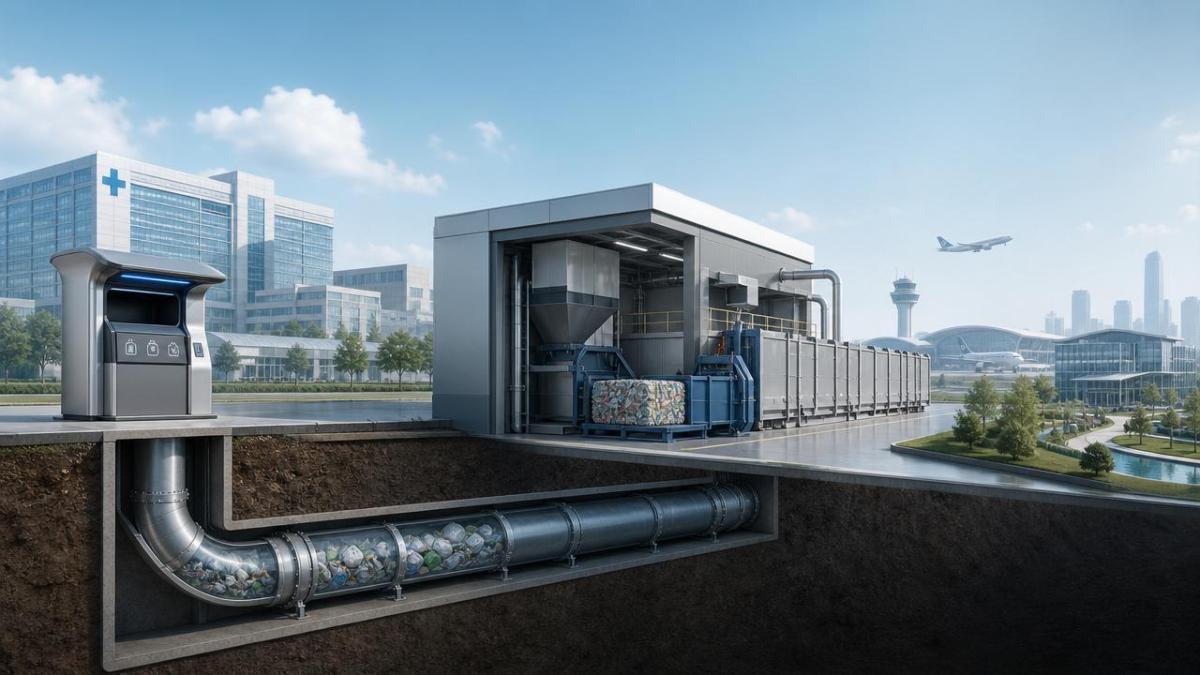
Automated waste systems have moved beyond a facilities upgrade. They now sit inside capital planning, labor strategy, and urban efficiency programs.
For approval teams, the main question is simple. What drives cost, and how fast does the investment pay back?
That question matters more in dense projects. Mixed-use districts, hospitals, airports, campuses, and smart neighborhoods all face rising collection pressure.
At the same time, labor shortages, stricter hygiene expectations, and carbon targets are changing the economics of waste handling.
In that environment, automated waste systems can reduce truck movements, lower manual handling, and improve space use across the asset lifecycle.
Still, payback is never automatic. It depends on system scope, building layout, operating volume, maintenance planning, and financing structure.
A better approval decision starts with a full-cost view. Upfront equipment alone tells only part of the story.
The stronger approach is to compare automated waste systems against current and future operating costs over ten to twenty years.
That also reduces approval risk. Budget justification becomes easier when the savings logic is visible, measurable, and linked to asset performance.
From a procurement perspective, the best decisions usually come from understanding cost drivers first, then testing realistic payback scenarios.
What Usually Makes Up the Cost of Automated Waste Systems
The capital cost of automated waste systems is shaped by both infrastructure and operations. This is where many early estimates go off track.
Pipe networks are often the biggest line item. Route length, pipe diameter, bends, vertical lifts, and connection density all affect installation cost.
Waste inlets also matter. More inlets improve user access, but they add civil works, controls, and future maintenance points.
Collection stations are another major factor. Their size depends on waste fractions, daily volume, storage needs, and site operating hours.
Fans, separators, compactors, filters, and odor control equipment shape the mechanical package. Higher throughput usually raises both capital and energy needs.
Control software is no longer a minor detail. Monitoring, predictive alerts, reporting, and integration with building systems can improve value.
But those functions must be priced correctly. Procurement teams should separate essential automation from optional digital layers.
Civil and architectural impacts are often underestimated. Utility conflicts, excavation depth, fire compliance, acoustic treatment, and service access can shift budgets fast.
Commissioning also deserves attention. Poor startup planning can delay occupancy, reduce performance, and create hidden rework costs.
A practical cost structure usually includes the following:
- Pipe network design, supply, and installation
- Waste inlets, valves, and user interface points
- Collection station, compaction, and container handling
- Power supply, controls, sensors, and software
- Civil works, structural adaptation, and permits
- Testing, commissioning, operator training, and warranty support
In real procurement reviews, total installed cost matters more than equipment price alone. That is the number that should anchor investment discussions.
The Operating Costs That Shape Real Payback
Payback for automated waste systems is mainly won or lost during operation. This is why lifecycle modeling matters so much.
Labor is usually the clearest savings category. Manual collection teams, internal transfer staff, and repetitive handling tasks can be reduced sharply.
Transport costs may also fall. Fewer internal carts, fewer collection routes, and fewer truck movements can improve both cost and site safety.
Space efficiency creates another financial benefit. Waste rooms on every floor or in every block consume high-value area.
When automated waste systems centralize storage and handling, that recovered space may support leasing, services, or other productive use.
Cleaning and hygiene costs can drop as well. Reduced spills, sealed transport, and lower touch frequency often mean lower sanitation effort.
However, operating savings should never ignore new cost lines. Energy consumption, preventive maintenance, spare parts, and software service fees must be included.
That is where some business cases become overly optimistic. A strong model uses conservative assumptions rather than best-case vendor numbers.
Typical operating cost categories include:
- Internal labor for collection, transfer, and supervision
- External transport and hauling frequency
- Energy use during suction and compaction cycles
- Routine maintenance, inspections, and wear parts
- Cleaning, pest control, and hygiene management
- Downtime risk and service response requirements
In many projects, the best payback does not come from one big saving. It comes from several medium-sized savings working together over time.
How to Estimate Payback Without Overselling the Case
A reliable payback model for automated waste systems starts with a baseline. That baseline should reflect current waste handling costs in full.
Include labor, hauling, space use, cleaning, compliance effort, and likely future cost increases. Inflation and labor escalation can materially change results.
Next, build at least three scenarios. Use a conservative case, an expected case, and a high-performance case.
This approach helps approval teams see risk range, not just a single headline number. It usually leads to better capital decisions.
Discounted cash flow is useful when the project is large. For faster screening, a simple payback period can still support early comparisons.
In practice, both methods are helpful. Simple payback is easy to communicate, while NPV and IRR better reflect long-term value.
A practical evaluation flow looks like this:
- Map current waste volume by day, peak, and season
- Quantify current labor and transport costs
- Model installed cost and commissioning risk
- Estimate energy, service, and maintenance cost
- Value space recovery and operational improvement
- Run conservative, expected, and upside scenarios
Most automated waste systems show stronger economics in dense, labor-intensive, or hygiene-sensitive assets. Hospitals and airports are common examples.
By contrast, low-density sites with cheap labor and short collection routes may face longer payback. That does not kill the case, but it changes the threshold.
Where Automated Waste Systems Usually Deliver the Best ROI
Not every project has the same economics. Automated waste systems usually perform best where operational complexity is already expensive.
Large residential communities benefit from reduced truck access and cleaner common areas. The savings often spread across labor, transport, and resident experience.
Hospitals gain from infection control, sealed handling, and fewer internal transfers. That operational value can be as important as direct cost savings.
Airports, rail hubs, and exhibition centers often see value from stable throughput under peak demand. Manual systems struggle when volumes spike sharply.
Mixed-use districts also stand out. Automated waste systems can simplify service logistics across retail, office, hospitality, and residential zones.
In smart city projects, the case can become broader. Fewer truck trips support lower congestion, lower emissions, and cleaner public space.
That broader value may not always sit in one budget line. Even so, it can influence approval when city-level outcomes are part of the mandate.
The key takeaway is simple. Automated waste systems reward density, complexity, and long asset life more than small, low-intensity operations.
Approval Risks to Check Before Signing Off
Even promising automated waste systems can disappoint if approval focuses only on the top-line business case.
The first risk is undersized design. If projected waste volume is too low, the system may face bottlenecks early.
The second risk is poor interface planning. Automated waste systems depend on smart coordination between civil, MEP, operations, and service access.
The third risk is maintenance underbudgeting. Deferred service can reduce uptime, shorten component life, and erode savings.
Contract structure matters too. Service scope, response time, spare parts terms, and performance guarantees should be clearly defined.
Before approval, review these checkpoints:
- Waste volume assumptions match real occupancy and use patterns
- Installed cost includes civil complexity and compliance items
- Service model includes preventive maintenance and critical spares
- Performance guarantees define throughput and availability
- Scenario model tests downside cases, not just optimistic ones
A disciplined review does more than protect budget. It improves confidence that automated waste systems will perform as approved, not just as promised.
A Smarter Way to Build the Business Case
The strongest business case for automated waste systems connects finance, operations, and long-term infrastructure value.
Start with total cost of ownership, not purchase price. Then link savings to labor, transport, hygiene, space, and urban performance.
Keep assumptions conservative. Use real site data where possible, and challenge every line that looks too smooth.
That is usually where better approvals happen. The case becomes easier to defend because it reflects operational reality.
In the current market, automated waste systems are not just a sustainability signal. They are a strategic infrastructure decision.
When designed well, they can reduce recurring cost, support cleaner urban operations, and strengthen long-term asset efficiency.
The next practical step is clear. Build a site-specific cost model, test three payback scenarios, and compare automated waste systems against the true lifecycle cost of doing nothing.
Get weekly intelligence in your inbox.
No noise. No sponsored content. Pure intelligence.
News Recommendations
 Sep 19, 2026How an electronics application guide helps prevent component mismatchHow an electronics application guide helps prevent component mismatch
 Sep 18, 2026When a resource allocation platform improves project deliveryWhen a resource allocation platform improves project delivery
 Sep 17, 2026What to compare when evaluating mineral processing equipment manufacturersWhat to compare when evaluating mineral processing equipment manufacturers
 Sep 16, 2026How mineral separation optimization can reduce concentrate lossesHow mineral separation optimization can reduce concentrate losses
 Sep 15, 2026How to assess lifecycle costs in urban tech procurementHow to assess lifecycle costs in urban tech procurement
 Sep 14, 2026Heavy industry technology trends reshaping capital investment prioritiesHeavy industry technology trends reshaping capital investment priorities
 Sep 14, 2026Why Infrastructure Equipment Buyers Are Shifting from Catalog-Based to Capability-Based Supplier SelectionWhy Infrastructure Equipment Buyers Are Shifting from Catalog-Based to Capability-Based Supplier Selection
 Sep 14, 2026Process Automation Project Execution: How to Align Supplier Capabilities with PLC Integration, Cybersecurity & Commissioning MilestonesProcess Automation Project Execution: How to Align Supplier Capabilities with PLC Integration, Cybersecurity & Commissioning Milestones
 Sep 14, 2026Are intelligent traffic systems worth the investment for small cities?Are intelligent traffic systems worth the investment for small cities?
 Sep 14, 2026How do intelligent traffic systems handle sensor failures?How do intelligent traffic systems handle sensor failures?
 Sep 14, 2026What should I check before accepting a smart building system?What should I check before accepting a smart building system?
 Sep 14, 2026Is a smart building system worth the maintenance cost?Is a smart building system worth the maintenance cost?
 Sep 14, 2026What data is needed for reliable resource allocation planning?What data is needed for reliable resource allocation planning?
 Sep 14, 2026How can resource allocation software reduce equipment idle time?How can resource allocation software reduce equipment idle time?
 Sep 14, 2026How should smart devices be maintained in harsh outdoor conditions?How should smart devices be maintained in harsh outdoor conditions?
 Sep 14, 2026Do smart devices improve worker safety on construction sites?Do smart devices improve worker safety on construction sites?
 Sep 14, 2026What environmental risks must be assessed before deep-sea mining?What environmental risks must be assessed before deep-sea mining?
 Sep 14, 2026Is deep-sea mining equipment commercially viable in 2026?Is deep-sea mining equipment commercially viable in 2026?
 Sep 14, 2026What Inspection Checks Should Procurement Teams Perform Before Ordering Dredging Equipment in 2026?What Inspection Checks Should Procurement Teams Perform Before Ordering Dredging Equipment in 2026?
 Sep 13, 2026How to verify an industrial product information source before specifying equipmentHow to verify an industrial product information source before specifying equipment
 Sep 12, 2026Which intelligent traffic systems hardware fits an urban intersection?Which intelligent traffic systems hardware fits an urban intersection?
 Sep 11, 2026How pump capacity affects response coverage for municipal fire fighting vehiclesHow pump capacity affects response coverage for municipal fire fighting vehicles
 Sep 10, 2026What to verify before choosing a heavy industry equipment supplierWhat to verify before choosing a heavy industry equipment supplier
 Sep 09, 2026When do adaptive urban traffic control systems reduce corridor delays?When do adaptive urban traffic control systems reduce corridor delays?
 Sep 08, 2026When logistics technology solutions in North America reduce delivery delaysWhen logistics technology solutions in North America reduce delivery delays
 Sep 07, 2026How reliable are wireless mining safety systems in underground mines?How reliable are wireless mining safety systems in underground mines?
 Sep 07, 2026How to assess a smart lighting technology platform for interoperabilityHow to assess a smart lighting technology platform for interoperability