How to verify procurement specification standards before bidding
A bid can look commercially competitive and still fail before evaluation because the offered item, document set, test method, or delivery basis does not match the requirement. Verifying procurement specification standards before bidding is therefore not a final compliance check. It is the work that determines whether a supplier can price the scope accurately, whether technical deviations are visible, and whether the project can accept what is eventually delivered.
The practical objective is simple: convert a tender package into a clear, traceable set of obligations. Every requirement should be classified as one of four things: mandatory compliance, a measurable performance target, a preferred option, or an unresolved item requiring clarification. Treating all specification language as equally binding is inefficient; treating vague wording as permission to assume is risky.
Start with the governing document hierarchy
Specifications rarely sit in one clean document. A procurement package may include commercial conditions, drawings, data sheets, schedules, employer requirements, referenced standards, inspection plans, and later-issued addenda. These documents can overlap or conflict. Before comparing products or asking suppliers for quotations, identify which document takes priority when requirements differ.
This step matters because a drawing may show one material or connection detail while a written specification describes another. A data sheet may set a performance duty that is stricter than the general specification. An addendum may replace an earlier requirement without repeating every affected clause. Pricing against the most convenient version of the requirement creates a bid that is difficult to defend.
Create a controlled document register with the title, revision, issue date, source, and status of each file. Record every clarification and addendum alongside the original tender documents. The team should work from one current package, not copies stored in individual email folders.
Turn the specification into a compliance matrix
Reading a specification is not the same as verifying it. The most useful working tool is a compliance matrix that breaks the requirement into individual, reviewable lines. It gives procurement, engineering, quality, and potential suppliers a common view of what must be supplied and proved.
Keep each line atomic. “Equipment shall be corrosion resistant, suitable for outdoor use, and compliant with the referenced standard” contains several requirements, not one. The material system, environmental exposure, protection method, and conformity evidence may each need separate confirmation.
For infrastructure equipment, a matrix is especially useful where items connect to larger systems: rail signaling components, smart-grid equipment, pumps, vehicle-mounted machinery, building controls, or waste-handling systems. A component may meet its own product specification but still fail the project requirement because its interface, communications protocol, mounting arrangement, power supply, or environmental rating is incompatible.
Check the standard itself, not just its name
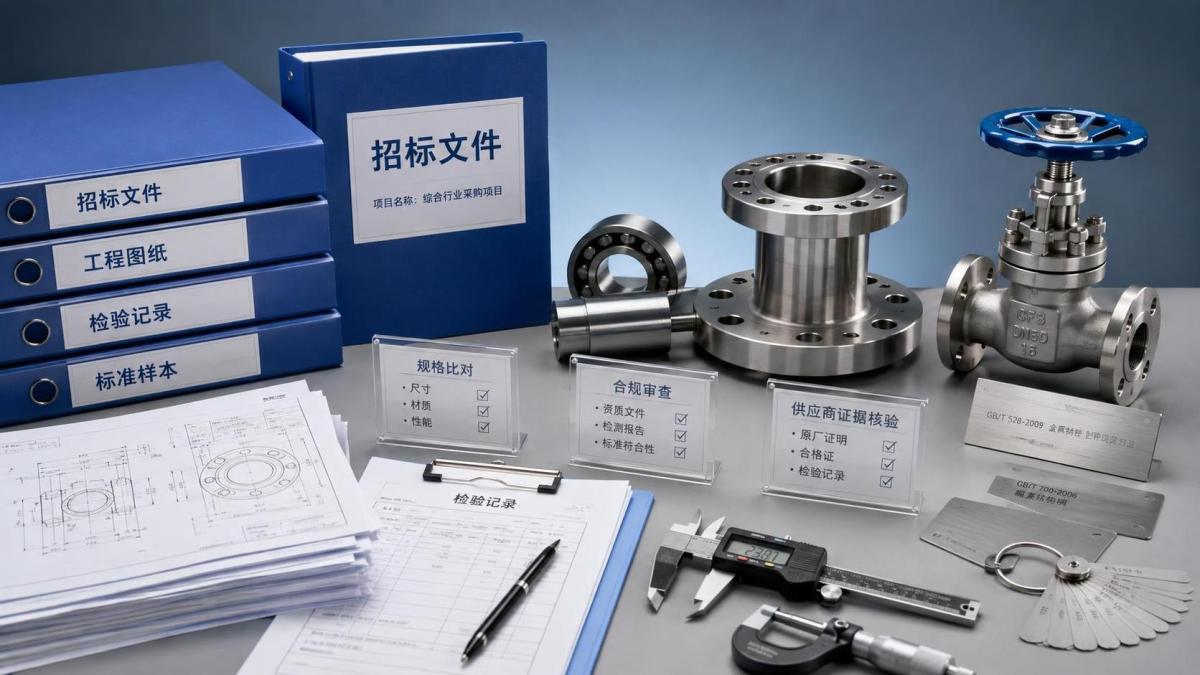
A reference to a standard is meaningful only when its application is understood. Procurement teams should establish whether the tender requires a particular edition, an equivalent standard, a third-party certificate, a factory declaration, or testing under a stated method. These are materially different obligations.
A named standard can cover design, manufacture, installation, safety, testing, quality management, or product performance. It may apply to the entire product, one critical component, the production process, or the site acceptance stage. Do not assume that a supplier certificate covers every part of the requested scope. Read the certificate scope against the actual item, configuration, manufacturing location, and intended use.
Equivalency needs similar discipline. An equivalent standard may be technically suitable when it addresses the same hazards, test conditions, materials, and performance outcomes. It is not automatically acceptable because the standard has a similar title or comes from a recognized body. Where equivalency is permitted, request a clause-by-clause comparison early enough for the technical evaluator to assess it. Where the tender does not allow substitutions, an alternative should be declared as a deviation rather than presented as full compliance.
Separate product requirements from project conditions
Product data sheets often describe nominal capability. Tender specifications define capability in a real project environment. The gap between the two is where unsuitable offers are commonly created.
Check operating conditions before relying on a catalog value: ambient temperature, altitude, humidity, dust, corrosion exposure, vibration, duty cycle, water quality, loading pattern, access constraints, available utilities, electromagnetic environment, and required service life can all change selection and cost. For heavy equipment, also examine site gradients, transport limitations, lifting points, fuel or power arrangements, and maintenance access. For smart-city and building systems, data ownership, cybersecurity responsibilities, network architecture, and interoperability can be just as important as the hardware specification.
Acceptance conditions deserve the same attention. A requirement is incomplete for bidding purposes if it states what must be supplied but not how it will be accepted. Look for factory inspection, site inspection, functional testing, commissioning support, samples, hold points, witness points, documentation review, and training requirements. Each can affect lead time, specialist labor, logistics, and liability.
Identify gaps before suppliers price them differently
Ambiguity does not disappear when a bid is submitted. It usually becomes a dispute over scope, variation cost, delivery responsibility, or acceptance. The strongest pre-bid review identifies ambiguities in language that the buyer can answer.
Typical gaps include a material grade without a corrosion-protection system; a capacity requirement without duty conditions; a request for certification without identifying the certificate type; a drawing without tolerances; an installation scope without site-interface details; or a requirement for “compatible” equipment without defining the connected system.
Write clarification questions narrowly. A useful question identifies the exact document reference, describes the conflict or missing condition, and asks for a decision that can be priced. Avoid broad questions such as “Please clarify the specification.” They invite broad responses or no usable response at all.
Do not hide assumptions inside the price
If an answer is not issued before the bid deadline, record the assumption in the bid where the procurement rules allow it. State its technical and commercial effect clearly. An assumption that changes a material, test scope, delivery boundary, or performance condition should not be buried in a general qualifications page.
There is a balance to maintain. Excessive qualifications can make a bid appear non-responsive. Silence, however, can mean accepting an obligation that was never priced or technically reviewed. The appropriate response depends on the importance of the issue: minor administrative uncertainty may be managed internally, while a requirement affecting safety, system integration, mandatory conformity, or long-term performance should be escalated.
Test supplier evidence against the bid requirement
Supplier selection should not be based only on whether a quotation says “compliant.” Ask what evidence supports the statement and whether that evidence will be available at the required project stage. A supplier may be capable of meeting a requirement but unable to provide the required drawings, traceability records, inspection documents, or approved submittals within the tender schedule.
Review the proposed manufacturer and model against the compliance matrix. Check that technical literature describes the offered configuration rather than a wider product family. Confirm that accessories, controls, protective devices, spare parts, installation materials, and software licenses are included where the specification requires them. A compliant core unit with excluded essential accessories is not a complete compliant offer.
For critical items, involve engineering and quality before the commercial position is fixed. Procurement can lead the evidence trail and contractual interpretation, but it should not independently decide whether an alternative material, calculation method, control architecture, or test regime is technically equivalent.
Use a short pre-bid decision gate
Before submission, hold a focused review around the exceptions that could change award eligibility or project exposure. The meeting does not need to repeat every line in the specification; it should concentrate on unresolved, high-impact items.
- Are all tender revisions and clarifications incorporated into the pricing and compliance matrix?
- Has every mandatory standard been mapped to applicable evidence?
- Do proposed products meet the stated operating and interface conditions, not only nominal catalog values?
- Are deviations, exclusions, and alternatives identified in the required bid format?
- Have inspection, testing, documentation, delivery, installation, and commissioning obligations been included?
- Does the supplier confirmation cover the exact offered configuration and delivery schedule?
This decision gate is particularly valuable when procurement covers several disciplines. Civil works, mechanical equipment, electrical systems, controls, and digital platforms often use different terminology and evidence types. A single procurement standard may also interact with site safety, environmental, asset-management, or public-sector requirements. The bid should show a coherent response across those boundaries rather than separate compliant-looking fragments.
Common verification mistakes
Using a previous project specification as proof of compliance. Previous requirements can be a helpful starting point, but they do not override the current project’s edition, scope, environmental conditions, or acceptance procedure.
Confusing a quality system certificate with product conformity. A manufacturer’s management-system certification may indicate a controlled process, but it does not by itself prove that a specific product meets the tendered technical requirement.
Reviewing standards after pricing is complete. By then, a different material, test, document package, or qualified manufacturing route may have changed the cost and lead time.
Accepting “equivalent” without defining the comparison basis. Equivalent performance, equivalent safety, and equivalent documentation are not always the same thing. The tender’s acceptance route determines whether an alternative is viable.
Leaving ownership of interfaces undefined. This is common in integrated infrastructure projects. If no party owns the connection, protocol, mounting, civil opening, cabling, or commissioning boundary, it can become an unpriced obligation.
Make verification a controlled procurement activity
The best result is not a longer specification review. It is a bid in which every material requirement has an owner, a source document, a compliance status, and a defined evidence path. That structure improves pricing discipline, gives engineering a manageable set of decisions, and helps suppliers respond to the same scope.
GIUT’s coverage of construction systems, urban technology, resource operations, railways, and special-purpose equipment reflects a recurring procurement reality: standards cannot be read in isolation from operating conditions and system interfaces. For complex physical assets, the bid team should begin with the governing documents, resolve conflicts before quotation, and carry confirmed requirements through supplier selection, inspection planning, and final acceptance.
Get weekly intelligence in your inbox.
No noise. No sponsored content. Pure intelligence.
News Recommendations
 Sep 19, 2026How an electronics application guide helps prevent component mismatchHow an electronics application guide helps prevent component mismatch
 Sep 18, 2026When a resource allocation platform improves project deliveryWhen a resource allocation platform improves project delivery
 Sep 17, 2026What to compare when evaluating mineral processing equipment manufacturersWhat to compare when evaluating mineral processing equipment manufacturers
 Sep 16, 2026How mineral separation optimization can reduce concentrate lossesHow mineral separation optimization can reduce concentrate losses
 Sep 15, 2026How to assess lifecycle costs in urban tech procurementHow to assess lifecycle costs in urban tech procurement
 Sep 14, 2026Heavy industry technology trends reshaping capital investment prioritiesHeavy industry technology trends reshaping capital investment priorities
 Sep 14, 2026Why Infrastructure Equipment Buyers Are Shifting from Catalog-Based to Capability-Based Supplier SelectionWhy Infrastructure Equipment Buyers Are Shifting from Catalog-Based to Capability-Based Supplier Selection
 Sep 14, 2026Process Automation Project Execution: How to Align Supplier Capabilities with PLC Integration, Cybersecurity & Commissioning MilestonesProcess Automation Project Execution: How to Align Supplier Capabilities with PLC Integration, Cybersecurity & Commissioning Milestones
 Sep 14, 2026Are intelligent traffic systems worth the investment for small cities?Are intelligent traffic systems worth the investment for small cities?
 Sep 14, 2026How do intelligent traffic systems handle sensor failures?How do intelligent traffic systems handle sensor failures?
 Sep 14, 2026What should I check before accepting a smart building system?What should I check before accepting a smart building system?
 Sep 14, 2026Is a smart building system worth the maintenance cost?Is a smart building system worth the maintenance cost?
 Sep 14, 2026What data is needed for reliable resource allocation planning?What data is needed for reliable resource allocation planning?
 Sep 14, 2026How can resource allocation software reduce equipment idle time?How can resource allocation software reduce equipment idle time?
 Sep 14, 2026How should smart devices be maintained in harsh outdoor conditions?How should smart devices be maintained in harsh outdoor conditions?
 Sep 14, 2026Do smart devices improve worker safety on construction sites?Do smart devices improve worker safety on construction sites?
 Sep 14, 2026What environmental risks must be assessed before deep-sea mining?What environmental risks must be assessed before deep-sea mining?
 Sep 14, 2026Is deep-sea mining equipment commercially viable in 2026?Is deep-sea mining equipment commercially viable in 2026?
 Sep 14, 2026What Inspection Checks Should Procurement Teams Perform Before Ordering Dredging Equipment in 2026?What Inspection Checks Should Procurement Teams Perform Before Ordering Dredging Equipment in 2026?
 Sep 13, 2026How to verify an industrial product information source before specifying equipmentHow to verify an industrial product information source before specifying equipment
 Sep 12, 2026Which intelligent traffic systems hardware fits an urban intersection?Which intelligent traffic systems hardware fits an urban intersection?
 Sep 11, 2026How pump capacity affects response coverage for municipal fire fighting vehiclesHow pump capacity affects response coverage for municipal fire fighting vehicles
 Sep 10, 2026What to verify before choosing a heavy industry equipment supplierWhat to verify before choosing a heavy industry equipment supplier
 Sep 09, 2026When do adaptive urban traffic control systems reduce corridor delays?When do adaptive urban traffic control systems reduce corridor delays?
 Sep 08, 2026When logistics technology solutions in North America reduce delivery delaysWhen logistics technology solutions in North America reduce delivery delays
 Sep 07, 2026How reliable are wireless mining safety systems in underground mines?How reliable are wireless mining safety systems in underground mines?
 Sep 07, 2026How to assess a smart lighting technology platform for interoperabilityHow to assess a smart lighting technology platform for interoperability